• Mozart Haus

    While visiting my girlfriend in Budapest, we took a side trip to Salzburg, Austria, the birthplace of Wolfgang Amadeus Mozart. Those who are familiar with my blog must know that I’m a diehard Mozart fanatic. Have you ever cooked a Sunday pasta dinner while listening to Don Giovanni? You must try it, I say! Must!

    In any event, I was struck by the breathtaking natural beauty of this small city on the Eastern edge of the Alps. In all my days of reading about, hearing about and listening to Mozart, I seemed to have missed this fact. Gorgeous snow-capped peaks loom in the distance, and Salzburg is surrounded by rocky hills, small and large. There is also a very large fortress on one of these hills overlooking the old town.

    Alps1

    A view from the tower of the fortress

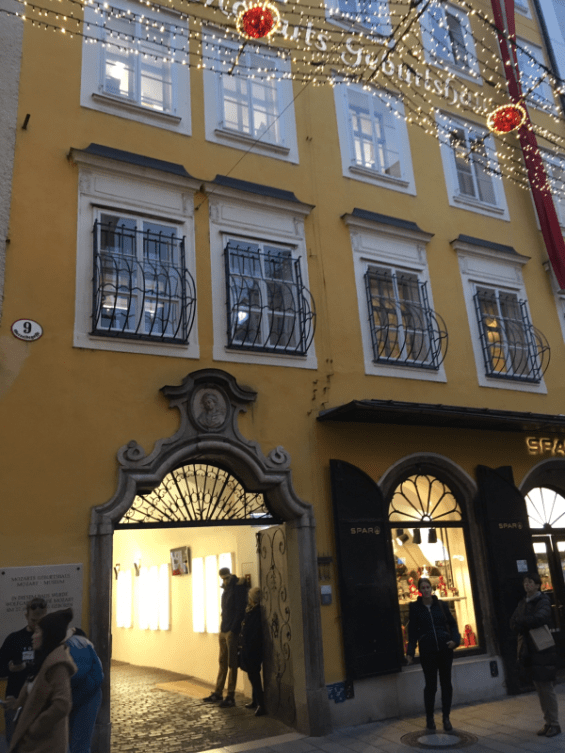
    We visited the house where Mozart was born (main pic, above), which is a very good museum on his early life and beyond. Included in the displays were a lock of Mozart’s hair and the violin he played as a child. The literature was very interesting, stressing that Mozart was never poor and in fact did quite well for himself. He just liked to spend money, you see. The house is situated right on one of the main streets of the old town, which is immaculately kept up. You would never know the buildings are all centuries old.

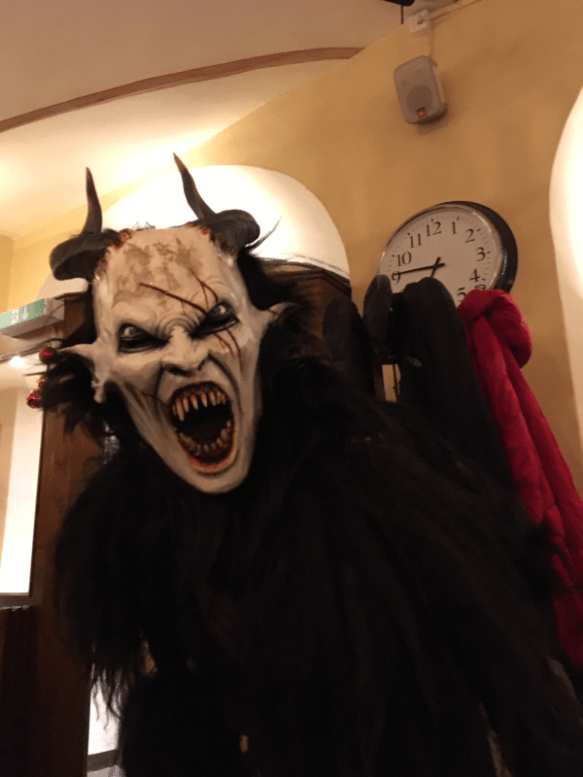
    The Mozart family eventually moved to lodgings on the other side of the river. Unfortunately, we didn’t have time to visit, but I hope to go back. You could easily spend a week in Salzburg, as long as you have an interest in going outdoors and getting some exercise. The hiking would appear to be first rate. The restaurants are also excellent, and we were lucky enough to encounter a Krumpus at one of the them.

    Krumpus

    One interesting thing about Salzburg and Vienna is that the population there certainly seems to have money, and everything runs like clockwork. But visiting is not expensive up to the eyeballs as it is in cities like New York, London and Copenhagen. Makes you kinda wonder…

    But back to Mozart. Well, anyway, in a last note, I must say that it’s not all that surprising that Mozart grew up in a place of such awesome natural beauty. It’s reflected in his music, naturally. Oh yes, one other thing – there is an incredible cathedral – The Salzburg Cathedral, where Mozart was baptized. There has been a church on the site since 774 AD and the present building dates from 1628. There are excavated portions of the earlier buildings in a lower area that you can visit. It’s a magnificent church. Unfortunately, we didn't have time to hear any music. We are sure to return one day. -Christian Botta

  • Maxim Vengerov today

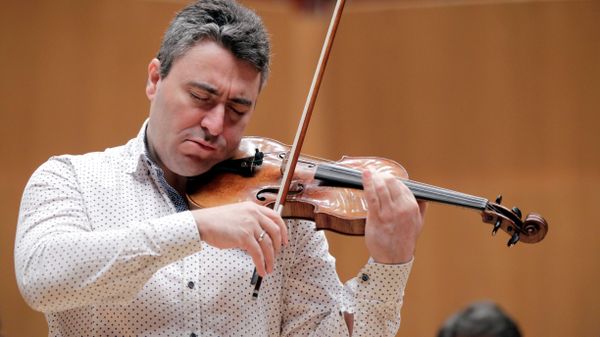
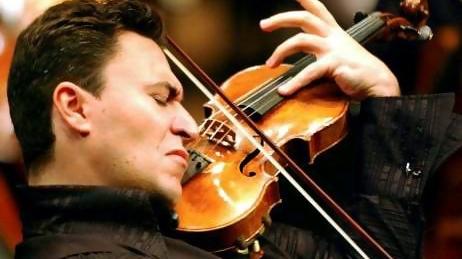
    The first time the violinist Maxim Vengerov came to my attention, he was pictured in the print version of the New York Times. Eyes closed and leaning back with his violin like Jimmy Page, he had a soulful, intense look on his face and was clearly caught up in a rapturous moment. This of course was a full-on orchestral concert and he was surrounded by other musicians. The conductor’s scowl clearly expressed his disdain for the emotional histrionics on display. I was an instant fan and I had that photo on my refrigerator for a good while.

    It took me years to finally catch Vengerov in concert. This is because I’m somewhat inept at following the musicians that I enjoy – it seems that I’m always reading about a concert the day after it happens. Also, Vengerov took a hiatus from playing in public due to an injury, and he made a new career out of conducting and giving master classes. His recent history is a little complicated. When I read about it now, it seems like there may have been two hiatuses.

    Maxim Vengerov rockin'

    Vengerov, presumably in his swashbuckling, romantic heyday.

    But several months ago, I hit the jackpot when I saw he would be playing at Carnegie Hall in a featured concert, just him and his piano accompanist, Roustem Saitkoulov. He also played a few selections by himself. Solo violin concerts are a bit of a different animal from a typical orchestral concert. There are more idiosyncratic works – pieces that are mainly known to fiddlers and their audience. Then of course there are the pyrotechnics and the encores – that's the super awesome part.

    The concert began with a stately Violin Sonata No. 3 in D minor, Opus 108 by Johannes Brahms (1888). As a rock and blues musician, it’s a little confusing for me to hear such a serene mood sustained in the opening number of a concert, but this piece worked well in the overall arc of the performance. I was completely unfamiliar with it but I will revisit it. George Enescu’s Violin Sonata No. 2 in F Minor, Opus 6 (1889) was up next, and this work took the night’s music to another level. Again, an unfamiliar work but seemingly more strident and well suited to a very large hall. The work is a violin staple.

    After the intermission, Maurice Ravel’s, Violin Sonata (1927) brought the evening a little further into the recent past or at least the past of only a century ago. The unusual textures and harmonies were evident and it was clear that this was a modern work although keyed in a melodic, resonant tonal space. Heinrich Ernst’s (1814-1865) “The Last Rose of Summer” was next and by this time the atmosphere was more relaxed and intimate. Composed in the last year of his life, the title would appear to be apt.

    Nicolo Paganini’s (1782-1840) “I Palpiti,” composed in 1819, was another violin specialty that Vengerov gave his impassioned treatment to. There were several encores, including one of Brahms’ Hungarian Dances, which was a treat. By this time, Vengerov would announce the names of the pieces in his soft, heavily accented voice. There seemed to be a hint of descreet amplification at work. Otherwise, it’s doubtful that Maxim would have been heard when he made his announcements.

    It was at this time that amazing virtuosic playing became the order of the day, and Vengerov did several tricks that seemed humanly impossible. One included what appeared to be the plucking of a second pizzicato melody while engaged in playing fast, difficult long runs up and down the violin’s fingerboard. A sustained, ethereal sound appeared at times, very high and pure. Maxim Vengerov’s violin, the ex-Kreutzer Stradivarius built in 1727, was in its element, in the hands of its rightful owner, in the right hall, and with the right audience, which would be to say, people who had come out to see some superstar quality fiddling. The arc of the evening was complete. -Christian Botta

  • Landreth1

    I was lucky to have the opportunity to catch a few concerts these past few months in NYC and beyond. I’m very picky, it’s true and the venue means a lot to me. Also, I don’t have a ton of dough and I’ve seen a shitload of really outstanding concerts (Frank Zappa, Led Zeppelin, and on and on…) in my time so I’m a tough sell. I managed to see some really top flight musicians in two out of the three shows, though, I’m happy to say.

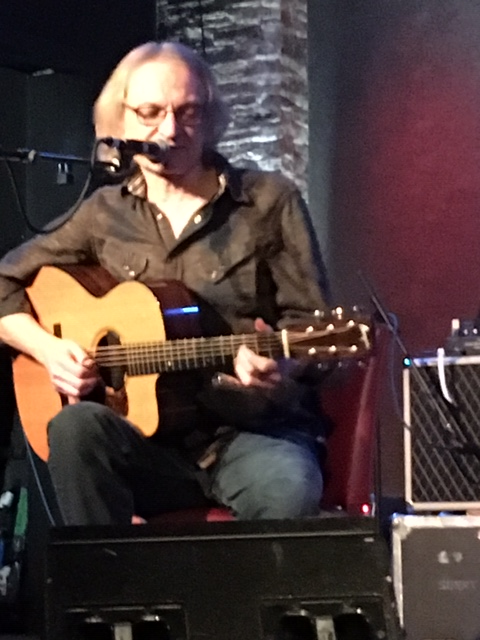
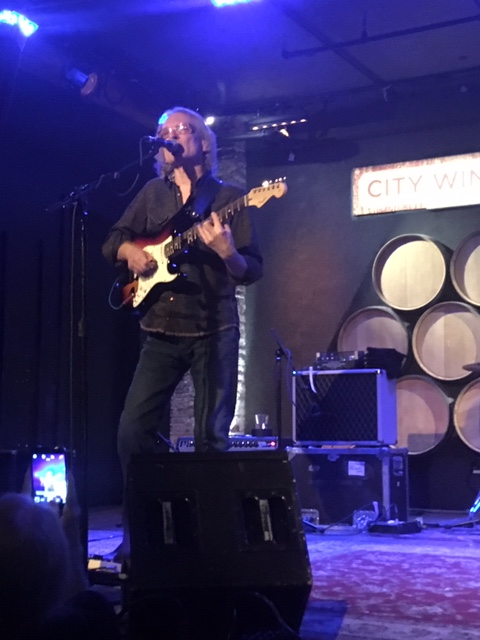
    The middle show in the lineup was Sonny Landreth at the City Winery. My friend who goes to tons of concerts, sports events and the like bought the tickets or I wouldn’t have even known that Sonny was playing and basically right in my own backyard. Just shows how you can be a knucklehead at times, despite the best intentions. I play a lot of slide guitar as anyone who reads my blog must know. So it was a no-brainer.

    Mr. Landreth as the NY Times might call him, was well on form. Definitely a super technical guitar player but with a lot of soul. He was playing a lot of numbers from his Bound By The Blues album, which was released in 2015. These included an excellent version of “Firebird Blues,” a Johnny Winter tribute that captured Johnny’s slinky, swaggering sexiness in the feel of the song in a very intrinsic, elemental way. It was way cool. All in the groove, perhaps. Killing.

    Landreth2

    Plenty of classic blues numbers including Robert Johnson’s “Walking Blues,” Elmore James’ “It Hurts Me Too,” and Big Bill Broonzy’s “Key To The Highway” were also on offer and delivered with inventiveness, passion and style. We were right up close and I got to see Sonny working his magic in detail, not that you can easily put together what he’s doing. What tuning is he in? It’s not that obvious but you can get an idea. He’s that good. His use of effects is also stunning yet tasteful and his legendary sound surprised me by its muscle. Most of the clips that I’ve seen online (posted by fans) emphasize his lyrical gifts, but in this here concert he was in more of an ass-kicking mood.

    The show was opened by… Sonny and his band in acoustic form. They played a relatively short set with drummer Brian Brignac on one of those zany box thingies and the bassist David Ranson playing an absurdly small ukulele bass. It sounded wonderful and complete, with a clear, full sound in which you could hear everything you wanted in an excellent, balanced mix. Unfortunately, the sound during the electric set was a little bit heavy on the guitar to the point where the vocals were somewhat lost. Also, it was rather short.

    I managed to steal a lick from Sonny, probably the simplest one that he played all night. It clicked for me because I’ve heard Lowell George play it as well. I used it last night in my gig so I figure, yes – he was playing in Open A or Open G at some point. Thanks Sonny! Another thing I noticed was Sonny’s supernatural ability to navigate the effects, his guitar and singing all at the same time, no easy Feat. There was one lightning fast move in particular that I can still see in my mind, a quick hit on the pedal board and an adjustment to the guitar volume or tone (one of his guitars was a custom Strat with four knobs, no less!) all in the blink of an eye as a solo gave way to a vocal. All slide guitar players who sing will appreciate that, I’m sure. -Christian Botta

  • Album Cover_resize

    It’s a crazy world. And Saints and Sinners are here to add some reality and emotion along with a good time to the situation. With their debut album, Saints and Sinners, the blues rock band from NYC brings you five originals, a few reworked classics and more choice covers from their live set, adding warmth, and an edge back into the system. Bucking the system – that’s what it’s all about, right?

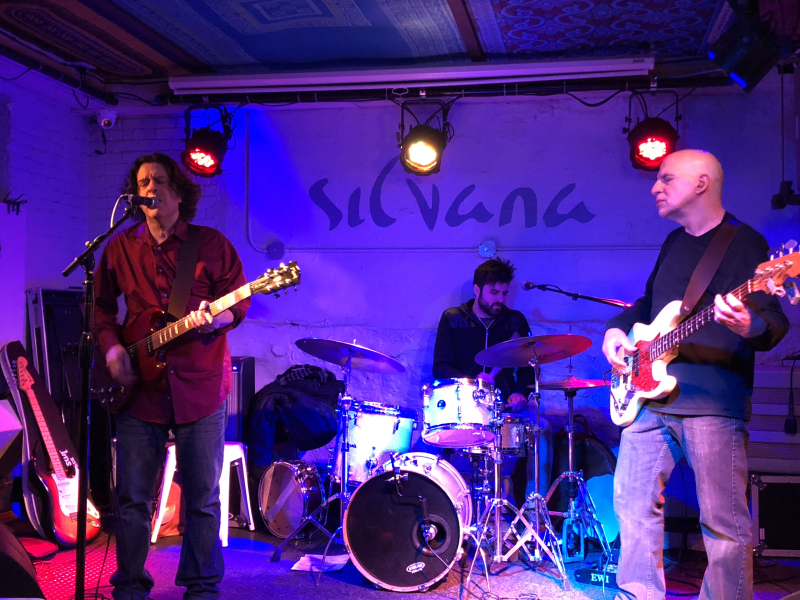
    Saints and Sinners at Silvana

    Recorded in Brooklyn at Virtue and Vice and Linden Underground, the basic tracks were cut live in the studio all in one day. It’s true, there were a couple of overdubs, maybe a few. But all the solos were full takes and there is minimal digital wizardry. Maybe a little. But the band – Christian Botta on guitar and vocals, Dave Gerstein on bass and Daryl Cozzi on drums can definitely bring it live. (Cozzi left after the album was completed and has been replaced by Chicago native Mike Rodbard)

    The set kicks off with a fast boogie, “Good Time Girl.” You must listen all the way through to fully understand the lyrics. Remember those? It could be a story of a hot girl or a hot boy you once knew – girls are doing it too these days. But check it out – have you ever been used? And didn’t you secretly love it? OK. I think I see a few hands… (click the title/link below to hear the tune)

    Good Time Girl

    “World Gone Mad” downshifts the tempo a little. You know what this one’s about. Penned in the waning months of the shocking year of 2016, the situation is still relevant. How many ways can you slice and dice a twelve-bar form? This is one of them. No shit! Some nice drum work by Cozzi and a funky bass from Gerstein. And some stolen agenda from Curtis Mayfield.

    World Gone Mad

    The next song, “Easy Rider Blues” is a transformation of Ma Rainey, as the musicologists would say. Remember her? No reason why you should unless you’re a hundred years old. A little Exile On Mainstreet vibe. A nice groove. More slide guitar. This was the second to last song cut in the session at Virtue and Vice Studios. Maybe a shot of whisky on hand. What was it that Keith Richards said about the acoustic guitar?

    Easy Rider Blues

    The last tune cut was the uptempo stomper, “She Gets Me.” Modern morals, they say, will be the uplifting of society. Yes indeed! But it swings. Cut with minimal supervision, planning, polish or contrivance. And a brand new amp, a sweetie. An impulse buy. I guess that would make it of its time. It’s a consumer society – always. The record company wants this as the single.

    She Gets Me

    The next tune is where the heavy blues starts. “Door to Door Blues” is a tune that Chris has been playing for a while. The arrangement owes a bit to the classic singles of BB King, circa the late ‘50s. And the guitar owes a bit to… Peter Green, someone said. Ha! We’ll take it. Ever go door to door? It’s not as bad as it sounds. You’ve got to listen all the way to 2:37. Chris wrote “Door to Door Blues” when he was selling wine on “The Street,” as it’s known in the trade. A notoriously difficult business, there are some perks however. And dig that beautiful walking bass from Dave!

    Door To Door Blues

    The pumping “Malted Milk” follows, a cover of the Robert Johnson classic. Totally re-imagined, whereby we go back in time to the night of the party. Yes, that’s right – if Johnson’s original describes the aftermath of the party, this is the night before. The party proper. The transformation, in reverse. Parties are meant to be loud. The tune is loud. With a six-four measure neatly stitched into the fabric. Parties sometimes yield complex situations. A slide guitar rave-up, you never knew Johnson’s rumination had such a pretty tune. Coruscating guitar – heh heh… Had to use one of those muso words…

    Malted Milk

    But every party has its aftermath, the next tune provides it. At the best party, you meet someone new right? Ever hear about the devil you know? Well they were right, but who makes smart decisions when it comes to love? “These Four Walls” is a love hangover, a minor blues – what else could it be? Let me tell you – it was worth it.

    These Four Walls

    “Going to Main Street” is a staple of the band’s live set. A Muddy Waters tune, the song inspired Chris to form the band when he heard Levon Helm kill it at a Hubert Sumlin birthday bash. Saints and Sinners take the song a little into the rockabilly zone, with a raw twang and swinging beat provided by Cozzi, also a Levon devotee.

    Going To Main Street

    Sonny Boy Williamson’s “Sad To Be Lonely” is the penultimate track. The rhythm guys dig the groove on this one and we hope you do, too. Sonny Boy II often laces his truest blues with humor, which is something the ‘Sinners try to do, too. Ooops, we meant Saints and Sinners. We almost named it the Solid Sinners in honor of Sonny Boy, but hey – that would have been presumptuous.

    Sad To Be Alone

    Finally there is “San Ho-Zay,” a Freddie King instrumental that the boys give a tough spin and a modern sound. The synergy of the rhythm section is on display as Chris plays a couple of Freddie’s choruses and then a couple of his own. Kudos to Jeff Cook at Linden Underground Studios for bringing the tight, minimalist sound into a crunchy and edgy update on the original.

    San-Ho-Zay

    With the release of the album, the band is hitting the road with the first stop at The Shrine in Harlem on November 2nd. Saints and Sinners will be bringing their modern and eclectic take on the blues to fans in the Tri-State area and hopefully beyond in the indeterminate future. It’s a world gone mad, but they’re aiming to bring a little sanity. Just a little bit.

    All songs composed by Christian Botta except as indicated.

  • Fender Strat
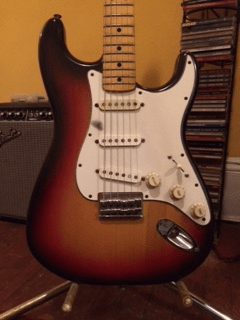
    Have you ever tried to pursue the mythical, deified “perfect Strat”? My first real guitar was a 1975 Fender Strat with a maple fingerboard, and it cost $220, made in America, no tremolo bar aka a “Hardtail.” I thought I knew something about Strats. How much can you know? Turns out I’m still learning. With Fender’s ever-diversifying catalogue, we may never get the full picture, unless of course, you have the bucks to shell out for a Pre-CBS and you can say, I’ve got it all.
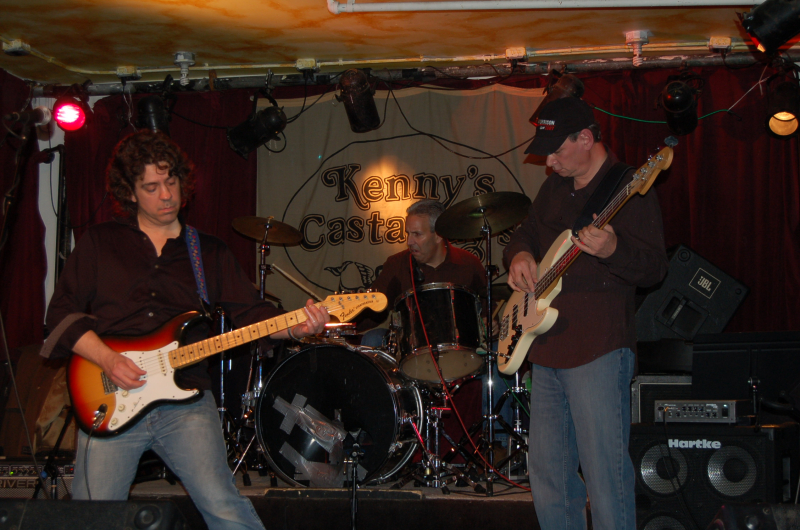
    ABB at Kenny's

    The Hardtail Strat in action at Kenny's Castaways with Chris Trotta on Drums and Aaron Chesler on bass. The slide conversion is official!

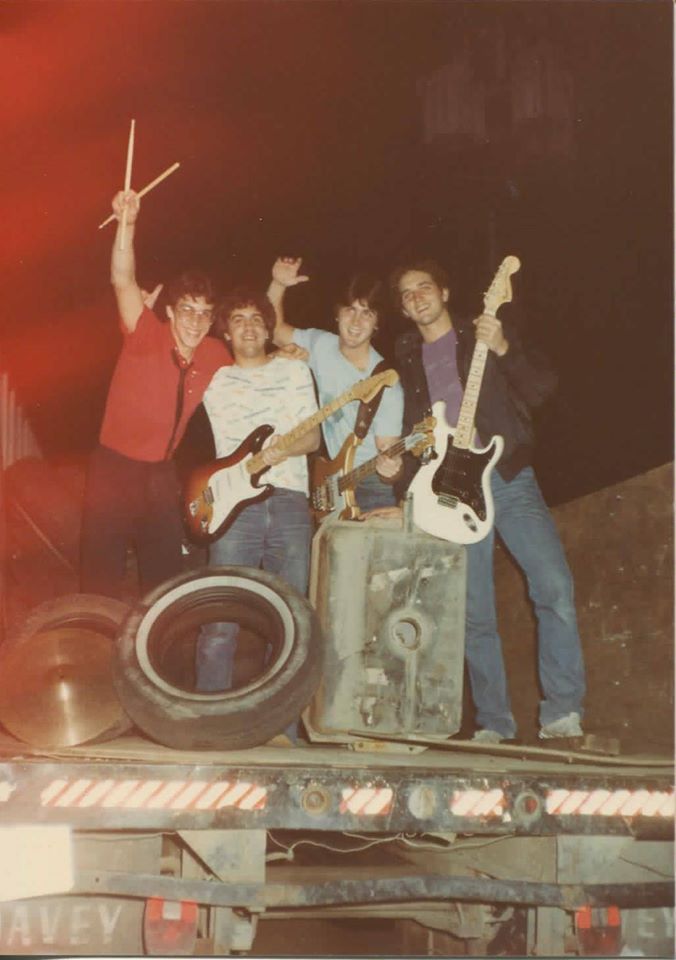
    This first hardtail Strat of mine was my main guitar growing up. I played classical guitar in college so that took me away from my Strat for four years except for a one year trip to the University of Richmond where all I tried to do was play in bars and get into trouble. While I was in Mannes College, I bought a ‘70s Les Paul Custom and that became my main guitar. I always kept the hardtail Strat though. I even played it at CBGBs once – behind my head! I had some pickups installed at one point, a crazy combination of Duncans – a quarter pounder for the neck, a vintage style in the middle, and a “hot Strat” in the bridge. That one really barks!
    The Plague

    The Hardtail Strat goes to college!

    Eventually after I got out of school I realized I needed a Strat with a Whammy Bar. I tried a couple at Matt Umanov’s in the Village – what a shame to see that store go! Anyway, I was so naïve about the setup that I decided to take a black American Strat over a nice Black ’62 Reissue because I couldn’t understand why the top note on a bent double stop would be going out of tune. Ever hear of the blocked off vintage style trem? Duh! Both were rosewood. I had become somewhat of a rosewood person. The American Strat was a little uninspiring but I threw my crazy pickups in there and then took them out when I sold it a few years later. I wouldn’t mind having that guitar now…
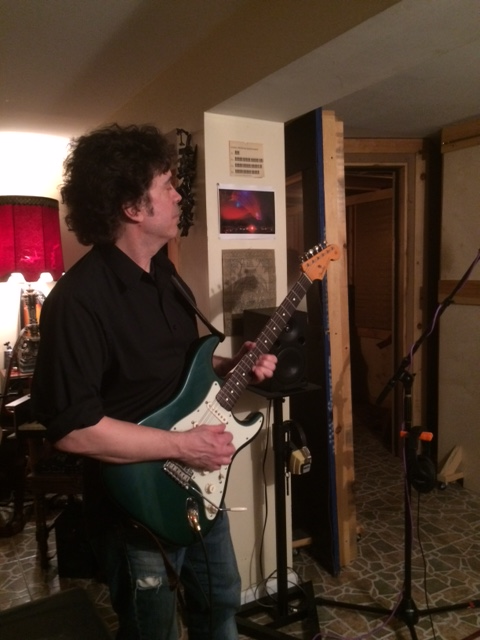
    I'll Be Your Mirror

    The Forest Green Metallic '62 Reissue in Jeff Cook's Linden Underground Studio.

    When I got some money a few years later, I started traveling, and I wanted a kind of “travel guitar.” I had a lot of students who had Mexican Strats and some of them were really nice. They cost $300 at the time. I got a beautiful Olympic White one and a set of Vintage ’69 Custom Shop pickups and threw ‘em in there. Or rather Rick Kelly put them in. It sounded great but the fretboard lacked a certain smoothness. I did play it at a club in the Netherlands, though. The pickups helped.

    Around this time, I purchased a custom made, white “Kelly Tele” with Lindy Fralin pickups (below) and that became my main guitar, replacing a Burgundy Les Paul Classic. Yes, it’s true – I’ve always loved Strats but mostly get my main sound elsewhere. But I was still hunting for that perfect Strat! I looked all over New York City – I’m not kidding! I even went out to Mandolin Brothers and checked out what they had. I must have tried fifty to a hundred guitars. I had certain colors on the brain – Olympic White, Candy Apple Red. Finally, I sort of decided on a ’62 reissue and they had about ten of them at Matt Umanov’s and I played them all over several days.
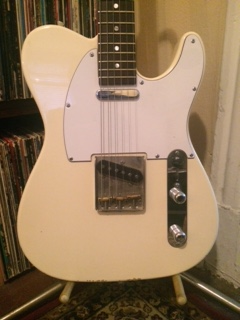
    Tele 101515

    Let’s backtrack a little. Once, around the time that I sold the Black American Standard, I worked at a guitar show where I tried a black ‘50s Strat (AMAZING! Each note like a hammer striking metal) and, a maybe metallic green slab board ‘60s model which was gorgeous. OK back to the story…

    So among the ten or so ’62 RIs at Umanov’s the best sounding one was a Forest Green Metallic. I didn’t really want a green Strat, but this one just had the most quack, the total Stratiness beyond any doubt. It was lovely. I couldn’t make up my mind. Then, I had a dream about the guitar at the guitar show, which was also a near Forest Green Metallic. When I woke up the next day I went to Matt’s and I bought it. They even took a little off the price: $1150 it came to.
    Chris Botta Jeanines Favorite

    That '62 Reissue Strat will def put a smile on your face!

    I took the Mexican Strat and the brand spanking new ’62 RI to Rick and had him swap the Vintage ‘69s into the RI and put the original Mexican pickups back in the Mexican Strat, which I sold on consignment. It went in a flash. I barely even played the original pickups even though I had loved the way the guitar sounded in the store. Crazy, right? Strats will do that to you!

    So I had this cool guitar and I played it a lot. The guys at Umanov even set it up for me for free a bunch of times, and I mean they set it up – it played and still plays beautifully. I still have it. Yes! So at this point, ha ha ha! I had two Strats! I had kept the hardtail.

    Now, I know there are people out there who have fifty Strats. We’re getting there… Not. Also around this time, I started to play blues almost exclusively. I realized it was what I did best, and there was no use fighting it. I had always played slide, but now I decided to really get down to business and started playing only in open tunings. I converted the hardtail Strat to a slide guitar, raising the action and using .011s. Oh, yes – I had a fret job done on it in the early ‘90s by Carlo Greco on 48th Street – big frets. It still didn’t sound that much like a Strat – it’s a hardtail. It’s a lightweight beast for slide.
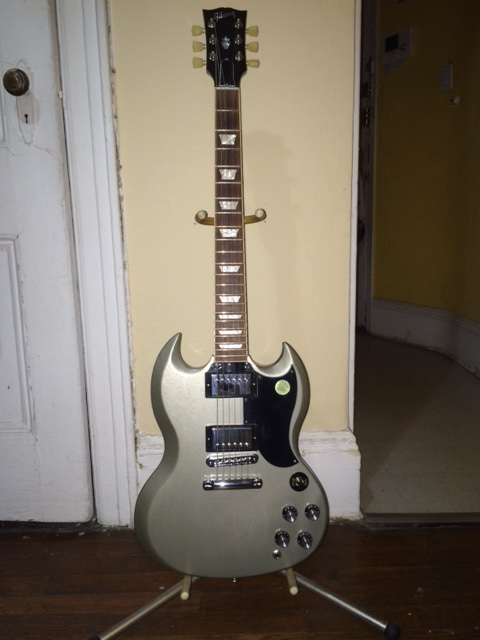
    SG I

    Fast forward to a couple years ago. I had a little extra money and most of my guitars were getting a bit fret-worn. I like big frets as you might have inferred from the previous paragraph. And yes, the frets on the ’62 Reissue where getting tinier and tinier. I bought an amazing 2013 Gibson SG ’61 Standard’ (above) in “Champagne” (a kind of silver sparkle with hints of olive or whatever – love it!) with nice fat frets on it. It’s got to be one of the most powerful guitars I’ve ever played. But it didn’t solve my Strat fixation.
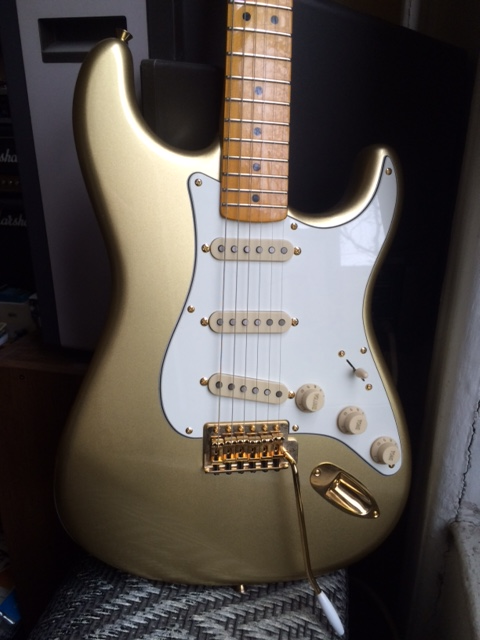
    Goldfinger

    Actually spending time in guitar stores – I’m not much of a tire-kicker and I don’t think I know one single real, “guitar store lick,” – I ran across “Goldfinger.” She was the most beautiful gold sparkle Classic Vibe Stratocaster, on sale used at Sam Ash for $250!!! I was like, “who in the hell would sell this beautiful guitar back to them?” I couldn’t believe how great she sounded, but I came back a third time before I bought Goldfinger. The maple fretboard has the vintage lacquer on it and it is just the most amazing ‘cheap’ guitar I’ve ever owned. OK, so now I have three Strats.

    In the interim, I developed an obsession with P90 pickups and after looking for nearly two years, I bought a cherry Gibson ‘50s Tribute SG on the spot at Guitar Center for $500. It kills. But it didn’t quell my desire for the perfect Strat.
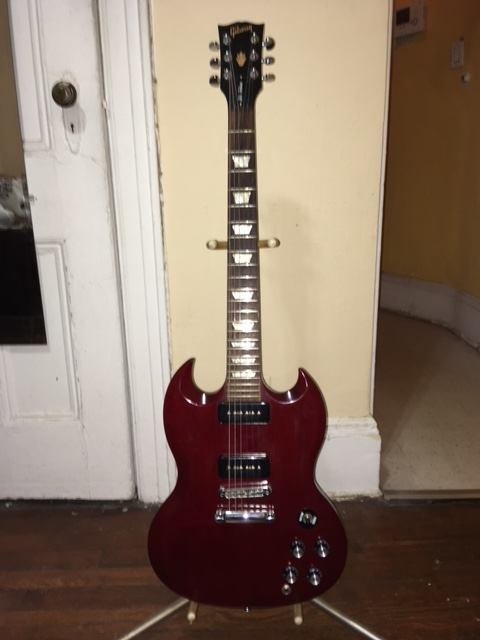
    IMG_2796

    Around this time, I had been looking on craigslist for various guitars, including Strats. I recently tried a couple of Mexican Strats at Sam Ash for one of my students. Not for me, although one was nice, a white one. A little rough around the edges for me. Also around this time, the American Professional model came out and the prices went through the roof. Matt Umanov closed as I said, and it started to get a little difficult around these parts to even shop for a guitar, let alone pay for it.

    I passed on a white American Standard with Fat ‘50s pickups – it was two hours away and I was getting over surgery – no thanks. I also had decided that I wanted Texas Specials. I wanted a Strat that was easier to play – bigger frets, more output to the pickups, and a flatter radius neck. The Green Strat as I call her, has the most phenomenal tone, but you have to work for it! It’s like another type of ‘woman tone,’ if you know what I mean.
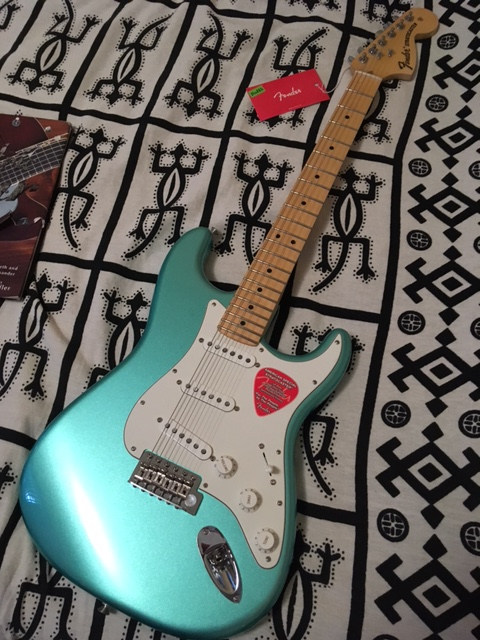
    New Strat with Neck

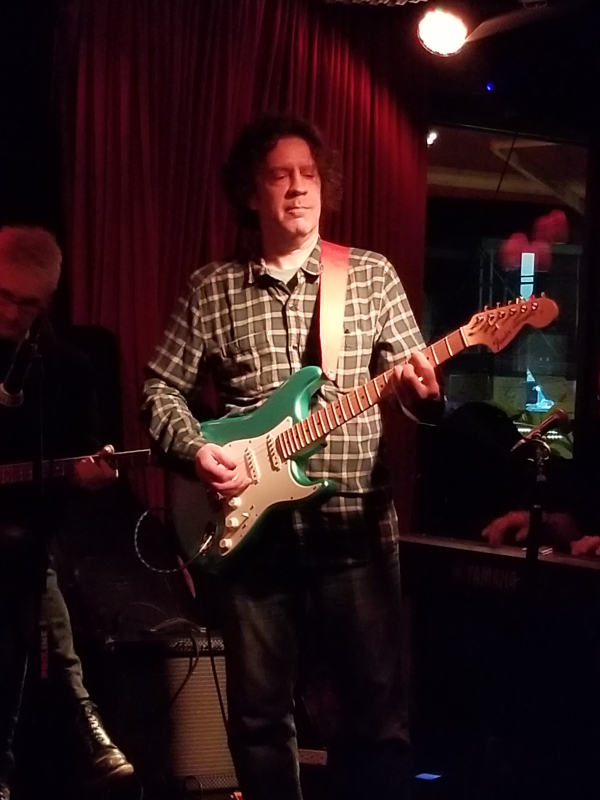
    Well, I saw a guitar on CL – an American Special Stratocaster. I am usually a person who has to hear the guitar through a dry tube amp, yes! No reverb for the tryout!! But in this case, I had to try it out in Starbucks. It had the most beautiful finish, but did I really want another sparkle guitar? It was super playable, with jumbo frets. It was impossible to really tell what it sounded like so I passed. Later, I was kicking myself. I called up the seller and told him I would buy it. I did! And the next day, I tried it out at the Red Lion jam session in Greenwich Village. It sounded great! I now have four Fender Stratocasters and I love them all!
    CBRL2

    The latest Strat in action at the Red Lion.

    The American Standard Stratocaster is a sophisticated and somewhat unique guitar. It has a distinctly modern feel and sound. Big frets, relatively flat fretboard, Texas Specials adding a little midrange bump, a vintage tremolo, and the “Grease Bucket” tone circuit, which is more radical than what they tell you. First of all, with these electronics, it’s the middle pickup that is bypassed by the tone controls, not the bridge. It has reverse polarity winding for hum cancelling, which is really nice (not so on the ’62 RI). It has a narrower tonal palate, and it’s a lot less quacky than say, the ’62 RI or any number of configurations. But it sounds wonderful with overdrive, has a ton of sustain, and is a little more smooth and compressed. Not for everyone, but a damned nice guitar. I am Stratisfied. For the moment… -Christian Botta

  • Scrapper Blackwell

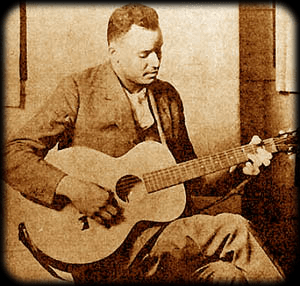
    Scrapper Blackwell is one of the most stylish blues guitar players to come out of the classic period of the late 1920s and early ‘30s. Yet, few modern fans even know his name, despite its romantic swagger. He was a true lead guitarist and played on over a hundred sides with Leroy Carr, one of the most influential blues artists. Carr sang, played piano and wrote songs, and Blackwell provided stinging single-note licks and chordal textures. They held a rapt audience, most notably on their biggest hit, “How Long Blues.”

    There are many surprising facts in the Carr-Blackwell story, including that they met in Indianapolis, Indiana instead of Mississippi or Chicago. And although they may have cut their teeth in the wild scene that gave their music its bawdy house aura, they played formal concerts and cut many of their sides in studios in New York City.

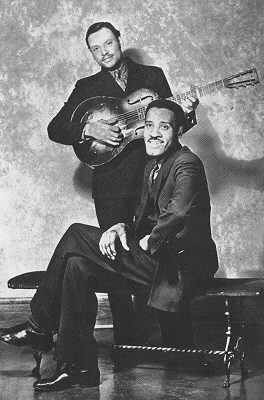
    Leroy Carr and Scrapper Blackwell Promo Pic

    A rumor persists that Scrapper Blackwell and Leroy Carr met in the bootlegging business (they both worked as bootleggers!) but it’s also possible that they were introduced by their record company, Vocalion. Little is known about the duo with much of the detail we have coming from an interview of Scrapper Blackwell by Theodore F. Watts that was published in Jazz Monthly in 1960. Leroy Carr died of complications of alcoholism in 1935 and one can almost hear the glasses clinking as they play, even if the tune is not “Straight Alky Parts I and II.” Legend has it that Carr spent his last advance on a party the night he died, and Scrapper recalls rolling around drunk on the train tracks in the aftermath of Carr’s departure from this mortal coil. Scrapper survived Carr’s death and continued to record. He died tragically in a mugging in 1959, right before a last hurrah was well due in the sixties blues boom. The interview, given right before his death, is essential reading for any fan.

    The relative obscurity of Leroy Carr and Scrapper Blackwell makes the study of their style, tunes and licks difficult but in ways, even more rewarding. The sound quality of their sides is relatively good, compared to say, Charlie Patton. I’ve transcribed a number of Scrapper’s licks for this article and made a video, below. The biggest challenge was deciding which licks to focus on. There are so many good ones!


    The first thing the intrepid lick thief will notice is that the duo does not play in typical guitar keys. Although an occasional sharp key will surface, the majority of the keys benefit Carr’s seductive blues croon and are therefore on the flat side: Eb, Bb, Ab, Db and C.

    Scrapper uses a capo a lot of the time and you can see him with one on the fourth fret in the picture above with Carr. I found that many of the licks can be played well with the capo on the first fret, allowing Eb, Bb and Ab to ring nicely. Scrapper uses the whole guitar but single notes on the low E string are few and far between, escaping obliteration by Carr’s heavy left hand.

    Scrapper uses the major pentatonic as well as the minor, and mixes them up liberally. His sense of rhythm and form is inspiring and all the licks swing. He seems to favor A form patterns for many scenarios. Let’s examine the licks themselves for more information about the style and content of this ingenious and prolific guitar picker, Scrapper Blackwell.

    The Licks

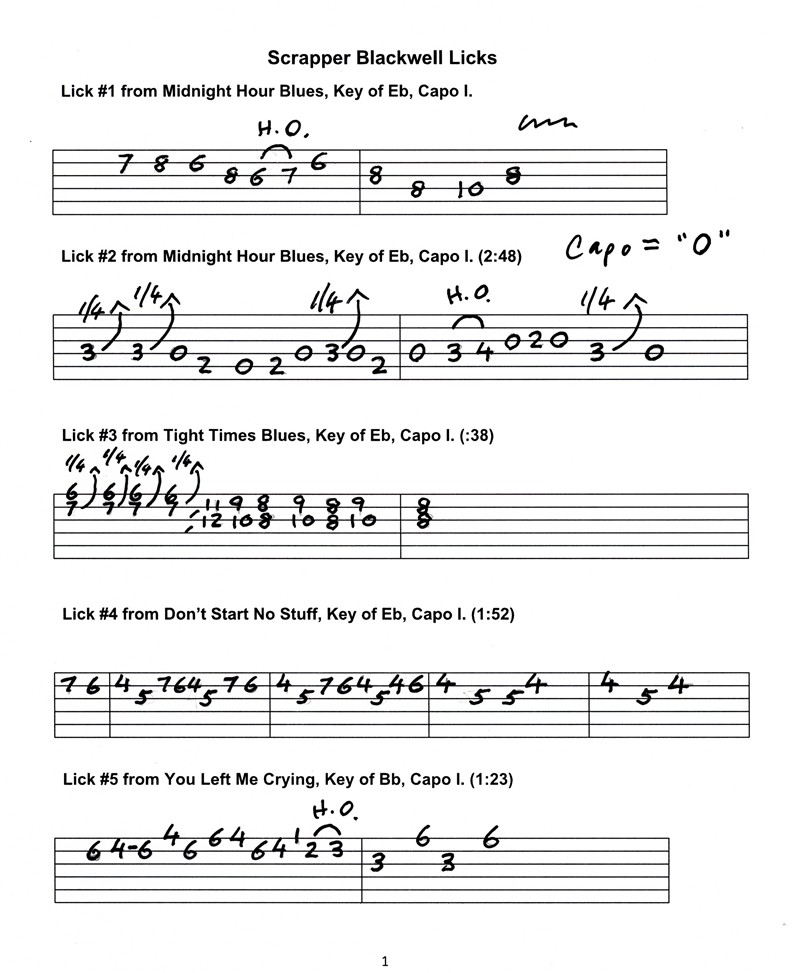
    Scrapper Licks Page 1_resized

    The first lick, from “Midnight Hour Blues,” is chromatic and occupies an unusual space with three notes on each of two strings at the same frets. If you were going to identify this lick with a blues scale pattern, it would be Form IV but that still leaves a couple of notes that come from the V chord, Bb7, and sharp three of the I chord.

    The next lick is from the same tune. Scrapper does many variations on this one. I call them the “Rod Stewart” licks because one appears to great effect in “All In The Name Of Rock And Roll” from Rod's Atlantic Crossing album. Says it all, right? It’s tricky to memorize several of these runs because they’re subtly different. The key is in the rhythm – where they fit in the shuffle pattern in terms of the long and short triplet notes and especially the bent notes.

    The third lick is from “Tight Time Blues,” and he uses it multiple times. I couldn’t really get this one but what I got I still like. It’s a little complicated with double stops following his trademark train whistle bends.

    The fourth lick from “Don’t Start No Stuff” is a great exercise using all four fingers. It’s important to understand that the lick starts on beat four, like many blues lines and fills. Otherwise, the repetitions can sound confusing if they appear to have started on the downbeat. Leroy Carr is singing on top of this. Pretty cool for a background line!

    Number five, “You Left Me Crying” is a nice lick that runs to the top of blues Form V and then slides back into Form IV, a Scrapper trademark. Check out how he starts with a note and then slides into the same note a split second later – it can be hard to identify as the same note when you’re listening – pretty clever right? Two notes for the price of one!

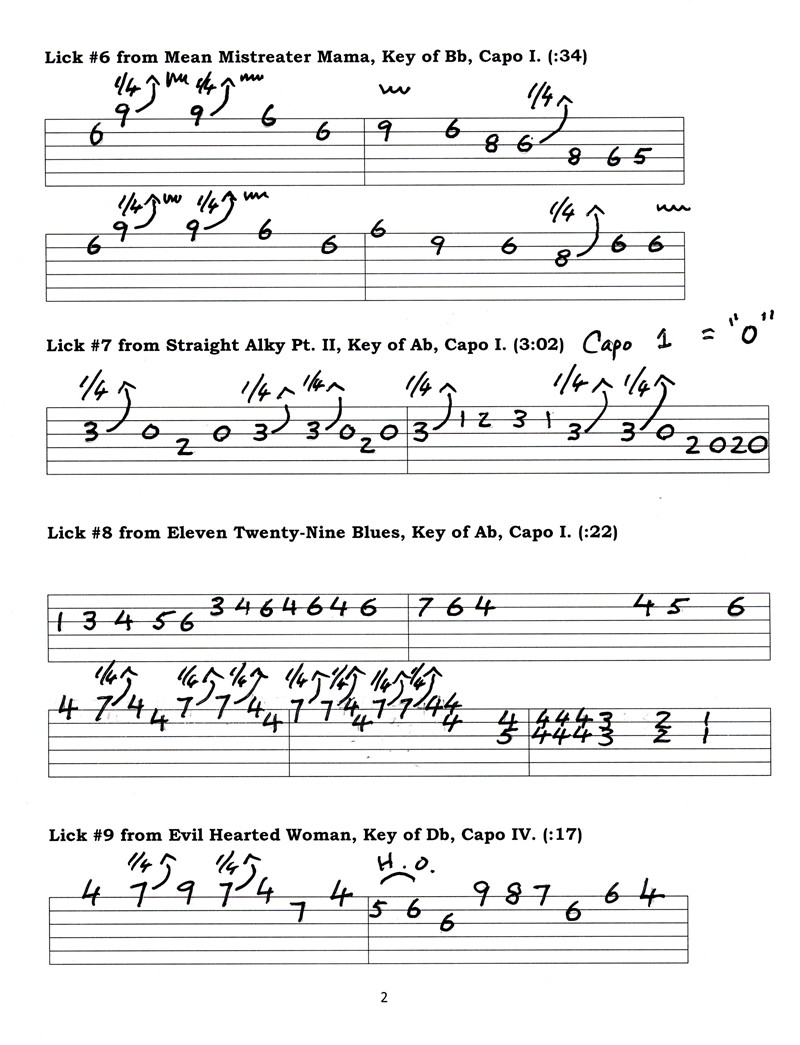
    Scrapper Licks Page 2_resize

    Lick number six from “Mean Mistreater Mama” has some straight Form I riffage. The bends with vibrato take time to master. It really swings and sounds a bit horn-like. Note how he outlines the chord progression. He does this all the time but here it’s obvious.

    Lick number seven is another Rod Steward riff, ha ha – in “Straight Alky Part II.” This time he does the run in Ab. If you can memorize this and the one from “Midnight Hour Blues” and play them at will, back to back, you’re onto something.

    In lick number eight, “Eleven-Twenty-Nine Blues” we have an extended section with three main licks. The first is a Scrapper favorite – he also does it in the classic “Hustler’s Blues,” below. Gotta use all of them fingers! The middle part went straight to Jimmy Page for a number of Zeppelin I riffs (Scrapper does this all the time), and then we have a lovely descending turnaround lick which is interesting because it resolves to an A Form chord as opposed to an E Form chord.

    Evil Hearted Woman,” lick number nine, has this cool phrase that spans the IV and V forms again. Works great with a capo or in the key of A. The really cool parts are the quarter step bends on the seventh degree, coming and going, and then the tonic that descends chromatically – I had never quite heard it that way, simple as it is. This brief but complex lick has a world of melody and harmony in it – it suggests that we are going to the second line of a twelve bar blues – the IV chord.

    Scrapper Licks Page 3_Fix_resized

    I botched lick number ten a little bit, from “Hustler’s Blues.” This song has the line “Whiskey is my habit, good women is all I crave,” that became the title of the great Columbia compilation album released in 2004 (you can see pictures of it in many of the videos). I used it for all the musical research on this article. Notice how the lick is similar to number eight in the way it starts but totally different in terms of how it ends. Listen to the song and look closely at the tab for the exact way to play it.

    In lick eleven we have a full verse from “Bobo Stomp,” one of the most rippin’ cuts from Carr and Blackwell. 172 to the quarter. Watch the picking in the arpeggios – you can accent the strong eighths using alternate picking. It was kind of Srapper to leave out an eighth at the end of each measure – makes it easier and more rhythmic. The last parts are tricky again utilizing a combination position of form IV and V.

    Finally, “Good Woman Blues” – Yikes! The train whistle lick again but way up the neck. This lick will test the strength of your left hand. Mine starts to lock up if I don’t practice it regularly. Easy on an electric guitar. Anyone for tennis elbow?

    I hope you have enjoyed this article on one of the greatest unsung guitar heroes. It was a blast for me to work on and became an obsession of sorts. I’ve already started to work on the next batch of licks. -Christian Botta

  • History of EC

    A guitar student of mine asked the question, almost to himself, “How do I know which Clapton album to buy?” The reason behind this is of course my student has a cool turntable now, but nevertheless it was music to my ears. Because I LOVE Eric Clapton. When I started listening to EC, however the question would have been more like, “Where can I find all of the amazing old Eric Clapton albums from the sixties?”

    Now that the man who treats MSG like his front room has been at it for over fifty years, the question is even more interesting. People now seem to forget those glorious first ten years or so. In the mid-seventies, when “After Midnite,” and “Cocaine” took over the airwaves, many folks still knew about Clapton's mysterious, explosive and brilliant records that were settling into the dust of what has come to be known as the “If you remember it, you weren’t there decade.”

    I was lucky. I had a more experienced friend in my neighborhood at the time who knew all about these things. She showed me the Blind Faith album and Live Cream Volume II, among other things. No, not those things, unfortunately. As soon as I heard those records I fell in love with them. It was tough for me when he went out of favor, and when I tried to forge a style of my own. Clapton's sound and style was so deeply embedded in my ears and fingers. But such is life…

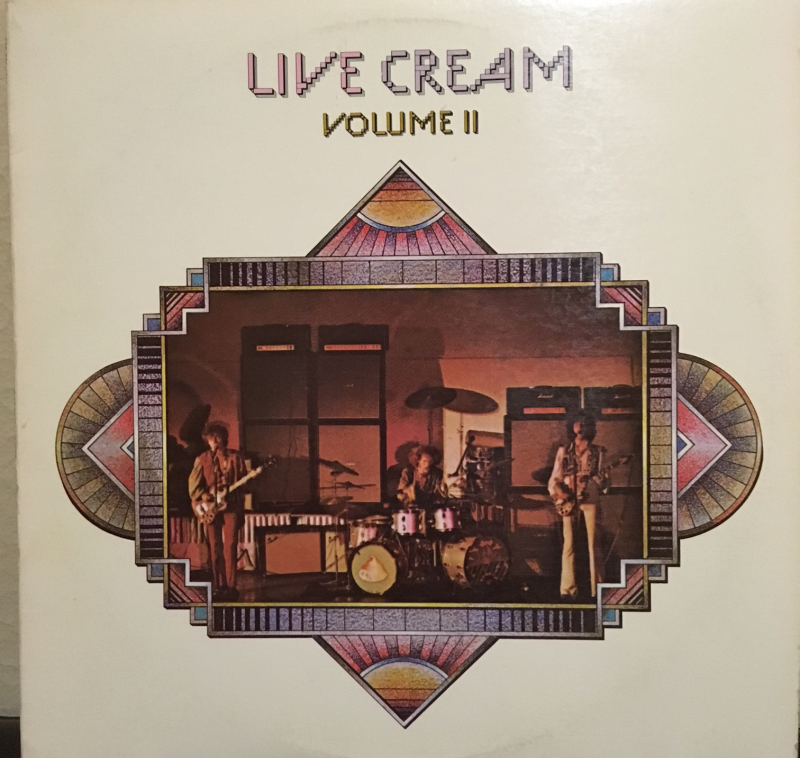
    Live Cream Vol II

    Quite recently, a musician that I respect immeasurably said, “What’s so great about Eric Clapton?!!??!!” I had been up against the Clapton Skeptics before. But I’m still always a little flustered by them. Even in my early days of listening to him, I had a friend who said, “The great thing about the solo (to “Sunshine of Your Love”) is that it sounds like shit!!!” He was ahead of his time no doubt but ah, my boy – the “Woman Tone,” sounds like shit? Must we educate these fools? Did Clapton once have a guitar nicknamed, ahem, The Fool? 

    The answer is yes, and yes. The list that follows includes my choices for best Eric Clapton albums. You may notice that none of them were released after 1974, and that there are very few that he made in his early period that are not included. I may have picked up this attitude from one of my babysitters. But that’s another story…

    Still in the Cosmos….

    Five Live Yardbirds

    Five Live Yardbirds (1964) – a pilled-up, thrashing set by a bunch of blues freaks who don’t realize that they’re actually mods. After forty-five minutes or so the lead guitarist’s approach becomes more and more focused… he starts to sound like… Eric Clapton!

    The God Emerges…

    Beano Album

    John Mayall’s Bluesbreakers with Eric Clapton “Beano” album – “Stirring stuff” – Jimmy Page. Essential. Clapton’s first great cover – Freddie King’s “Hideaway.” Freddie King is one of my favorite guitarists and Clapton just blows his doors off. The dawn of the Les Paul-Marshall amp sound. The engineers complained, but nobody else did.

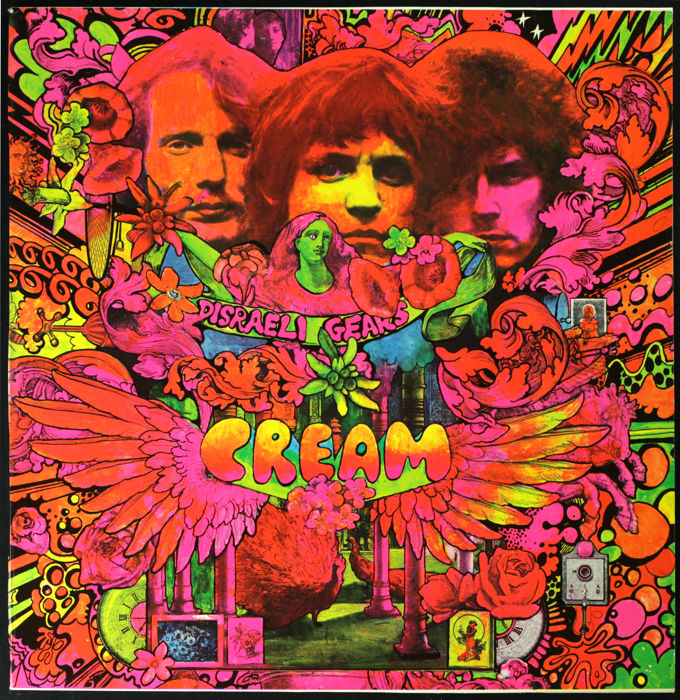
    Fresh Cream (1966) – A great debut album with groundbreaking, big guitar and drums

    Disreali Gears

    Disreali Gears (Cream) – the original LP with “Sunshine of Your Love.” It does not compete exactly with Are You Experienced? but it was made in like four days in NYC in 1967 – who had time to make an album? Fantastic.

    Wheels of Fire (Cream) – they’re not kidding with the title

    Goodbye Cream – has “Badge” and a fierce, live “Sitting on Top of the World” – Smoking!

    Live Cream – loose and bluesy, raunchy and cool. 

    Live Cream Vol II – one of my all-time favorites – live and loud! Has the hits. All you have to do is look at the cover, where Jack Bruce has Fender Twin Reverbs just as monitors to hear Clapton on his side of the stage. There is a very interesting review on All Music.

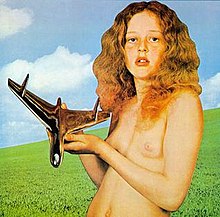
    BlindFaith

    Blind Faith (1969) – another favorite. This is very gassed up guitar playing. The tone is beautiful, the melody flows, one must assume the drugs are also flowing. Steve Winwood is on board and so is Ginger. Folks complain about this album. It has four great songs, more than most albums, a fabulous sound, and wonderful guitar playing. Something that I call, the “spiritual sound.” There’s something about it – it’s hard to describe, a purity perhaps. No false steps. Sometimes, there are two lead guitars at the same time playing off of each other. As James Honeyman Scott once said, “Long guitar solos suck if you can’t play them.” Don’t bother to google it – JHS was the guitarist in The Pretenders.

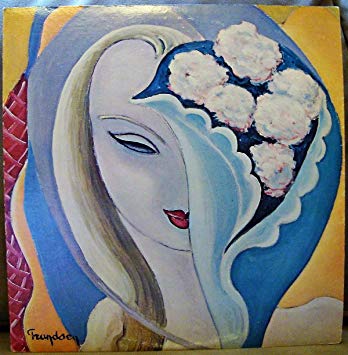
    Layla

    Layla and Other Assorted Loves Songs – with Duane Allman. No explanation necessary except that people are still confused by the name of the band – Derek and the Dominos. Yes, that guy in the pictures inside getting wasted with Duane is indeed our fearless hero, heading for a fall, unfortunately.

    Derek and the Dominos Inc Concert– soaring like Jimi with the great Jim Gordon on drums. An underrated album and the only live record of the Dominos. Beautiful texture with just organ, bass, guitar and drums plus vocals.

    Back From the Dead..

    Eric Clapton’s Rainbow Concert (Expanded CD Version much better) This album is somewhat of a greatest hits live collection and the supporting cast is amazing. Worth it just for the picture of EC, Pete Townshend and Ron Wood. And of course Townshend’s hysterical MC act. Clapton had just come out of hibernation at his mansion Hurtwood, where he consumed massive quantities of heroin for several years and ate next to nothing. But his guitar! It still soars to beautiful melodic heights. Emaciated and frail, he is still none other than Eric Clapton. Unfortunately, he soon backed off of the role of rock diety, probably with good reason. Better to be a live king than a dead god.

    461 Ocean Boulevard (1974) – “I Shot the Sheriff” EC the badass, journeyman, cocaine cowboy emerges. He can still craft a cover tune like nobody else.

    The History of Eric Clapton – compilation – has great stuff on it and a nice overview of EC's many hairstyles. I had this record before I bought all the other ones. It's pictured above and has a photo on the cover of Clapton playing at The Concert for Bangladesh. There is an excellent and revealing review of it at All Music.

    Some others…

    Eric Clapton First Solo Album – “Let It Rain”

    Delaney and Bonnie and Friends – On Tour with Eric Clapton – EC the sideman. A beautiful production and an all star cast. If you've ever loved the Rolling Stones' Get Yer Ya-Yas Out, this is your one chance to hear something slightly similar, because it was recorded live by the same guys – Andy and Glyn Johns

    Some Important Songs…

    “While My Guitar Gently Weeps” from The Beatles. Did they wear all white because they were riding the white horse? Clapton was one of the only musicians to ever play on a Beatles album other than the Beatles themselves. He got along with all of them. If that makes you jealous, I understand. But the guitar solo here is unparalleled. 

    “Superstar”  This single version is like a demo compared to the great hit for the Carpenters but it has EC on lead guitar and it’s stellar – the song seems to almost be about him so, it really works. An all-star cast in a restrained mode. Sung by Rita Coolidge and included in the deluxe version of Clapton’s first solo album, which I am not a huge fan of otherwise. I love this song and the rendition is perfect. -Christian Botta

  •  

    The jamming scene in NYC has been going full tilt recently. I’ve been going to the Red Lion in Greenwich Village on Monday nights and American Trash on Wednesdays in the Upper East Side, as often as I can. I recently made it out to the Red Lion for what turned out to be a well-attended and spirited jam. Just check out those dancers!

    I got up on stage about midway through the night of music (stage right, red SG), which runs from 8pm until 11pm, when another band takes over. Thanks to Bluesy Dan (Merle Haggard Tele, stage left), our ‘set’ was recorded for posterity on YouTube and I was joined by my friend Mike Rodbard (drums, vocals), and Ross Daisomont (bass, vocals), who runs the American Trash jam. Eric (keys), and Jim (harp) rounded out the group, which kicked out two up-tempo numbers, “She’s About a Mover,” by the Sir Douglas Quintet, which was sung by Mike, and the immortal “Six Days on the Road,” made famous by Dave Dudley and sung by Ross.
    -Christian Botta

  • Chuck Berry

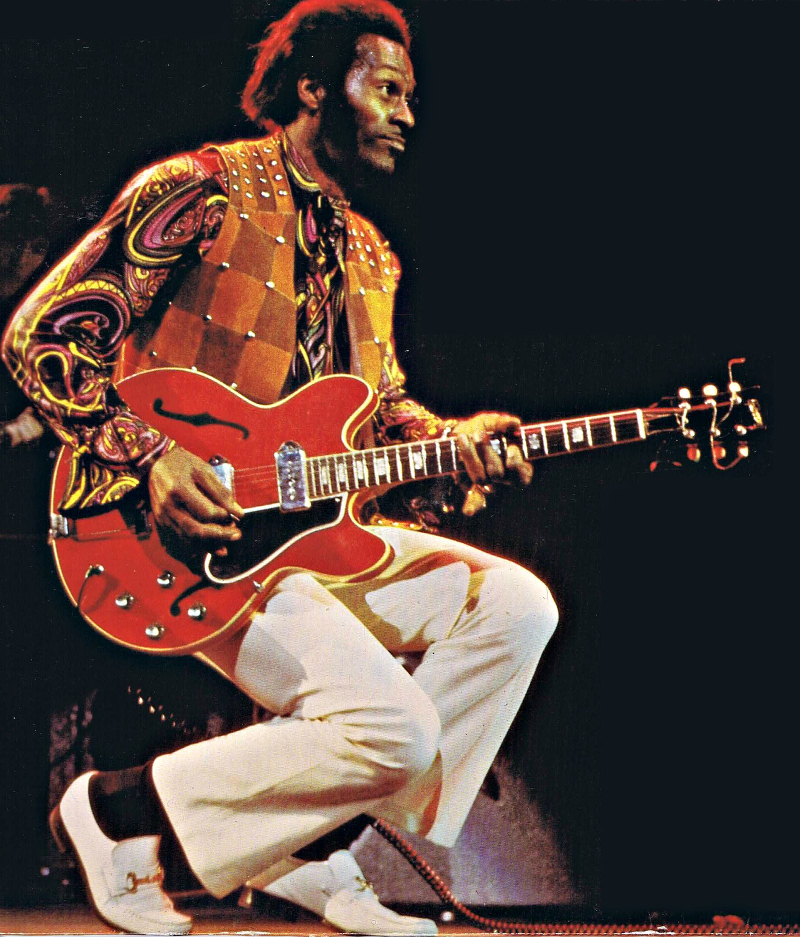
    When I was still carryin’ my guitar in a gunny sack, I started playin’ Johnny B. Goode, and jamming on it with some local kids. I thought it was the greatest thing. One of the kids even told me, “you can really play that song.” I was like, “everybody plays it.” But he insisted, “no, you have a way with it.” I think I just loved it.

    What probably helped was that I got to see some top stars playing their versions. One of my biggest heroes of the time and any time, Johnny Winter, did a super-charged version on his album, And Live and I saw him play it live, too. But the version that really caught my ear was Grateful Dead. It was included in a seminal rock and roll movie, Fillmore, about the closing of the Fillmore West. I saw it at a midnight movie. Somehow, with Bob Weir singing and Jerry playing the lead, it seemed easier. The Dead’s version really rocks and has great harmonies on the chorus. I am a Bob fan!


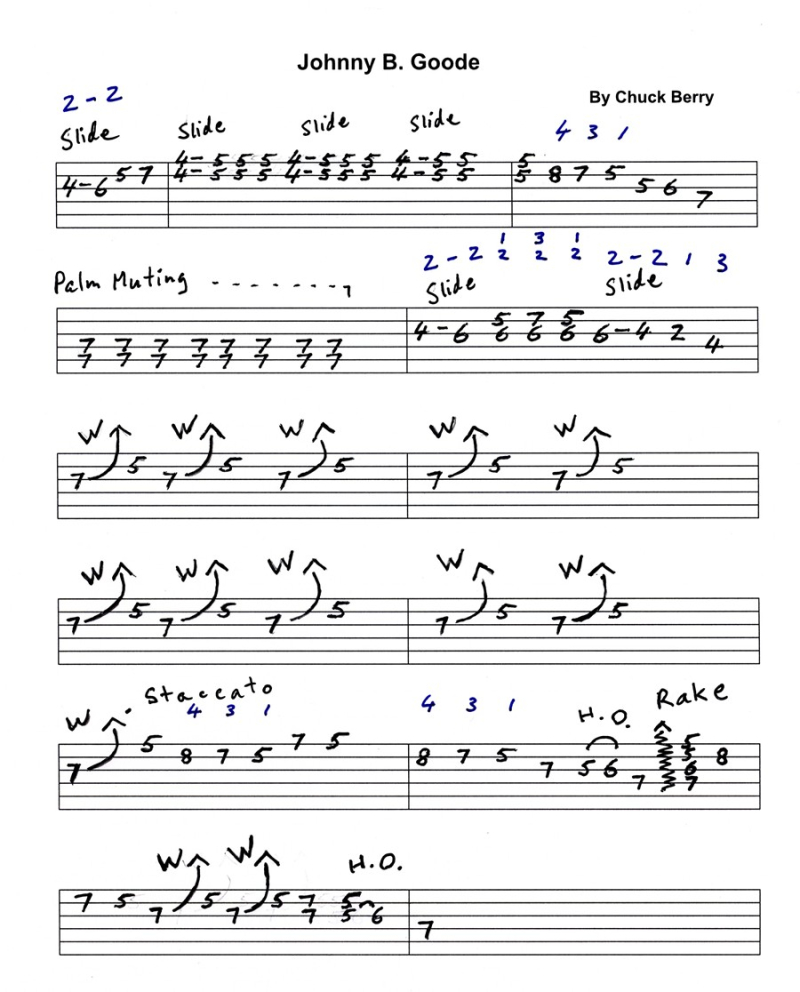
    I knew the original Chuck Berry version too, but didn’t really follow his licks, which are a little different from the way most people play it, even Chuck Berry. My other favorite version is by Jimi Hendrix. He does a kind of psychedelic metal version at breakneck speed. The point is, you’re supposed to do it in your own way. But I think the Chuck Berry version is a good place to start, so that's the tab that I've included here. It’s one of the most difficult ways of playing it and therefore, if you can do it, you’re in a good position to do your own thing. Please note that Chuck Berry plays the song in Bb while most everybody else plays it in A. Below are some technical points to help you along.


    Double Stops – Playing two notes at once on adjacent strings is a hallmark of Chuck Berry and Johnny B. Goode makes heavy use of the technique. Play the main double stops in measure one (first complete measure) with your first finger, as if you were playing an F chord. In measure three, I use my third and fourth fingers, as if I were playing an A bar chord at the fifth fret. Many people would just use the third finger in a little bar. The complicated little run before the long repeated bends is a combination of first, second and third fingers. If it’s too hard, just play single notes, keeping the ones that move. The quick one at the seventh fret, measure eleven should be played with the third finger.

    Johnny_crop

    String Bending – Use your third finger for the whole step bends. Try not to let any “release” after the bend ie, the fully bent pitch is where it ends. Use the second finger to support the third – look at the video.

    Palm Muting –Time precludes us going into a discussion of Palm Muting but there is definitely some palm muting in measure three. You can get away without it. Essentially, you touch the lower strings with your picking hand palm right at the bridge while playing to mute the strings a little, not completely.

    Fingering – check out the blue numbers above the tab. Note the use of the second finger for the third string slides. It sets up what comes after. I suggest also using the pinky for the eighth fret notes on the B String – the frets are pretty far apart in the fifth position and a three fingered approach is a little strained here. Also note that the longer runs are influenced by T-Bone Walker, who was the coolest guitar player around before B.B. King and Chuck Berry came on the scene.

    Staccato – in measure nine on the tab, you will see the articulation marked, “staccato.” This means the note is short or disconnected from the next note. Most of the big bends have this feeling also, ie no release. Staccato is an important phrasing tool and you must learn to use it but at the speed that “Johnny” goes, beginners will be forgiven for overlooking it here…

    Rake – play the chord with the notes slightly separated aka not all at once. Use a downstroke. Check the video. 

    My Chuck Berry Story/Not punched by Chuck Berry! – I met Chuck Berry once when he played at the Ritz in Manhattan. Before the show, some people said, “Chuck Berry is up there!” One of my friends even said, “He punched me!” I went up and Chuck Berry was standing against the wall in an upper balcony with two huge bodyguards. I went up to him and nervously (Ha! The definition of it!) I extended my hand and said, “I really love your music, Mr. Berry!” There were a bunch of early Rolling Stones videos playing and he just kind of sneered and cool as can be he said, “Listen to the music.” I stammered a few more words and he said it again, more of a soft hiss this time, “Listen to the music!” I got out of there quick.

    -Christian Botta


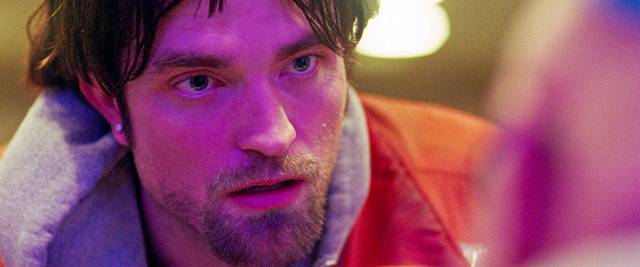
  • Robert pattinson good time

    The new film by the Safdie brothers, Good Time, finally found its proper venue – for me. The Roxy is a beautiful, Paris-inspired movie theatre in the basement of the Roxy Hotel in Tribeca that shows classic, indie and other creative films for $12 a pop. Red curtains, red seats, a little bar – there’s nothing like it in NYC. They also have a jazz club called The Django right next door, and the High & Mighty Brass Band was blasting away, people laughing and you could hear it more than faintly in the cinema.

    That is, until the movie started. The soundtrack by Oneohtrix Point Never aka Daniel Lopatin was so loud and full of ominous synths and buzzing sounds to make you nervous that the good times of the crowd next door dissolved into the swoon of dread, tension and fascination that is Good Time, the film.  

    The name of the film is so ironic as to be completely absurd, beyond sarcasm, beyond even trend-speech. No one was laughing! It was not funny at all, although I would say there is some intended dark humor. A definite stab at a serious, experimental type film, yet with a well-worn, near cliched plot, and of course, a twist. There is a big star in the main role, Robert Pattinson who is very good. So far as I understand, the Safdies do not approach the happy, peppy and bursting with love side of things although the story moves at high speed and centers on the devotion of Connie (Pattinson) to his developmentally disabled brother Nick (Benny Safdie). For undisclosed reasons, Connie decides to rob a bank but being completely untrustworthy, friendless, or both, he enlists Nick as his accomplice. No spoiler alerts here but I hate spoilers, so… The film also includes the considerable talents of actors Barkhad Abdi and Jennifer Jason Leigh, and a highly credible and central turn by real life hood Buddy Duress.


    The lurid but effective cinematography is by Sean Price Williams, an indie darling who has shot forty or more films and has a list of his favorite one thousand films that is known in the industry. It would seem like it might be a good time for him to test his obvious chops on something that is not so circumscribed in terms of its intended audience.

    The title song “The Pure and the Damned,” is very similar in ways to “Walk on the Wild Side” by Lou Reed. The song, though, added emotional depth to the film, albeit it right at the end. It helps you to feel something in what has otherwise been a bleak and breakneck ride. It is sung or rather crooned by no other than Iggy Pop. It’s not exactly Funhouse but the movie is so full of funhouse ideated riffs that a long, central scene actually takes place in a funhouse.

    I imagine there will be film school papers written about Good Time. It takes place in Queens which is a great start and that might even get some young NYers to visit the place or at least think about it. I didn’t really recognize the Queens of the movie but the locations were perfect and included other Tri-State area locales, as well. Way to go, Safdie Brothers! Nice job. -Christian Botta