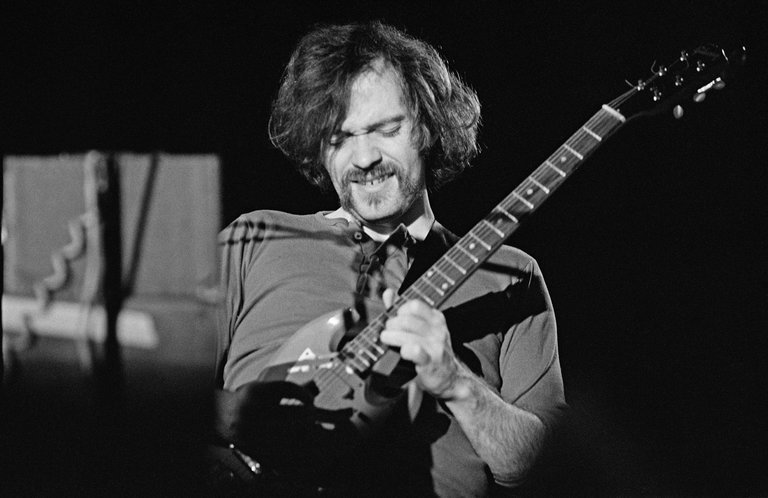
• Abercromie with SG

    Love and devotion were in the air at the recent “John Abercrombie: Timeless,” tribute at Roulette in Brooklyn. The music was spot on – inspired, beautifully played and non-competitive. In a tribute to a great guitarist, only three guitarists would take the stage. For me, there was reason to be grateful because a friend and his Dad took me. This fortune brought me my first glimpse of both John Scofield and Bill Frisell, plus many other great jazz musicians.

    Also on hand were the legends Jack DeJohnette, Randy Brecker, and Peter Erskine, plus Joe Lovano, Billy Hart, and pianist Elaine Elia, who literally had the piano shaking to her groove. There were many others who I had heard of but never experienced either on record or live. For a different take, check out this review or this one.
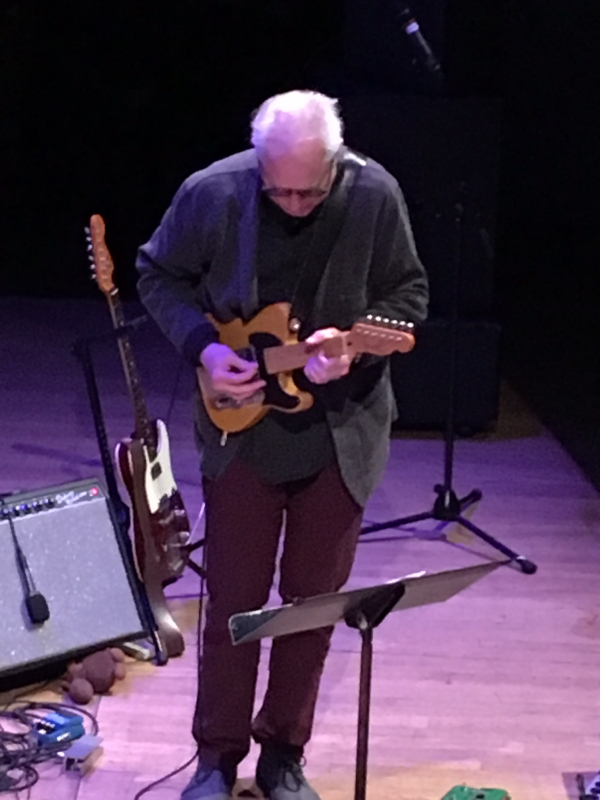
    Bill Frisell

    Bill Frisell wields the cutest mini-Telecaster you are ever likely to see.

    We got seats in the balcony, overlooking the stage. In a quirk of the concert’s vibe, the guitarists seemed to be playing straight to us rather than the front rows or orchestra, as you can see from the photo above. The sound was crystal clear and not too loud – just right for jazz.

    The purpose of the concert was to pay tribute to a great, and gone musician, and for his friends and collaborators to meet one more time and share their experiences and love for him. But while many in the audience were die-hard fans, knowing every tune, every nuance, the concert also spread the word of John Abercrombie’s great music and inspired me to delve into it more. As I write this, I am listening to a CD (yes! An actual physical CD that I got out of the NYPL!) of Abercrombie and Scofield’s Solar, released in 1984.
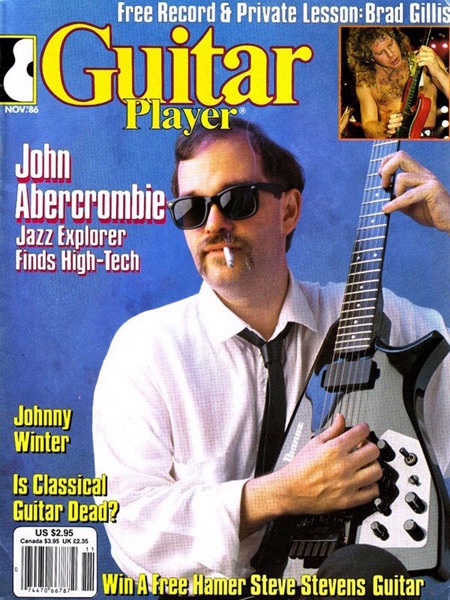
    Abercrombie Guitar Player Cover

    I have a copy of this GP issue in my closet. I think it's really funny for many reasons but I have to say, John Abercrombie maintains his cool despite it all. 

    One obvious question however remained palpable. With most of the players getting up in years, who will take on the mantel of the great jazz players in the future? Not up and comers, or the latest new wave, but the solid, long time practitioners who are appreciated by a devoted audience and held in esteem by their peers. It will be interesting to see. But for this one night, it was a joy just to still be around. -Christian Botta
  • IMG_5115

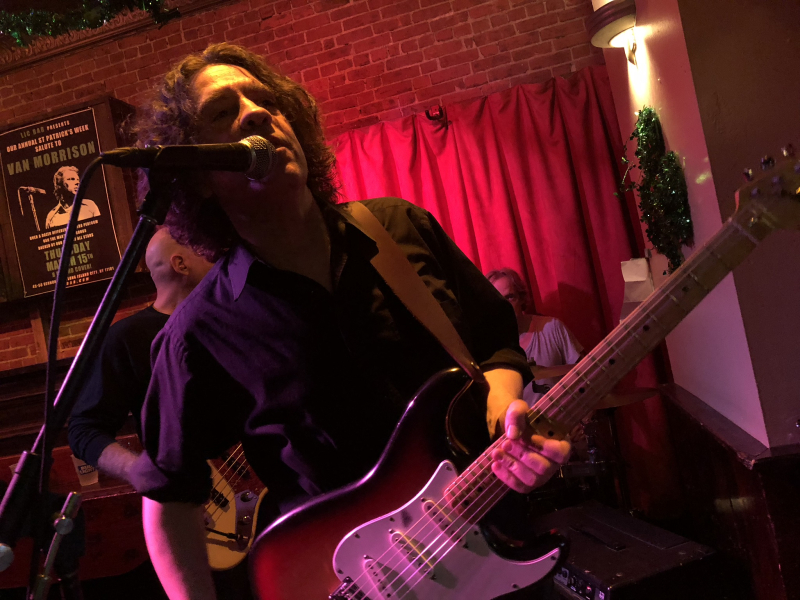
    With the wind at my back, I steadied myself. And pushed on. I could see the city lights before me. The wharf, the piers, les clochards, all beckoned. I was headed to the LIC Bar to play a gig with Saints and Sinners, AND Mancie, mind you. This was no ordinary night. Google maps says that it’s four tenths of a mile from the Court Square subway stop to the bar, and I was feeling every decimal point. I had my ’75 hard-tailed Strat, a Gibson SG, an old beaten up bag from some place in the Village, and my fully stocked pedal board. You’ve got to figure the fifth floor walk-up into the equation. How many steps is it from the apartment down to the bowels of the Spring Street subway station? But I dither. I had a mini of Dickel Eight Year on me as well. It was coming soon.

    IMG_5136

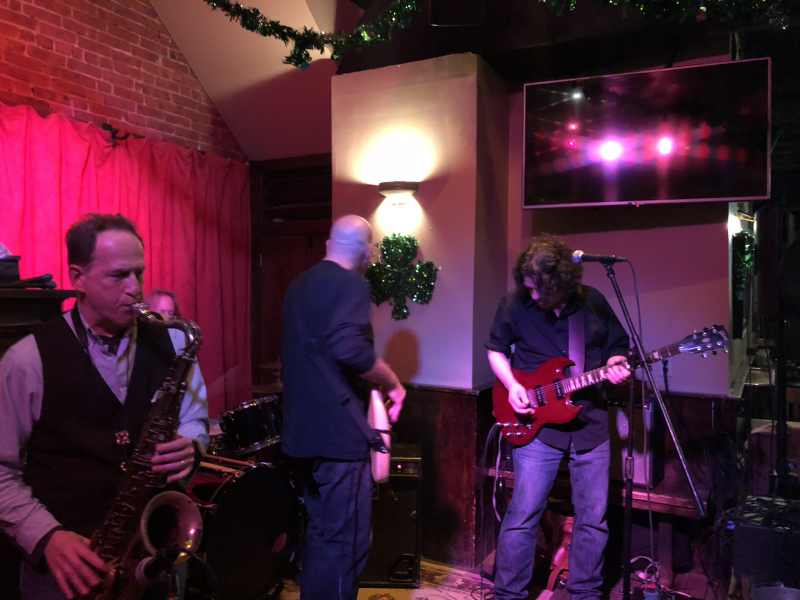
    L-R Rich Philips, Mark Feldman (obscured), Dave Gerstein,  Chris Botta

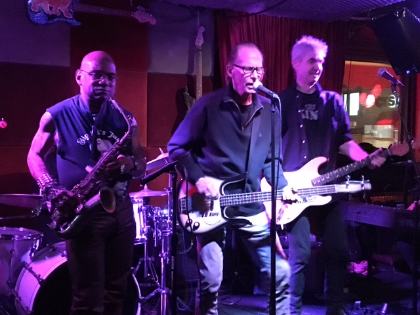
    A Girl was singing Irish songs when I got there. She was good, belting them out and thrashing a sweaty but beautiful Gibson J-45. It can take a shot, she told me afterwards. The first set went well. Mancie. She’s a classy dame, but still full of surprises. We ripped and roared through a mix of originals and covers. The crowd began to build. Then the set was over. We worked at the beer. Saints and Sinners took the stage for the final set, starting as a three piece, then four. The saxophone splattering and echoing in my mind for days afterwards. A girl took up her position at the bar right across from me but I didn’t seem to notice as I obsessed over the blues and the abstract truth. The trashed Deluxe Reverb spoke its sweet and hard charging melody as the bass shadowboxed with the ineffable. Then Mancie joined the fray. “I just want to make love to you,” she sang. It was almost over. We cut a few more tunes, the drummer doing double duty. Everyone vanished as soon as the last note drifted out the window and onto Vernon Boulevard.

    -Christian Botta    Photos by Andrea Fischman
     

  • 7 Comes 11

    Sadly, ruts are a part of practicing – I first noticed it when I was fourteen. My teacher explained to me, “You’re going to have ups and downs.” I won’t say that I was in a rut recently, but I felt that I was having trouble getting my practice sessions off the ground. I was looking for something new.

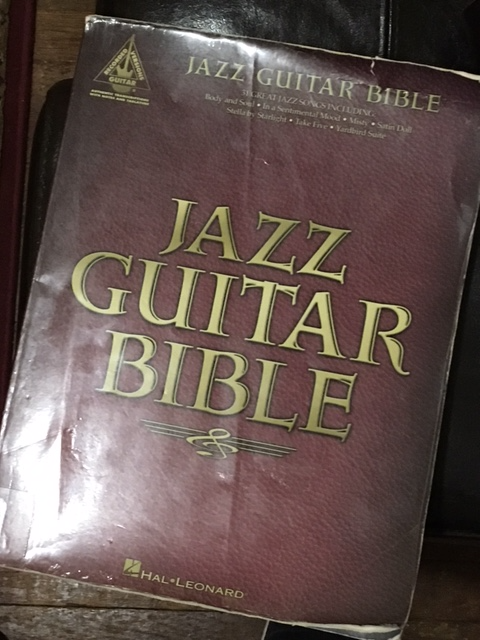
    I decided to build my practices around transcriptions and lead sheets instead of just picking up the guitar and improvising, or doing scales and then reviewing material for gigs. This obviously isn’t ground breaking, but I think it’s more about the material. The idea is to play new music at a high technical level. For me, that involves a lot of bending, really good and well placed vibrato and some challenges for the right hand. Plus, there must be high quality, melodic ideas at work. Here are some of the pieces I’ve been working on. Please note that I got the Jazz Guitar Bible, which contains the amazing “Seven Come Eleven” out of the library. A library card is a must – you can get tons of great scores out of there!

    Jazz Guitar Bible

    “Mr. PC” – John Coltrane

    This is a ‘head’ from John Coltrane’s great Giant Steps. Mr. PC is a blues tune in C minor and it goes really fast. The object is to play the eighth notes at over two hundred BPM. But instead of scales, you’re playing music. The phrasing is also a bit of a challenge. It’s not that hard to improvise over the changes, which I don’t generally practice. Playing rhythm in the hard bop style is a whole ‘nuther ball game. But I have a goal of getting up someday and jamming this tune at a jazz jam session. You would have to rip the head at blinding speed – worth preparing for! Great for right hand picking and coordination between the hands.

    “Seven Comes Eleven” – Charlie Christian

    More jazz, this time from a guitarist, the great Charlie Christian. The right hand picking is again a challenge on the head but this time it’s even more difficult from a musical perspective. How do you play the across the strings eighth notes with alternate picking and still make it smooth and swinging? Inside the string or out? Neither one is obviously better. This must be the eternal question for jazzbos but, they have obviously solved it by now, right?

    The solo is another matter. Not that hard, very blues-based. Yet he is not exactly crawling along. And don’t they say that he was an early be-bopper? The arpeggio choices merit study. There is also a super cool sequence of chords before the solo that form a cycle of fifths with really neat voicing. Great kinda ‘inside out’ (again!) left hand finger moves with a pair of guide fingers/common fingers. Cool stuff!

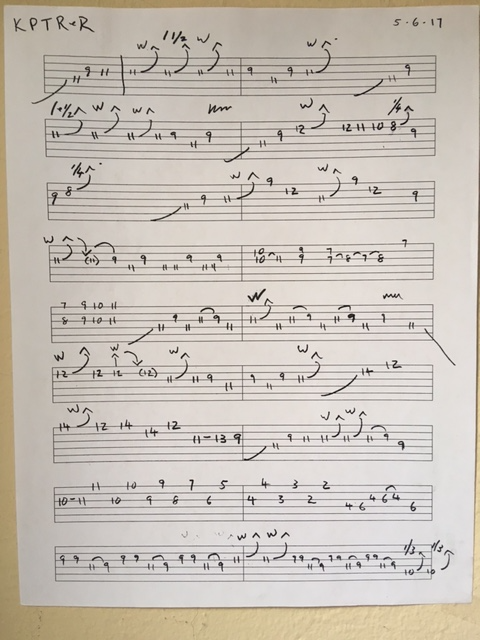
    “Keep Playing That Rock and Roll” – Rick Derringer

    Keep Playing That Rock and Roll was played by Rick Derringer and features tons of big bends, fast pull-offs, tasty licks and a bunch of fast sixths for good measure. The song is an awesome listen, one of the hits off of Edgar Winter’s phenomenal White Trash album. What a band! Derringer could really put a well-constructed solo together in his day and it’s always fun to play along with Edgar Winter in the back-up band. Slick, lyrical, ballsy, speedy – when was the last time you heard all these qualities in a commercial radio guitar solo? Mostly major pentatonic licks.

    KPTRAR

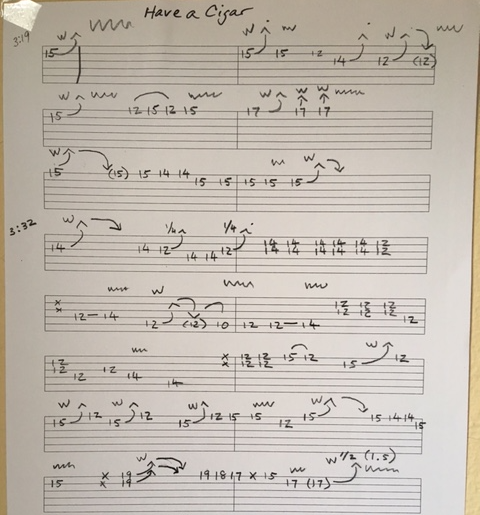
    “Have A Cigar” – Pink Floyd

    I had meant for a long time to transcribe some of the solos from Wish You Were Here by Pink Floyd, one of my all-time favorite albums. When I finally got down to it, it was hard to decide which solo to do. I decided to transcribe “Have a Cigar” first (see first page transcription tab below). It’s a long solo in E minor, using only one position, the twelfth. In a sense it’s a bit like the solo to “Hey Joe.” Jimi was a major if not obvious influence on Gilmour. The phrasing is tremendous and Gilmour employs lots of big bends and a variety of different vibratos. There are sweet choices of notes plus ideas that are easy to grab and incorporate into something of your own. The feel and atmosphere are fantastic and the music is great to listen to. Really fun and a great work-out. 

    Have A Cigar

    “Will My Man Be Home Tonight?” – Earl Hooker

    This is my lesson and transcription of one of Earl Hooker’s most successful studio sessions and one of his best slide performances. He probably played the whole song in standard tuning but I do it in open D because I play in the tuning all the time. It works. I will probably do a standard tuning transcription in the future but in this arrangement, intonation and speed are given a major workout and test. It won’t be any easier in standard, trust me! He may play a few licks with his fingers but that’s a whole other ball game – you will have to be one slick mofo to pull that off. Can you hear them? It’s often hard to hear where Earl’s finger work takes over from his slide. There are some killer single string licks here that can work in any tuning and translate to any slide style. File under “Keeping the chops up.” -Christian Botta


  • Chris at Silvana

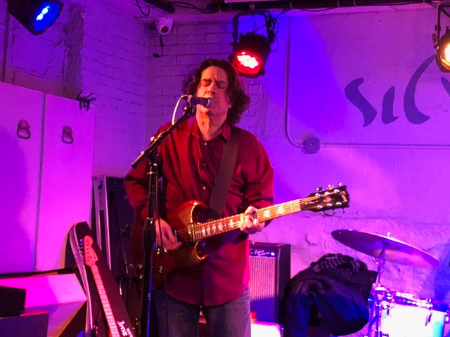
    The cold winds of February brought along a trio of blues gigs in my hometown, New York City. Two of the hits were over in a New York minute, but there were lots of great musicians and plenty of fun. The venues included the Delancey on the Lower East Side, Big Ed’s World Famous Blues Jam at the Red Lion on Bleecker Street, and Silvana in Harlem, where I played with my band, Saints and Sinners (above, bottom).


    The first stop was a reunion show with the Fountain of Blues, a tight band I used to play with that features my friend John Birdsall on harmonica. This Thursday night gig was a brisk walk from my crib down to the end of Delancey Street, where the club that bears its name has lost some of its disco/LES cache but still provides a spartan room downstairs with professional sound and some formidable half stacks on the stage.


    And there were plenty of people on that stage! The crowd was very receptive. I only got to play two songs (see videos above), but they were two of my favorites: The Magic Sam penned, “That’s Why I’m Crying” and the Little Walter classic, “Just Your Fool.” The impressive band before us was Orphan Jane (below). They plied a Kurt Weill inspired, circus and burlesque-friendly sound and stage show that was polished and highly entertaining, and featured some smirking slide guitar. Who says clowns are scary?


    The following Monday I made my way to the Red Lion for the jam. The crowd was a little sparse at first but it wasn’t long before musicians and fans started to drift in and the house band, minus a few regulars, started to rock out in a funky and committed New Orleans style. There were quite a few Telecaster players on hand and by chance I had brought mine that night. I got up pretty early in the procession of keyboardists, pickers, harp players and more and led a feisty group through “Going Down to Main Street” by Muddy Waters and an original of mine, “Door to Door Blues,” both with Country Joe keyboardist David Bennett Cohen riding shotgun.

    Mike at Red Lion

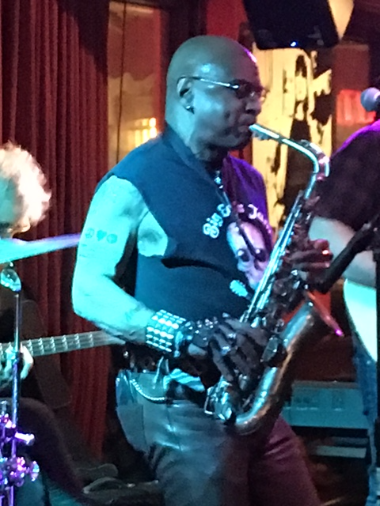
    My friend Mike Muller played in a number of combos as there was a paucity of bass players. He gave a spirited performance in all of them as you can see from the picture above, which includes Chuckie on sax and VD King on guitar. It was a good night for Chuckie as he fronted the band on a number of tunes and displayed a gritty and soulful tone on the sax.

    IMG_3441

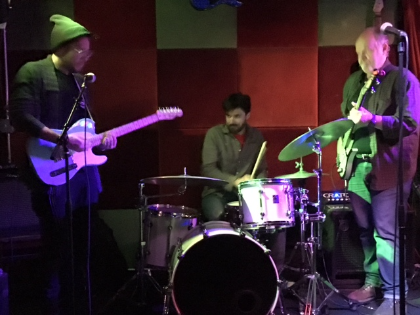
    Daryl Cozzi, the Stax-inspired drummer (below) who plays with me in Saints and Sinners was also on hand as he has started to make the jam more regularly. The set he played with his bandmate in Drop Diamond Karl Markgraf (left, below) on guitar and some totally new acquaintances was cooking and tight – impressive.

    Daryl at Red Lion

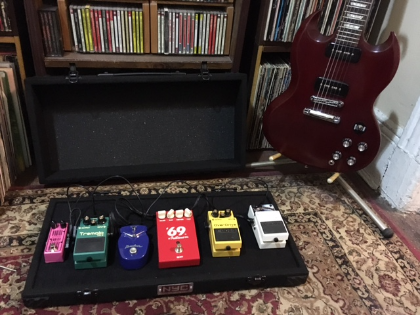
    I neglected to mention that I picked up an important package from UPS that night, my first pedal board, made by NYC Pedal Boards and naturally shipped to me from Upstate. I started setting it up with an eye towards using it immediately at the Thursday night gig at Silvana, the final stop of my eight-day Blues Odyssey. It was kind of a schlepp for a NYC gig but I brought two guitars, the pedal board and a large backpack, drawing some looks on the subway. However, I wanted to try out the new board plus I had just gotten the electronics in my Gibson SG completely redone by Maggio’s in Brooklyn, where I teach guitar. I also really felt like playing slide guitar and I needed a second axe, my '70s hardtail Strat.

    Pedal Board and SG

    A last minute cancellation allowed us to stretch out a bit so we did two short sets with a mix of originals and covers that included “She Gets Me” from our forthcoming album. We also knocked out a sizzling version of “Money” by Pink Floyd and I was jazzed to find that my Fulltone ’69 Fuzz pedal does in fact work quite well with a Deluxe Reverb. Another tune that came off well was a new original, “World Gone Mad” – I guess you know what that one’s about.

    Silvana 020818

    Saints and Sinners L-R: Christian Botta, Daryl Cozzi, Dave Gerstein

    We were followed by a power trio called Merrymakers Orchestrina, who played tight 1970s styled blues rock with a classical precision. The sweet mix was aided by the blending skills of soundman Wyatt Mones. Eventually the club was turned over to a dance party and as the couples started to get cozy we headed to the C Train, the Blues Odyssey over, for the moment…

    Special thanks to Gary Kiyan and to Dalia for the Silvana pictures and massive enthusiasm! –Christian Botta

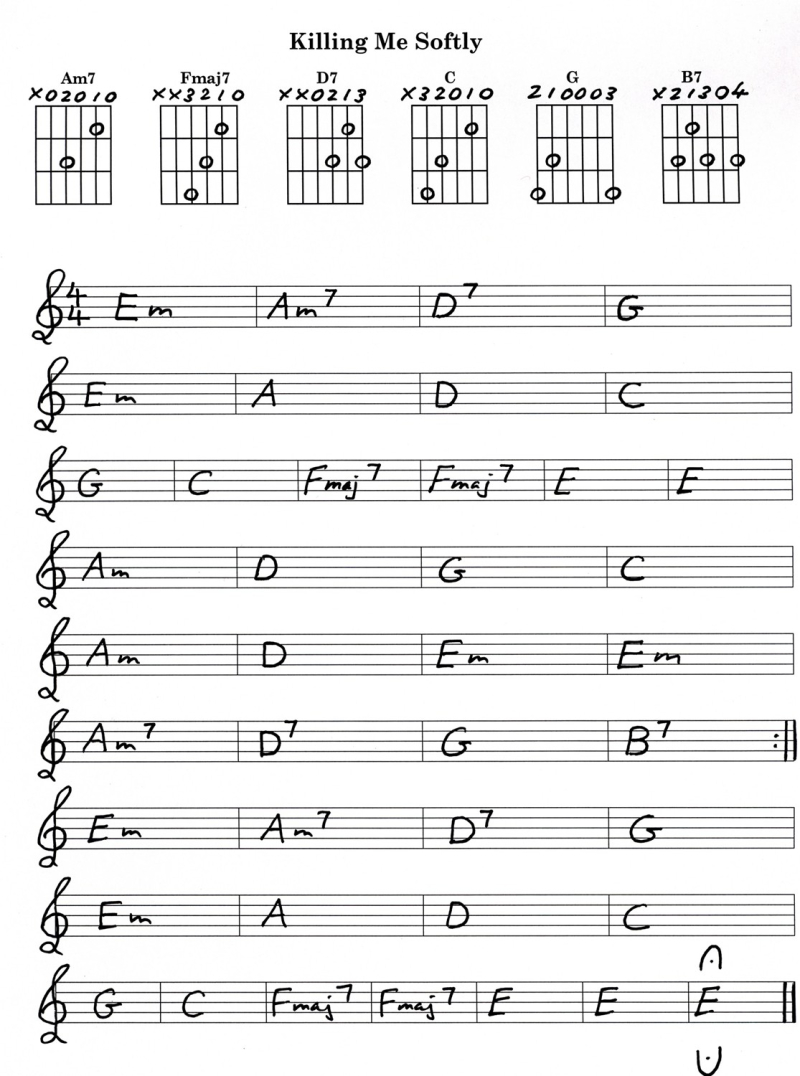
  • “Killing Me Softly (With His Song)” makes for an excellent review and exercise of the basic chords in addition to being a lovely tune with some interesting theory behind it. The song was a number one hit for Roberta Flack in 1973 and with her beautiful vocal and arrangement she crystallized a certain kind of style – folky soul with a hint of Latin.

    There are eleven chords in all: G – Em – C – D – Am – A – E – D7 – Am7 – Fmaj7 – B7. You don’t really need the extra 7th chords, ie Am7 and D7, but they add to the jazzy vibe. The main point is you have to memorize these chords. It’s worth it because you can play many songs with them. You’ll notice that there are three different A chords, and two different E chords, plus two pesky D chords – the way I like to think about the D and D7 chords are that one is a triangular shape pointing towards the body of the guitar, and the other is pointing away from the guitar. You will eventually use them all and here is a great chance to get them down.

    Killing Me Softly_Resize

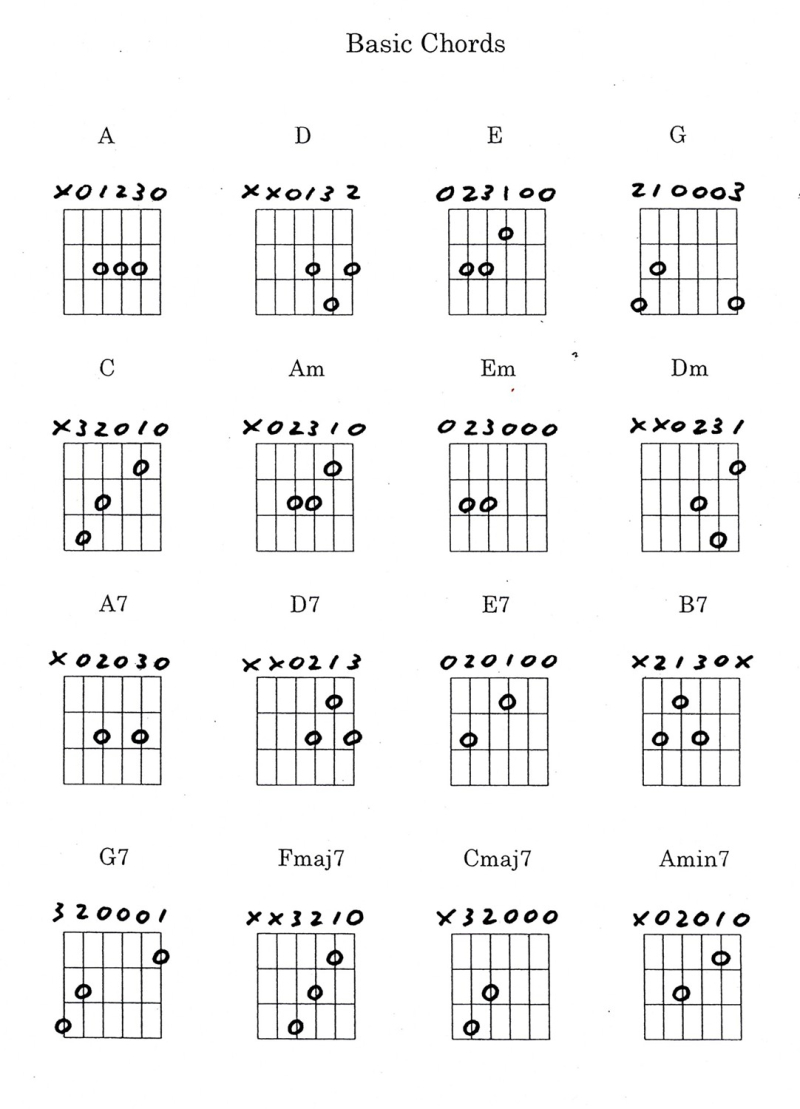
    You’ll also notice that not all of the chords are listed at the top of the main chart, above. This is simply due to space limitations but it also it serves a purpose – you need to know as soon as possible what an E major chord is, and an E minor chord, and a C chord, etc. They are the ultimate in basic chords. I’ve included a handout of mine that I call, “Basic Chords,” below. These are sixteen of the easiest chords. I’ve heard it said that there are twenty-five chords that you need to play most songs. These are the sixteen easiest and most essential and they would definitely be included in any group of twenty-five.

    Basic Chords_Resized

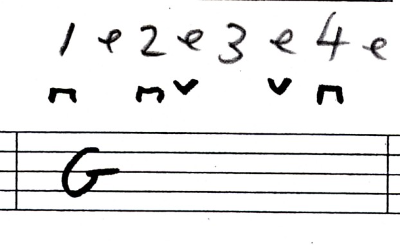
    Take a look at the video. The simple rhythm is used in many songs, and one pattern equals one measure of the song or one chord. Some people refer to it as down – down – up – up – down. I call it the ‘basic syncopated strum’ and you can see a lesson based on it by checking out my post on the Rolling Stones’ “Dead Flowers.” There is a chart below. Note how the strum on beat two and a half carries through on beat three, hence 'syncopated.'

    Dead Flowers2

    The Down-Down-Up-Up-Down Strum Pattern or "Basic Syncopated Strum" is illustrated above.

    Make sure that you use the ‘guide fingers’ that are available and also ‘common fingers.’ You can read a primer on guide fingers in my lesson on “Wild Thing.” Some of the available options include the common finger number one (index) that sits on the note C at the first fret, B string and is present in both the Am7 chord and the D7 chord. Do not lift it completely off the string when you go from Am7 to D7. Keep it there! It saves time! Next, you can use the third finger at the second fret of the high E string in the D7 chord as a guide finger to slide to the next chord, G major – the third finger is also on the high E string in that chord, just one fret up. Think, “guide finger, slide finger,” if you want to. These two important techniques are applied right in the first line of the song. You have to apply this theory wherever you can. Where else can you find guide fingers in “Killing Me Softly”? The move from A major to D major is one example, using the third finger on the B string (second line of the song). 

    Roberta Flack First Take

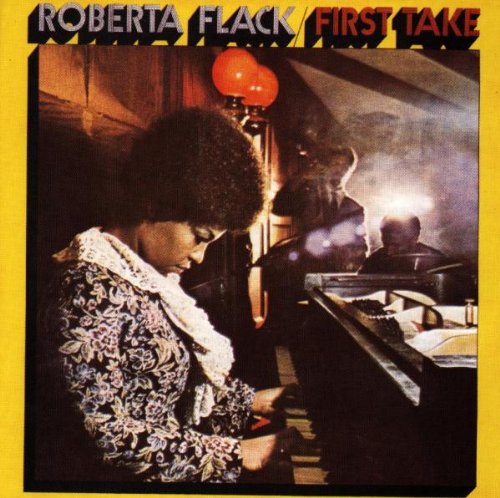
    The cover of Roberta Flack's first album on Atlantic Records – Note the jazzy trappings – Oh Yeah!

    On a theoretical level, the harmonic progression that underpins much of the song’s gorgeous melody is a circle of fifths – you’ve probably heard of that – for example the Em – Am7 – D7 – G progression of the chorus. (Count backwards from E to A in the alphabet: E – D – C – B – A. Voila! E to A equals five equals a fifth.) Another interesting theoretical device in the song is called a Picardy Third – this accounts for the E major chord at the end of the chorus – the third of the Em chord is raised from G to G#, making the final chord of the phrase and eventually the song major instead of minor, for a more uplifting ending. For more on "Killing Me Softly" click here. Have fun! -Christian Botta
  • Gary Clark Jr

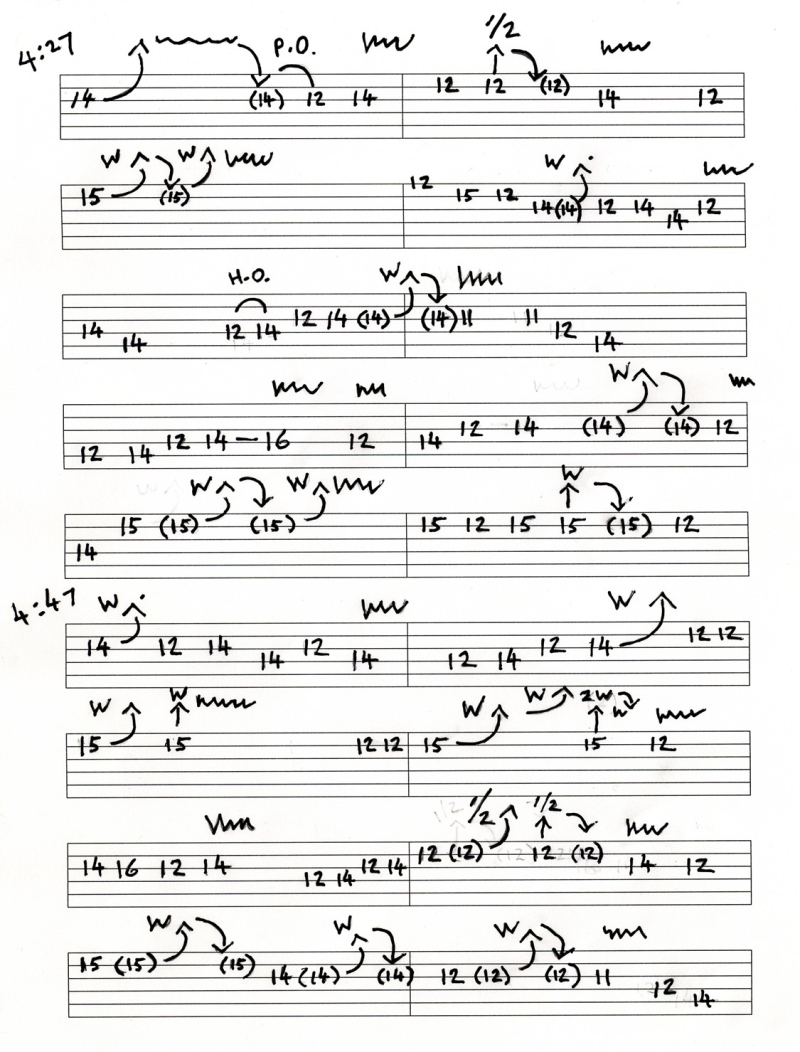
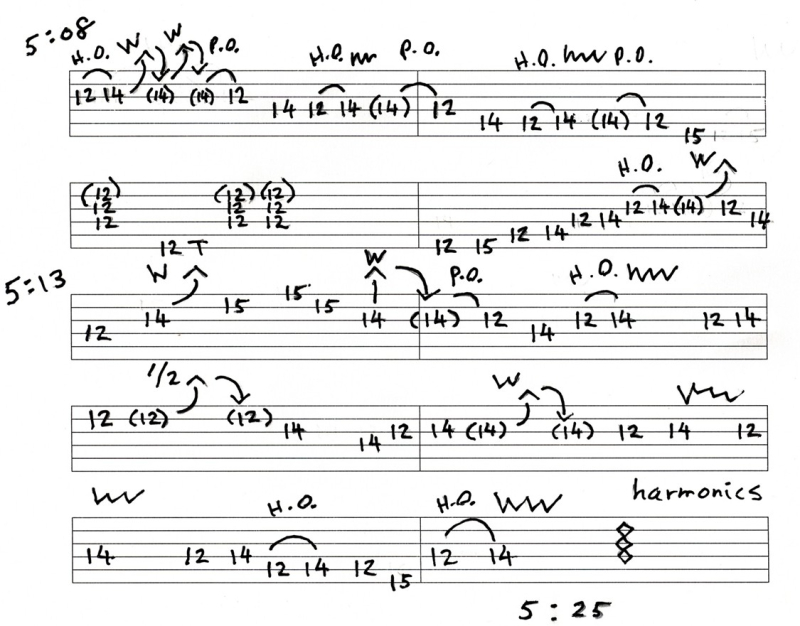
    When I first heard Gary Clark, Jr., I have to admit I was a bit skeptical. The hype surrounding his playing, his acting gigs, the perfect image and awesome singing voice made me wonder about his gasp, authenticity as a player, but the truth is that what I heard in terms of his guitar playing did not impress me. The new Hendrix or (even) Stevie Ray? It’s tough to live up to that! But I stand corrected. A student of mine turned me onto this fine live recording from Glastonbury, England, and I admit now that I’m a convert (see video below).


    “When My Train Pulls In” is a minor blues in Em in a twelve bar form. GCJr deftly blends in notes from the natural minor scale (E – F# – G – A – B – C – D). It’s not always easy to use the flat sixth, in this case the note C, as it can sound a too little Medieval, a little, well, really flat and sad. But GCJr does a great job with it, his lick in the first chorus, over the IV chord, Am is a perfect example. The major second of the scale, F# is much easier to use in a blues but Gary does more than just use it as a passing tone, highlighting it with vibrato and then a Bm arpeggio over the V chord, you guessed it – Bm (line 3).

    A tab for the first solo is below. The video is very helpful but at times there are parts where I’ve just used my educated guesses and understanding of the modes involved. Your fingering and fret choices could certainly differ. Gary plays most of the solo using the twelfth fret, form I blues scale. Interestingly, he bends down a whole step towards the end of the solo and it makes you wonder if he’s doing it elsewhere. The solo certainly provides a workout in terms of a bending extravaganza. The construction is so nice that one wonders if it were composed beforehand.

    GCJr3ReSize

    GCJr4Resize

    GCJ plays one of my favorite guitars on this performance, a ’61 Gibson Les Paul/SG given to him by the Foo Fighters. He’s getting a really fat sound with two Fender Vibro King amps with three ten inch speakers. He mainly uses .011s and medium picks. Kudos also to the great band, especially rhythm guitarist King Zapata, who as a great sound to go with his tough image. Drummer Johnny Radelat and bassist Johnny Bradley also contribute to the big, original sound that the band gets. And let's not forget one important thing – it's a great song! -Christian Botta
  • Bowie Ronson Woody

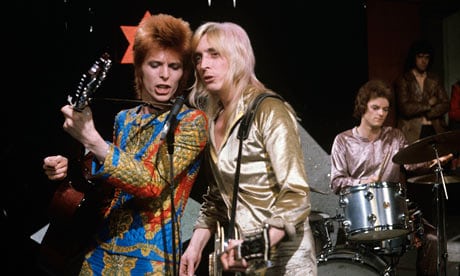
    To All My Friends, Happy New Year and Many Happy Returns! It’s been a bit of a crazy year, but let’s not worry about the tough stuff. It was productive if arduous. I spent a lot of time working on a new album which will be ready soon.  A lot of great lessons and students coming and going.

    Recently I read a bunch of music biographies, especially the highly recommended one by Woody Woodmansey, the drummer for the Spiders From Mars, David Bowie’s great band in his Ziggy period and just prior to it. Of course, I had to follow that with David Bowie: A Life, which is also a great read although quite a bit less down to Earth. An oral history, it includes many forgettable accounts towards the end but there’s still plenty to recommend it and it’s a must for any Bowie fan. Not definitive but then how can you define David Bowie?

    Woody’s (not that Woody, but more on him later…) book also led me to the great Deluxe version of Elton John’s Tumbleweed Connection, an album that I’ve never really listened to other than the hits. Great album! A real gem on the deluxe version is the original version of "Madman Across the Water" with a smoking performance by Mick Ronson on lead guitar.


    Some upcoming projects for my blog include a transcription of a Gary Clark, Jr. solo and a transcription of a masterpiece by the great Ron Wood. I’ve got a gig coming up with Mancie at the LIC Bar on January 17th and I’m really looking forward to that. I’m also really looking forward to 2018. I always look at what I want to do in the new year and this one is no exception. I’m hoping to play a lot of music and write more songs. I wish you all the best! -Christian Botta
  • SANC COLLAGE

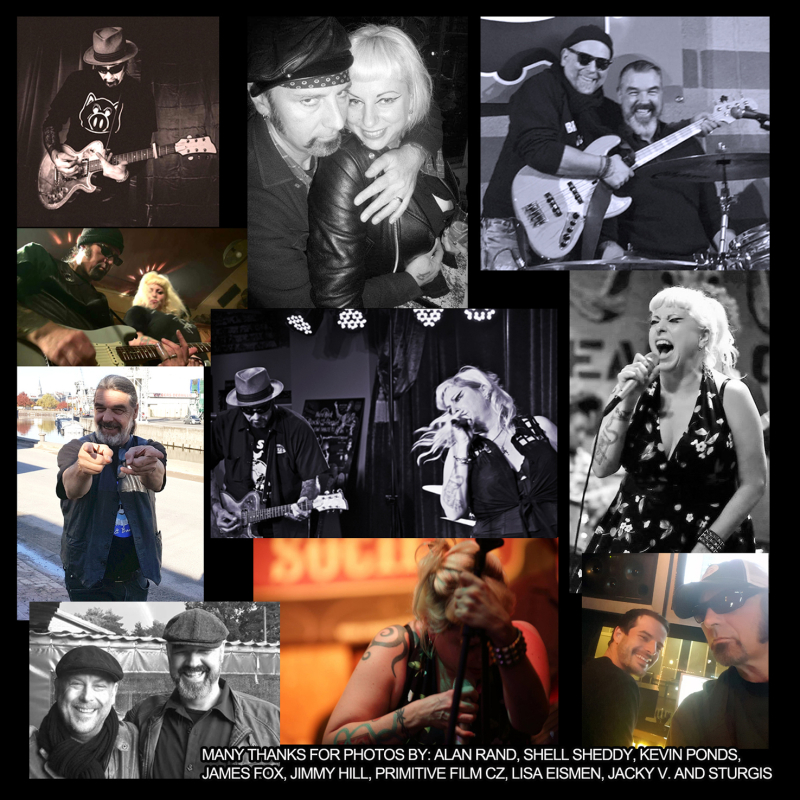
    Low Society is back with a new album that is drawing attention, having been placed on the ballot for a Grammy in the American Roots category. The title song is a hit and a delicious irony in itself. Sanctified means pure – whereas “Sanctified” the song is an unselfconscious synthesis of blues, rock & roll and rockabilly. The insistent, lighthearted slide lick is an ear worm that sticks in your head for hours, driven by handclaps. The audacious, clever lyrics are delivered in a fire and brimstone vocal performance by Mandy Lemons, and they name-check some classic songs: Driving Wheel, Broke Down Engine, Take it Easy, sealing the deal that this tune is a love letter to rock and roll. In the account below, Sturgis recounts the genesis of the song and album, Sanctified by Low Society.


    “Sanctified,” let's see. First draft/concept in Jan/Feb 2012, written shortly after leaving NYC and relocating to Texas. Landed in Memphis in April '12 and a year later started looking for a way to crank out the 2nd Low Society album. Enter Johnny Phillips and Icehouse Records/Select-O-Hits.

    We went into a cheap studio in the winter of 2013 to do pre-production demos for You Can't Keep A Good Woman Down, for Icehouse Records. Sanctified was one of ten songs we recorded, and was the ONLY song that was dropped from the list of potentials. The approach was a little too "hard rock" and not bluesy enough, I guess. The funny thing is, Icehouse was less than enamored with our demos and Johnny Phillips (Sam's nephew) sent me a CD of songs he owned the publishing on, asking me to pick what I liked and consider recording them. You can imagine my reaction – "F You!!!!!"

    Fast forward to October 2016. We're in Belgium for our second consecutive year, touring. Through the recommendation of our great friend and booker Danny De Man, we picked up a Belgian rhythm section to support us over there. Two extremely capable and lovely gentlemen: Jacky Verstraeten (Bass), and Bart De Bruecker (drums), from the Belgian group Raw Blues Experience. We got along with them SO well, and Low Society sounded SO good, that I expressed a wish to do some recording with them while we were there. Jacky took it upon himself to make some inquiries, and found us a GREAT studio. Closed Session Recording, in Roeselare Belgium – owner/engineer Kristof Maes.

    Low Society Studio

    We booked twelve hours. I started thinking about what we could record. There were five songs, of the twenty or so we were performing, that were possibilities. Mandy and I had a little meeting to discuss what other songs we had "stashed" that would be appropriate for such an occasion. There were 3: “Sanctified,” “Drowning Blues” and “River Of Tears.” Get to the studio – the five songs that were already in the repertoire we knocked out in no time flat, and took a lunch break. When we got back to work I taught Jacky & Bart the three additional songs, and we would consecutively do a rehearsal take, and then go for a master take. In the space of ten hours we recorded rhythm tracks for eight of the ten songs that ultimately became the album, Sanctified. Kristof handed me a thumb drive and wished me luck.

    Low Society Mandy

    We said our tearful goodbyes after our last gig, and got on the plane and returned to Memphis in November. I contacted our engineer, Will Danger, when we returned, and within two weeks, we were at American Recording. I honestly didn't know exactly what I was going to hear when we unzipped those files, whether or not we had enough quality anything to make a record out of it. Fortunately for everyone involved, the quality was extremely high. Kristof is an excellent engineer, and the bass and drum tracks were wonderfully recorded, except for one minor issue. My guitar. You see, we didn’t go to the trouble of isolating my amp that day, so the guitar bled into the overheads and room mics. Unless we scrapped everything, I would have to keep what were essentially scratch rhythm guitar tracks as master takes. On all eight songs! Ultimately, as I usually do, I decided that my first instincts are my best and the guitar tracks I recorded live with Jacky and Bart in Belgium make up the bulk of the guitar that you hear when you listen to Sanctified (the song….and the album).

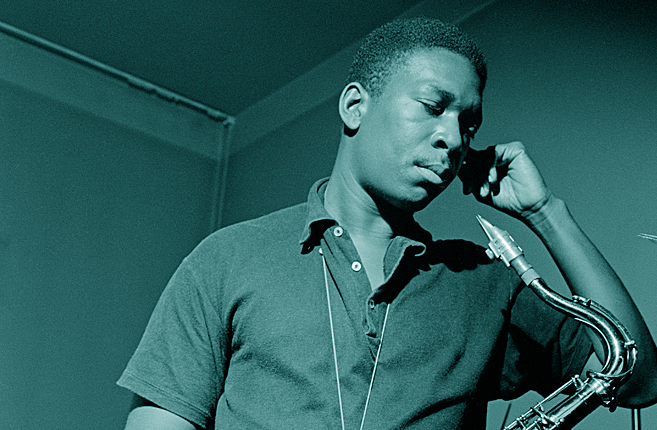
  • John-Coltrane

    In a recent Facebook post someone asked, “If you could meet xyz dead rock star, what would you ask them?” My immediate thought was, “how did you practice?” I can remember numerous tips from various guitar heroes and heroines over the years, but they're never enough. In a series of blog posts exploring this eternal question, let’s examine the crux of what my blog is all about – practicing guitar. Please feel free to comment! Share your thoughts on practicing and your practicing routine!

    Let’s Start with the Basics

    I just got through re-reading a great book about John Coltrane, called Chasin’ the Trane. The reason I bring up Trane is that he was super serious about practicing. He practiced scales obsessively, and he would practice from methods and exercise books for different instruments. This is a time honored, hard-core approach, but you can apply some of Trane's rigor to your routine without an insane, Trane-level commitment.

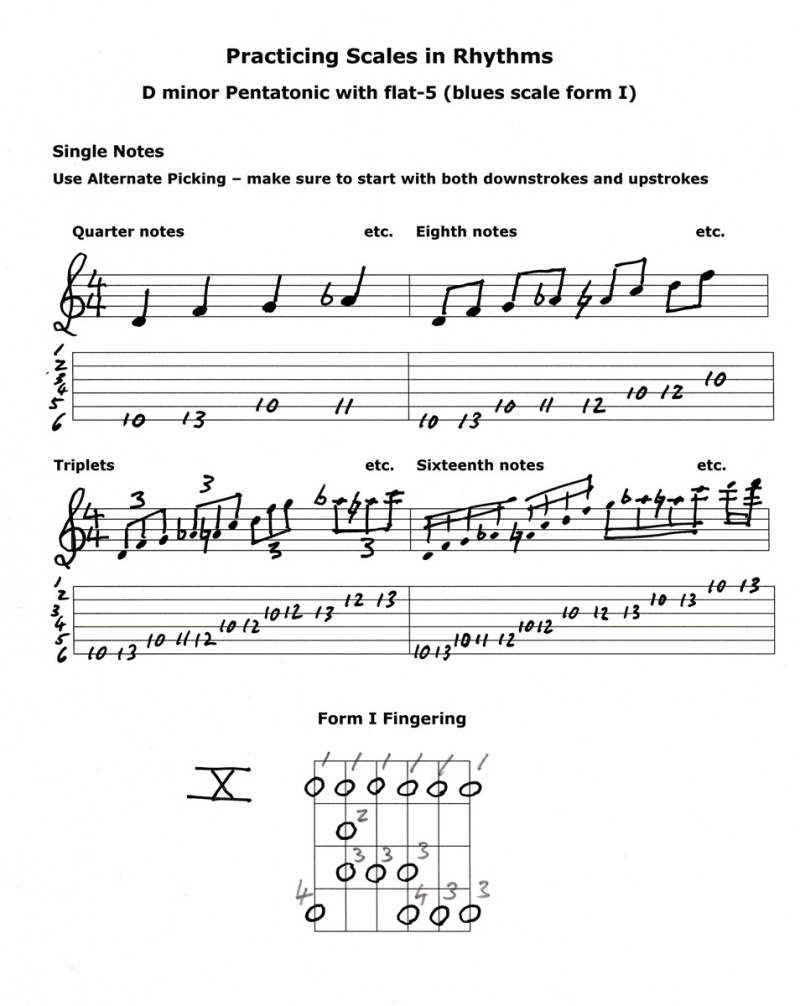
    I learned one of the most simple and popular approaches to practicing scales from my classical guitar teacher at Mannes College, Michael Newman. He introduced me to practicing scales in rhythms. Practice your scales as quarter notes, eighth notes, triplets, and sixteenth notes (below), using alternate picking. Make sure to start the scales both with an upstroke and a down-stroke. This exercise warms up your fingers faster than anything else I’ve found. Michael also suggested that I, “spend more time focusing on two or three scales per day.” The idea is to perfect the scales, not just run through them mindlessly. How musical do they sound? Where are the flaws? Do they flow? Of course, it can be fun and beneficial to run through numerous patterns in five or ten keys over the course of one session and I often do that.

    Scales in Rhythms_smaller

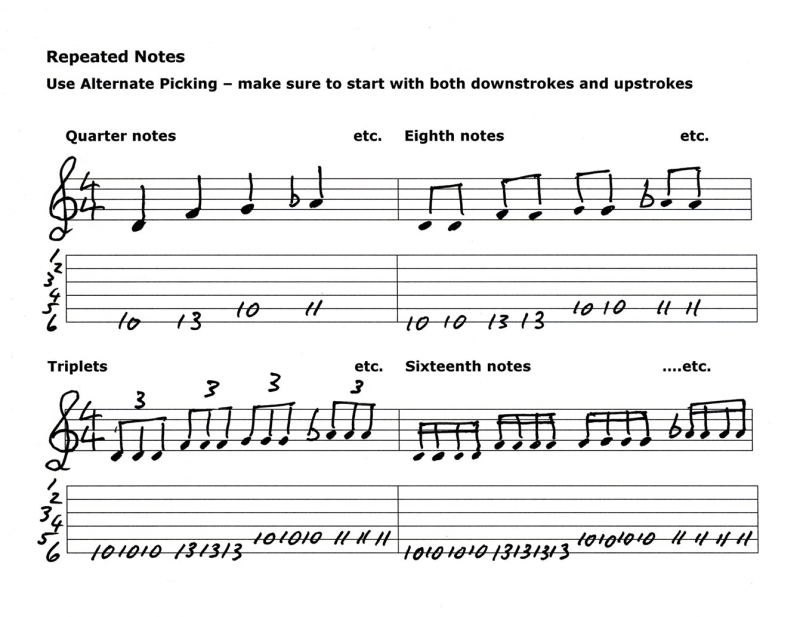
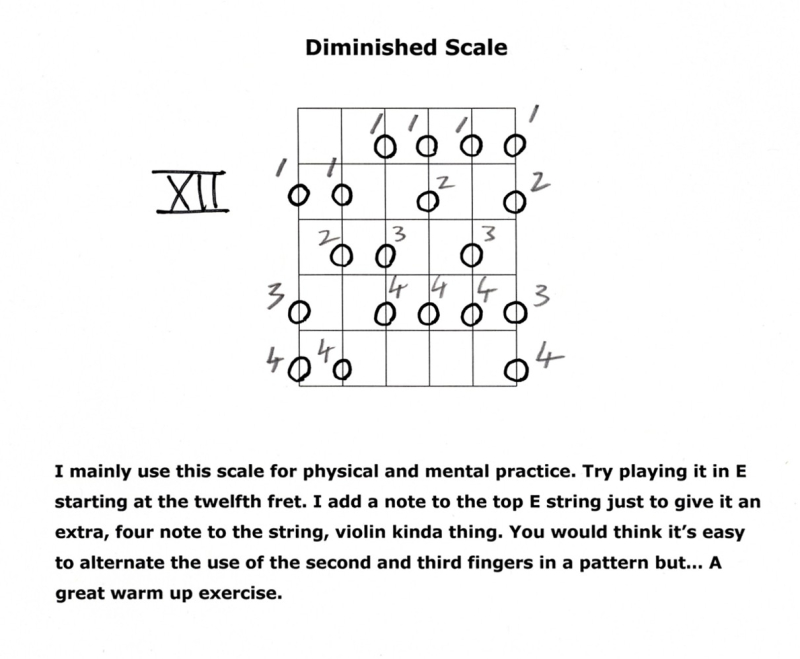
    Start slowly and build up to higher tempos. Make sure to play the rhythmic patterns as single and repeated notes (below). Because I’m mainly a blues player, I spend most of my time practicing pentatonic or blues scales. I use fingerings that will work when I’m improvising and using bent notes, vibrato, hammer-ons and pull-offs. As I go up the fretboard, I alter my fingerings to take advantage of the smaller space between the frets. Some patterns become more or less exercises in coordination because I may never really play a lick in that exact way, but I include a little abstract stuff in my routine because it’s fun! I’ve included one, a diminished scale, towards the end of this article.

    Repeated Notes_Smaller

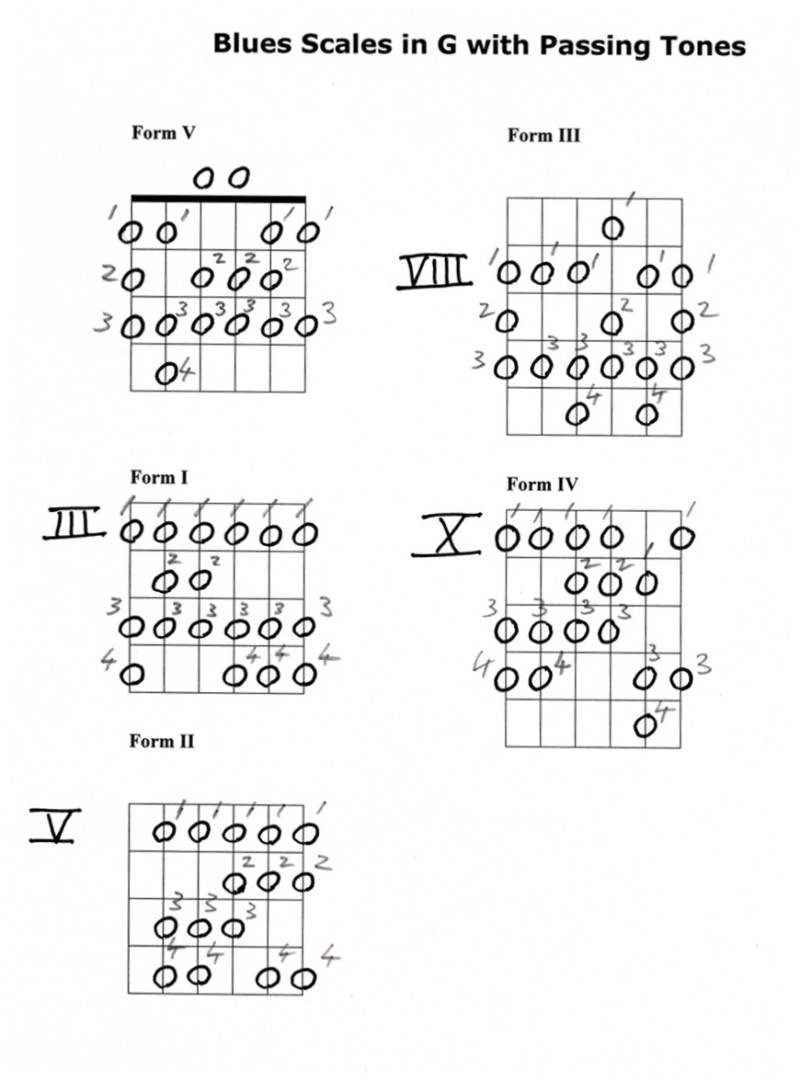
    It’s important to practice scales in different keys. I like to play in G so I’m including my basic routine for that key below. This may seem obvious but being that so much guitar music is in the keys of A and E, we all emphasize these keys. But if you never practice in F and then go to a gig and play a solo on “The Things I Used to Do,” by Guitar Slim, you’re almost certain to make a mistake at some point unless you’re playing it really safe. For this tune, D minor pentatonic (F major pent.) and F minor pentatonic are a must. You can find some useful major pentatonic scale patterns here.

    Blues Scales in G_Straight

    I find that playing scales up the neck from lowest to highest works well. Note the crazy open position variation of the Pentatonic Scale Form V above. Even if I rarely improvise in this position in this key, the use of open notes, the pinky and the uncommon pattern promotes coordination between the hands, which is super important. Should you use a metronome? It certainly can be fun but I wouldn’t do it all the time.

    Diminished Scale_Straight_Small

    Next time we’ll take a look at the what and when of practicing. In the meantime, please send in your ideas, comments and exercises. Keep on practicing, and have fun! -Christian Botta
  •  

    “He has the magic right hand!” So said a student of mine about David Bowie and his amazing twelve-string guitar playing. We all want freedom of expression on the guitar and no less with rhythm and strumming. You need to be able to play any rhythm at any time. But where to start?

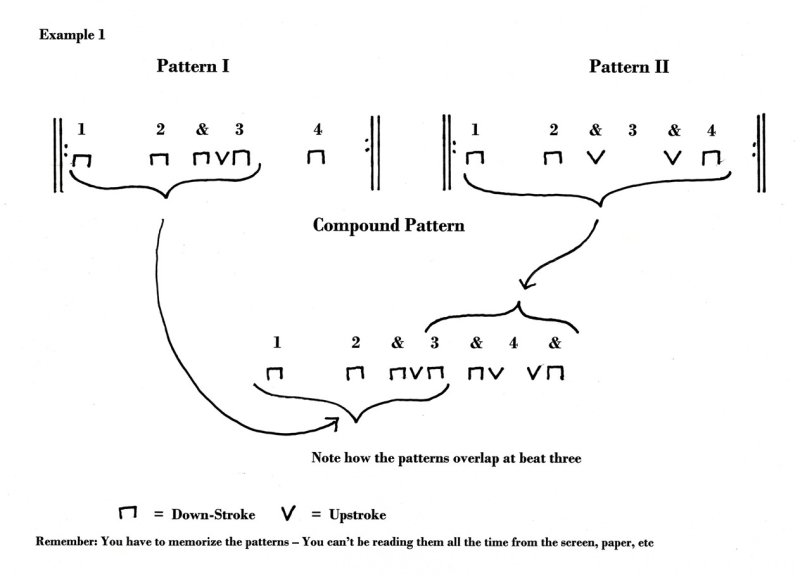
    The key to this freedom is to learn compound strumming patterns. This means that two patterns are pieced together to form a third pattern. You also need to be able to use one pattern in one measure, and a different pattern in the next and so on. We will make a one measure, compound strumming pattern out of two separate patterns, and then use it in the chord progression from Jimi Hendix’s “Hey Joe,” which includes both a simple and a compound pattern.

    Hey Joe Main Chart

    Let’s call the two source patterns I and II respectively. Take a look at Example I above, which shows how the two patterns combine to form a third, compound pattern. You may also want to take a look at my lessons, “Essential Strum Pattern in ‘Knockin’ On Heaven’s Door” and “Learn the Strumming Pattern for ‘Dead Flowers," which explain Patterns I and II in detail.

    As you may recall from the two earlier lessons, Pattern I is used in slow songs and allows more rhythmic activity, namely sixteenth notes. Pattern II generally goes faster and relies more on eighth notes. So, what we’ll do is shoehorn Pattern II in its entirety into the second half of Pattern I. When we drop Pattern II into the second half of Pattern I, the eighth notes of Pattern II become sixteenth notes.

    Look at the video and use your ears and eyes. But sooner than later, you have to memorize the patterns. In music, the ears are faster than the eyes, but the memory is the fastest of all. You should be comfortable with both patterns one and two before attempting the compound pattern. If you find it difficult to execute, go back to patterns one and two and practice them separately over one chord – use E for example. Then attempt the compound pattern again, repeating it over one chord. 

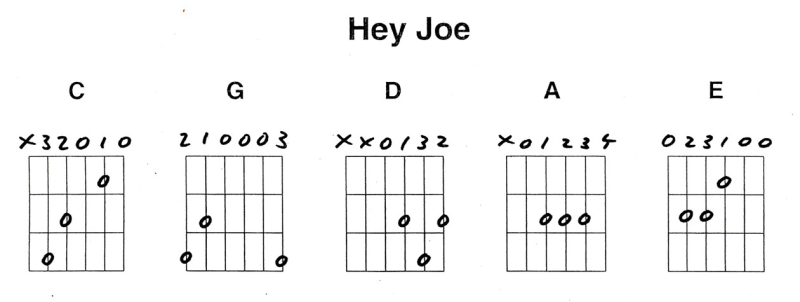
    When you listen to “Hey Joe,” it may be hard to hear the patterns under all the surface embellishments and fancy lead work. But if you were to play a rhythm guitar part consisting of these patterns (behind the right chords, see below), it would fit perfectly underneath someone else playing the leads, licks, accents, singing, etc. More specifically, Pattern II in the compound pattern supports the main guitar fills or hooks that punctuate many of the lines.

    Hey Joe Chords_resize

    Hey Joe Strumming_resize

    The chart above shows how the chords and strumming are aligned. Note how Pattern I is used on the first two measures, and the compound pattern is used on the last two measures. It's a blues/gospel influenced form: the singing takes place in the first half, and the response, aka the guitar leads, takes place in the second half, over the compound pattern.  

    The “accuracy at any speed or rhythm rule.”

    If you still have trouble with the compound pattern, try playing it very slowly, making sure that you’re completely accurate with the series of down and upstrokes. Because the down-strokes and upstrokes naturally sound different (the down-stroke is a little more forceful, more full and the upstroke a little lighter and thinner), even if your rhythm is a little off, if you go slowly enough, and you’re perfectly accurate, the inherent rhythm of the pattern will emerge. Then try speeding it up and you’ll probably find that it takes off.

    Make sure that you keep your right hand moving all the time. Sometimes it can be good to take a look in a mirror, not necessarily a roomful of mirrors, but a well-placed full-size mirror, and watch what your right hand is doing. It shouldn’t be hanging around in the ‘down’ position too much, but floating, jiving, boogying up and down. Always moving, a bit like Marc Bolan at a party in the ‘70s. That's the idea – be free – have fun with it! -Christian Botta