I grew up a huge Johnny Winter fan, and as luck would have it, I got to see Muddy Waters perform in 1977 during his Hard Again tour. One of my biggest memories from that show at the Palladium in New York was Muddy sitting on a stool, playing a ferocious slide solo. He was getting so into it that James Cotton, who was sitting next to him, reached over and kicked him in the leg as if to say, “Calm down, Bro!”
So, I guess it makes sense that “I Can’t Be Satisfied” would end up being the first number in open tuning that I would figure out. In another important first, it was Muddy’s first hit in Chicago (recorded 1948), and it helped to get his career started. The song offers a complete, structured, and totally catchy tune to help you explore some important areas around the fretboard. There are easier tunes to begin with, such as “No Expectations,” (Open E) by the Stones, or “In My Time of Dying,” (opening sequence, Open G) by Led Zeppelin. But if you are an advanced beginner at slide and up for a challenge, it’s right here.
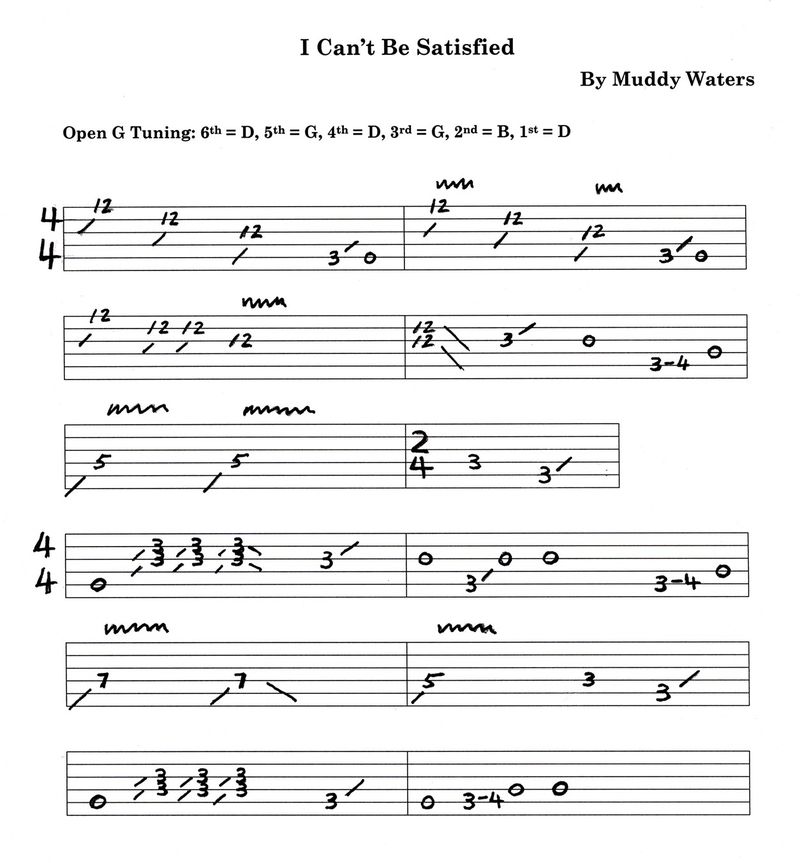
Regarding the tab, the small lines that sometimes proceed and follow a note indicate either an upwards or downwards slide. The squiggly lines above the staff represent vibrato. Most of the slides are of an indeterminate amount, a quarter step, slightly less than a half step, etc., except where there is a standard 3 – 4 notation, for example. You have to listen carefully. Part of the beauty of the style is that it’s so expressive and open to interpretation.
Measure number six is in two-four time, i.e. there are only two beats. This makes the piece an eleven and a half bar blues. It shouldn’t be difficult to follow because it sounds so natural. Notice the slap bass part, played by Ernest "Big" Crawford. It’s quite busy, with an eighth note feel against the quarter notes of the guitar, and it really drives the song. I often feel that I’m hearing a high-hat in there!
I played the short example (one chorus – Muddy plays the same part all the way through the song) using my right hand fingers. It’s totally possible to play it with a pick, although the use of the right hand fingers allows for better muting. Many people talk about Muddy’s wild vibrato, and I approximated it on the long notes that stand for the IV and V chords, but much less unhinged.
Some important points to remember: Keep your left hand fingers behind the slide touching but not pressing on the strings, to reduce noise. Aim the slide right above the fret of a note to get that exact pitch, i.e. directly above the 5th fret on the D string for the note G. Finally, the slide that I’m using is a Dunlop #218 glass slide. I love it!


 On Practicing Guitar
Leave a reply to On Practicing Guitar Cancel reply