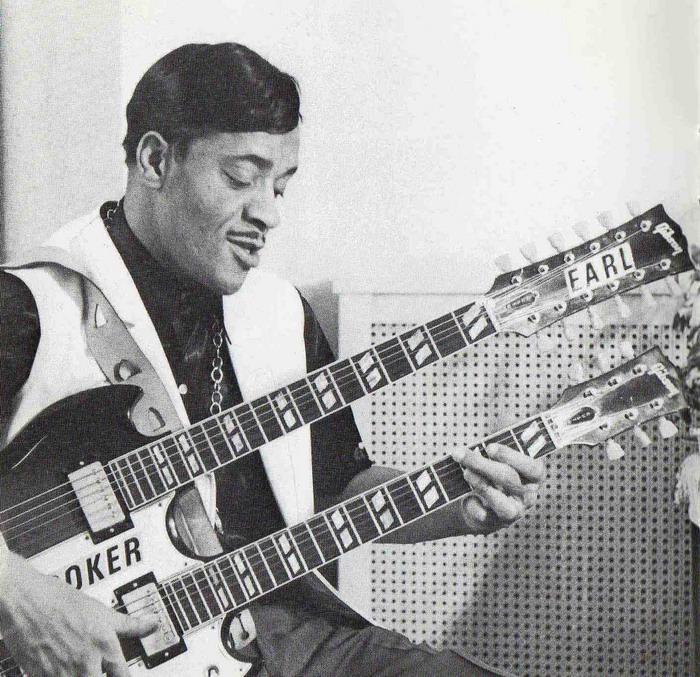
The jury may have finished with Jimmy Page for the moment, but the Zepmeister must certainly enjoy a chuckle from time to time knowing that one of his greatest sources may never be revealed: Earl Hooker. That’s right – the music for the track “You Need Love,” by Muddy Waters was not actually written by Willie Dixon, but was written and performed by Earl Hooker. So, Earl Hooker turns out to be one of the main architects of “Whole Lotta Love.”
I had long heard about Hooker’s slide guitar prowess and his deep bag of tricks. I found an interesting collection at the library, the Chief/Ace Story that includes some EH tracks. The tune that really caught my attention was the weeper (literally) by Lillian Offitt, “Will My Man Be Home Tonight.” It was recorded in 1959 when Hooker was thirty years old. I decided to learn the slide part which is greasy, difficult and sly as the devil, comprising fills throughout, a big twelve bar solo and even a wickedly weeping descending lick over the ending.
I admit however that I am not literally copying Earl’s style. Hooker mixed straight (fingered) guitar licks into his slide excursions and this piece is no exception. He also played in standard tuning. This song is in the key of D, one of my favorite open tunings, so I decided to just play it that way (D – A – D – F# – A – D), fully with the slide. I hope to incorporate some of the ideas into my own open D slide work. It's probable that Hooker placed the slide on his pinky, but I can't confirm that.
There are some interesting aspects of this tune beyond the solo. The interplay between the piano and guitar is almost telepathic, and Hooker’s use of dynamics is highly sophisticated. Then there’s the sound of Lillian Offitt crying throughout the solo. At first I thought, “Is she laughing?” Obviously not but there’s a sense of irony to the playing that takes this blues to another level. The guitar and piano are so slick and the rhythm section perfectly restrained. Makes you wonder a little bit, “Whose side are they on?”
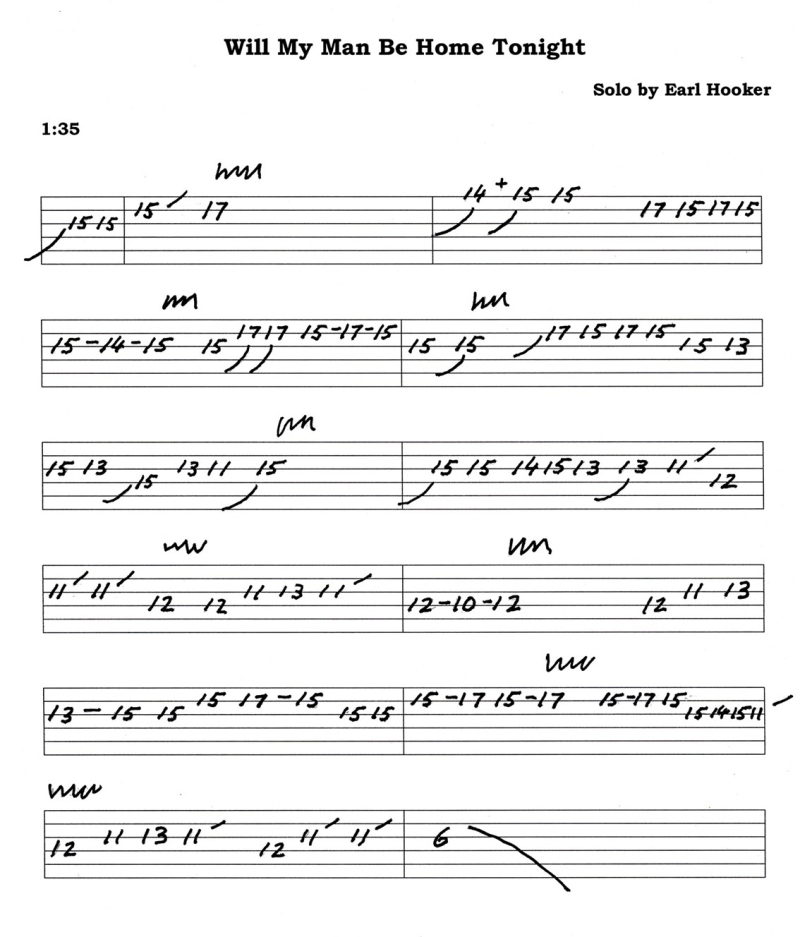
Check out the tab and video. The hardest part of the solo is the extended single note run that goes from the second half of measure four to measure five. I figure that Hooker played all but the last note with his fingers, and I’ve tried it, but it doesn’t make it that much easier, especially in terms of duplicating the sound. I had to play this run a million times and many of the licks in the solo had to be broken down and practiced as three or four note fragments. Another point of interest is that Earl stays in a pretty minor mode. He never quite reaches up to a full major third. Perhaps that’s another layer of emotional commentary. In terms of right hand technique, I find I prefer the sound of my index finger and I use it for a lot of the notes.
For the video, I used my ’76 hardtail Strat through an MXR Dyna-Comp and a Fender Pro Junior. A little noisy, but I feel that I got some of Earl’s smooth, glassy sound along with an element of attack that was missing from my attempts with a Marshall. I used a Dunlop #218 glass slide.
Earl Hooker’s achievements tend to fall somewhat below the radar of all but die hard blues fans and musicians. But an invaluable source did come into my possession during the time that I was researching this article and digging Earl in general. It’s a book by Sebastian Danchin, a noted blues and jazz scholar, writer and radio programmer, entitled, Earl Hooker: Blues Master (1998). It’s a detailed, well-researched and spirited work that will help anyone who is interested in finding out more about Earl Hooker and the 1950s and ‘60s blues scene in general. -Chris Botta


 On Practicing Guitar
Leave a reply to On Practicing Guitar Cancel reply