• Wild Horse Tavern8 (640x640)

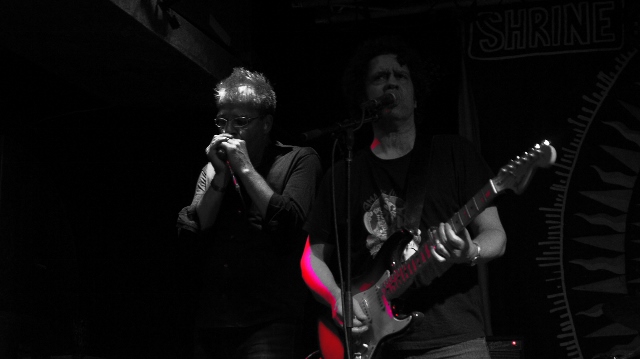
    We finally made our debut at the Wild Horse Tavern this past Sunday, July 19th on the Upper East Side and it was worth the wait. An earlier show had been cancelled but this one more than made up for it. The Wild Horse is a sleek bar/restaurant that seems to be new or at least has been extensively renovated. There is a small stage in the back and it’s obvious that the owners love music, especially classic rock, because of the enlarged and perfectly lit photos of the Stones, Janis, Bob Dylan and George Harrison, et al.

    An expert sound man was engaged for the night, and he provided a mix that worked well for both the performers and the audience. Amps were angled in towards the stage to act more as monitors and to keep the sound level down in the room. The result was a highly rocking stage sound that I imagine was comfortable in the relatively small room and not too difficult for the neighbors. I know that the band was totally jazzed by it and the audience's response seemed to confirm that.

    We performed as a trio with myself on guitar and vocals, Dave Gerstein on bass and Chris Trotta on drums. Here is the set list:

    She’s Telling Me Off – original

    Drunk Dialer – original

    Lonely Girl – original

    Crossroads – Robert Johnson via Clapton/Cream

    Sad to Be Lonesome – Sonny Boy Williamson

    Malted Milk – Robert Johnson arranged by Chris Botta

    Just Ain’t Right – original

    Hey Joe – Jimi Hendrix

    There was an appreciative crowd and a couple of groups and solo artists played before and after us, mainly acoustic driven sounds. This is a really hip spot and we’ll be returning on Sunday August 9 at 8:45. Thanks to Sid Moskowitz for bringing us in here and for providing the terrific Roland Blues Cube amp – made me realize how much I miss my echo effects! Also thanks to Melissa Hazim and Michael “Max” Schrader for providing the photos and cozy spirit.

  • Chis Squire

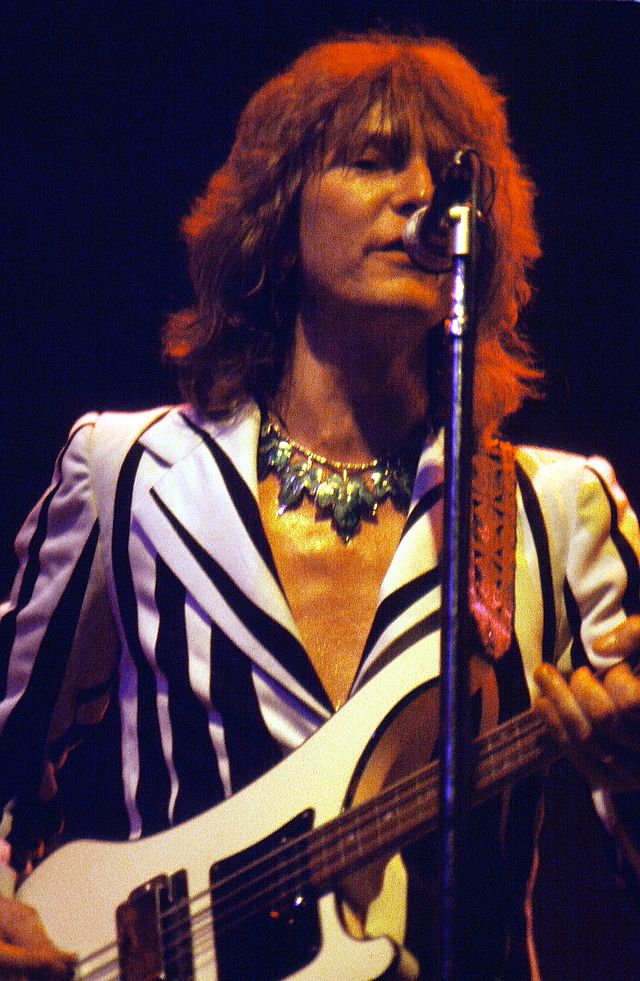
    Chris Squire passed away on June 27th, 2015 in Phoenix, Arizona at the age of 67, as reported in theguardian and other publications. Squire was among a small group of dominant bass players that came out of the ‘60s rock music scene. The four top bassists – to my ears and in no particular order – are Jack Casady of the Jefferson Airplane, John Entwistle of the Who, Squire, and Jack Bruce of Cream. With Squire’s passing, only Casady remains.

    From the first notes of “Beyond and Before,” a repeated and resounding D4 played way up at the 19th fret of Chris Squire’s bass, from Yes’s eponymous first album, the rock world of 1969 should have known – a star was born. It took Yes several more LPs to gain traction on the charts and in the concert halls, but the counterpoint was there from the beginning, with Squire and Jon Anderson respectively holding down the lower and the upper voices of what would become an epic progressive rock sound. A perfect example of this highly original approach can be found on the verses of “No Opportunity Necessary, No Experienced Needed,” the first track on Time and a Word, their ambitious sophomore effort.

    When I saw Yes live at Madison Square Garden in 1977, the two band members that stood out most for me were Squire and Rick Wakeman. Yes was a band that featured only top flight players. Yet it’s a difficult fact of music performance that sometimes even superstars such as the extraordinary guitarist Steve Howe can be overshadowed. Squire was attired in the jagged, graphic suit that you see above, and his rocking stage presence seeming to resonate into infinity.

    Wakeman, on the other hand, melted into his keyboards while attired in a sparkling cape with his long blond hair hanging over his face, absolutely killing the Hammond solo on Close To The Edge. Donovan opened the show but was sadly heckled. I remember a fan of his, who makes me smile to this day because he sported a T-Shirt that said on the back, “Nostalgia Now.” Although the crowd may not have made the connection back to Donovan’s heyday, it was a vertiginous, psychedelic concert. The last thing I remember was the entire building shaking as Yes played “Starship Trooper.”

    I’ve been thinking about Chris Squire a lot recently, although I have never stopped listening to Yes, especially the first five or six albums, with a more recent emphasis on the first two. But I was shocked to hear that he had passed away. For those who would like to glimpse another side of him, I suggest that you listen to an interview he gave regarding the first time that he saw Jimi Hendrix perform in London, when Squire’s band, The Syn opened up for The Experience. He was a good storyteller with a sense of humor, in addition to being a great musician. 

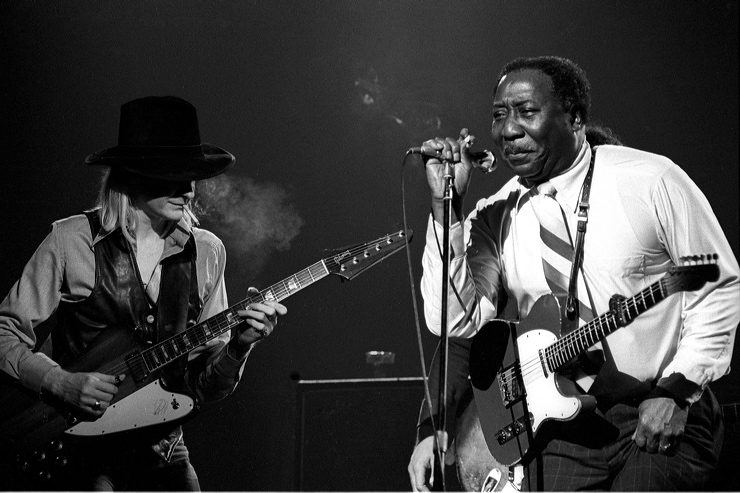
  • Muddy-waters-johnny-winter

    I’ve been planning a trip to Memphis recently and in my research I ran across an interesting New York Times article called, “Driving the Blues Trail – In Search of a Lost Muse,” by Rick Bragg. At the end of the article, the author includes a list of blues records that have been honored by inclusion in the Blues Hall of Fame by The Blues Foundation. Their choices inspired me to put together this list.  

    This is not the definitive ten blues albums by any means, but ten that I feel are absolutely essential for any lover or student of the blues to hear. Each of them has touched my life as a musician in some way. There are obviously many more, some of which are included on the Blues Foundation’s list. Most of my choices I’ve owned for years on CD, and some I have on LP. However you find them, every track is worth listening to. But if you must cherry pick on iTunes or whatever, not to worry – a cut or two from each would make an incredible play list.

    I’ll follow up with a list of more essential blues albums at some point in the future, if I ever get out of these blues alive. In no particular order…

    Elmore James, The Sky Is Crying – The History of Elmore James, Rhino

    I’ve been listening to this one a lot lately, and I learned one of my first slide tunes from here, “Shake Your Money Maker.” Influential? I play much of my slide in open D – the key of ‘Money Maker.’ It’s like, ‘OK, whatever you say.’ The liner notes are amazing, too. Elmore James is name-checked by The Beatles and he was an influence on Jimi Hendrix, as well. He was one of the first guitarists to exploit the electric guitar as a sound source. The record features appearances by Sonny Boy Williamson and Eddie Taylor, and a woman screaming in the background as the solo begins on a single recorded live, “Cry For Me Baby.”

    Sonny Boy WilliamsonHis Best, MCA/Chess

    Little WalterHis Best, MCA/Chess

    Although these collections feature two of the greatest blues singer/harmonica players and a wealth of classic blues songs, a bonus is the extraordinary guitar playing, with Robert Nighthawk and Luther Tucker (both records), and Louis and Dave Myers (Little Walter) leading the way. It almost makes me drool thinking of hearing them play with an old Gibson or Fender amp in a dangerous club somewhere on the outskirts of town…

    Howlin’ WolfThe Definitive Collection, Geffen/Chess

    There are numerous collections that comprise the Wolf’s central material, but this album sounds terrific and includes most of his best tunes. Another CD or so will be necessary to get all of his best work, but this is a great place to start.

    Jimmy ReedThe Best of the Vee-Jay Years, Vee-Jay/Shout

    An excellent and brash sounding collection. Includes his awesome, first single, “High and Lonesome,” which is often and strangely absent from a lot of compilations. Jimmy Reed is the  master of the blues hit and a prime employer of guitarists – his band and recordings often include three – can you make them out?

    Robert JohnsonThe Complete Recordings, Columbia

    When I was learning to play blues and rock and roll in my early teens, I read an interview in Guitar Player Magazine with Johnny Winter, one of my biggest influences and one of the greatest modern blues artists, where he said, “If you want to play rock and roll, you’ve got to listen to Robert Johnson, B.B. King and Jimi Hendrix." I ordered a Robert Johnson LP, which I still have from my local record store, and I eventually took possession of it and listened as best I could. But I didn’t get what Johnny was talking about. In more recent years, I’ve come to understand what he was saying, and then some.

    I often think that it’s one of music’s major miracles that Johnson managed to record this group of songs, when he could so easily have missed the opportunity due to the obscure nature of his lifestyle or just simple fate – he didn’t last much longer after cutting the sides. A number of these songs are in the repertoire of my band, most notably “Stop Breaking Down” and “Malted Milk,” a cover that I’m particularly proud of.  

    I was once hanging out with one of my students when a friend of his contradicted me by saying that Johnson’s playing – we’re talking recreating the tunes on acoustic guitar – wasn’t that hard. I have to say, I have never heard anyone sound anything like Robert Johnson. It is a simultaneously ferocious and deadly accurate axe that he wields. And his singing? Phenomenal.
    Missississippi John Hurt

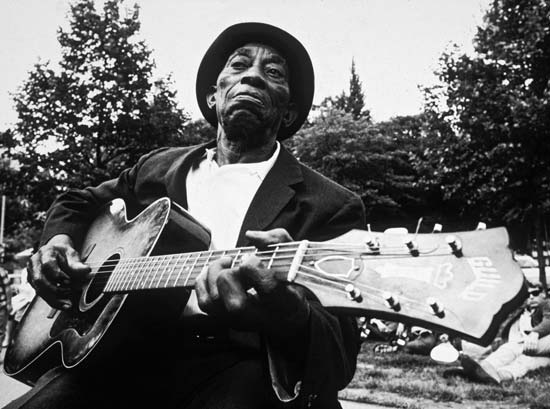
    Mississippi John HurtAvalon Blues: The Complete 1928 Okeh Recordings, Columbia/Legacy

    This is one of my personal favorite artists, and I learned many of his tunes off an album from his revival period, Mississippi John Hurt Today, on Vangaurd. I only got this record a few years ago, and I couldn’t believe I had never seen it. Another total miracle, and beautifully recorded. In 1928, John Hurt traveled to New York City and recorded this album for Okeh. He was homesick and skeptical of the big city, but he made a super record of his inimitable double thumbing, Travis Picking before anyone called it that, country blues stylings, with lyrics about sex, death, violence and God, all sung in a gentle and knowing voice that is a true one of a kind. He’s got some chops on guitar, too – no kidding!

    B.B. KingCompletely Well, MCA and Singin’ The Blues, Ace/Crown

    The King of the Blues has so many records, it’s impossible to pick one. Most people cite Live at the Regal as a definitive B.B. King record. But it has never really touched my soul. On the other hand, when I first heard “The Thrill Is Gone” off of Completely Well, I immediately figured it out and started playing it with my band. This was at age sixteen. Much later a student of mine turned me onto the original recording of “Sweet Little Angel” that’s included on Singin’ The Blues. He had found it on a Mojo Magazine CD, The Origins of Eric Clapton or something like that. I started playing that song with my band and taught the fills and solo to anyone who would listen. The production on Completely Well is beautiful, and it includes the great studio ace Hugh McCracken on second guitar. Singin’ the Blues has kickin’ horn arrangements, fierce leads, and that awesome ‘50s atmosphere but in a way that is just not quite like anyone else.

    Muddy WatersThe Best of Muddy Waters, Chess/MCA

    Little explanation needed here. This gem covers the period from 1948 to 1954, when Muddy Waters could basically kick anyone’s ass that had the nerve to try. One of my favorite scenes in the awesome Chess Records biopic, Cadillac Records is when they show, numerous times, Muddy packing up his guitar case for a gig. He puts in the picks, he puts in the guitar, he puts in the gun… Twelve tunes, every one of them great. The circa '80s vinyl pressing sounds amazing.

    Blind Willie McTellThe Best of Blind Willie McTell, Yazoo

    I bought this album many years ago on LP and I recently replaced the destroyed vinyl with a nice new Yazoo CD. It’s exactly the same. Bob Dylan supposedly once called McTell one of the greatest blues singers. It’s not hard to understand, as his tenor voice is incredibly expressive yet so easy to listen to. His original version of “Statesboro Blues” provides a textbook example of how to revamp a song, ie when you listen to Taj Mahal and of course the Allmans, you can see how easy it is to ride on the coattails of a genius, if you get it just right. He plays a wicked twelve-string guitar and in his own words, he “drinks so much whiskey, he staggers in his sleep.” If I had a time machine, one of my first stops would be a street corner in Atlanta, circa 1927. 
  • Desmond's Tavern

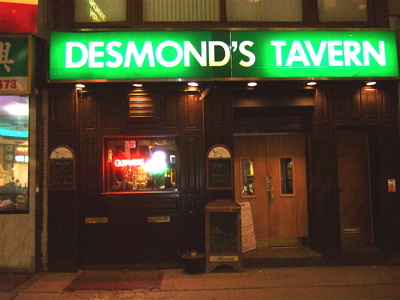
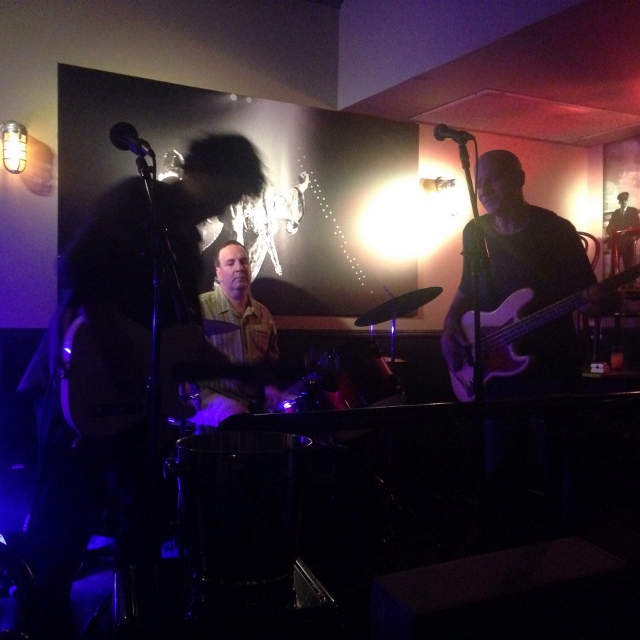
    The Anodyne Blues Band will be playing at Desmond’s Tavern on Saturday, June 27 at 8pm. There are three bands after us – Bugs and Crumbs, Badavacado and the Paul Anthony Band – and it costs $8 at the door. Desmond’s is a classic dive – the first time we played there was during a deep winter freeze over five years ago. A pipe in the ceiling froze and water was dripping down but the place was packed and it was an awesome show.

    More recently, we played there this past January and it was another rockin’ night. I could feel the bass and the kick drum resonating through the cheap wooden stage as I was playing and it was an exciting sound – major vibes!

    But maybe the coolest thing about Desmond’s is the unlikely location – 433 Park Avenue South, just south of 30th Street, practically in the shadow of the Empire State Building. It attracts a diverse and unpretentious crowd of night-crawlers and other New York City people that are in the mood to party. Come for the music and stay all night for the good times. We hope to see you there!

  • My first guitar teacher was a really young guy, but he showed me the basics, and he may have inadvertently got me on the path to the blues. It was the early 70s and he wore his hair like Noel Redding. I only remember a few other things about him and the lessons that I took at Crest Music Center on Metropolitan Avenue in Forest Hills, Queens, but all of the memories are good. 

    We were working from Alfred’s Basic Guitar Volume I, a great book. Whenever he (I wish I could remember his name) would demonstrate one of the little tunes for me, at the end of the song proper, he would race up the neck of his guitar, a Favilla classical, and play a wailing blues or rock lick. I remember saying once, “I want to play that!” Maybe he thought I wasn’t listening. But I made my way through the entire book and still own it, with his check marks and the dates on all of the pieces.

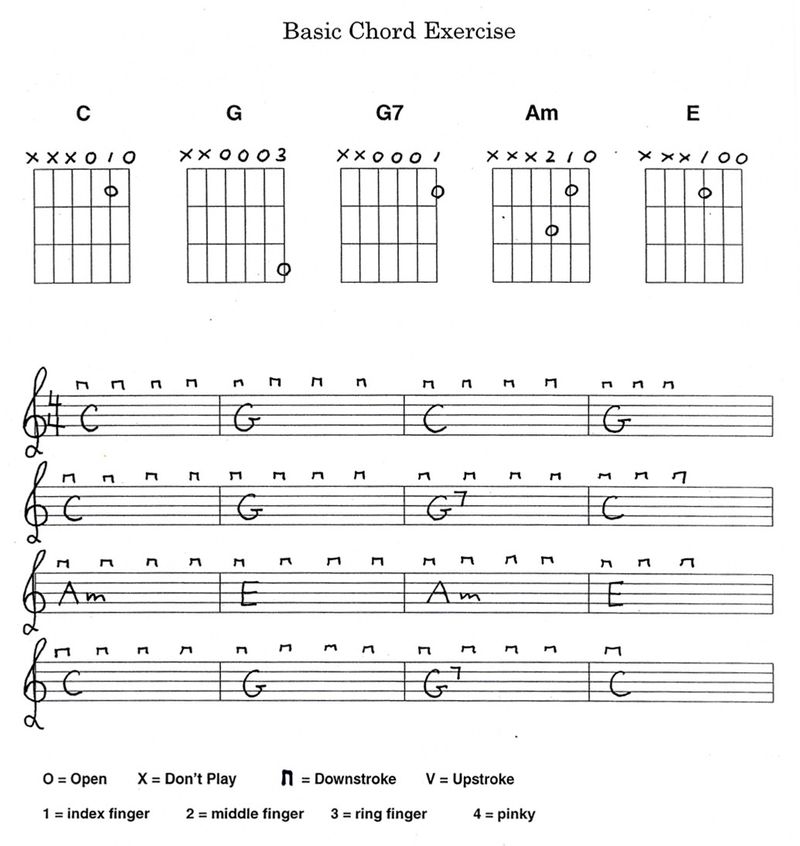
    Perhaps because I said that I wanted to do more, he gave me a simple chord piece, the second line of the exercise below. It was no harder than the chord melody arrangements in Alfred’s, but there was an element of independence to playing something outside of the book.  I liked it. It was more adult to me, just strumming chords, and using chord symbols.

    Years later, I expanded it to four phrases. It’s a little more difficult, with the two-fingered A minor chord in line three, and it has more of a place to go. Most adult beginners can play it after a few hours or less. Try to play slowly enough to where you can make the chord changes without interrupting the rhythm. Also, make sure to observe the rests at the end of each line. Don’t play on those beats. This lets the music breath, and gives the fingers and eyes a chance to rest. For an explanation of chord charts, see my Anatomy of a Chord Chart handout. 

    Basic Chord Exercise

  • Hey Joe Picture Sleeve

    Second Half and Climax

    Phrase Four begins the second half of the solo, and this is where it really takes off (See Part I of the Hey Joe Solo Analysis below for the tab). The opening fragment from Phrases One and Two returns, but this time it’s expanded by a double pump on the whole-step bend with vibrato, and the second bend has a more intense, ‘Hendrixian’ feeling to it. Again we have three parts, with the middle one echoing the middle of Phrase Two, but again it’s expanded. The first three notes can form a repeated lick that Jimi (and many others) often used, but the last two notes confound expectations and demonstrate how Jimi would rarely succumb to cliché during this period of his career. Part three of the phrase is one of the most affecting melodic fragments of the solo, a short, four note phrase that outlines an implied minor seventh chord. It is melodic, harmonic and eerie, all at the same time. This figure echoes the second part of Phrase Three, our ‘second theme,’ again rising up from the lowest note of the solo, B, the dominant.

    Phrase Five is the climax of the solo. The opening figure of Phrase One is composed out, with the whole-step bend moving to the G string. This is followed by a broken double-stop, again ala Chuck Berry, that is followed by half-step bend up to G# that falls to the tonic, E. This five note figure outlines an E major triad, E – G# – B, and encapsulates the essential tonal material of the solo, from the low B of the ‘second theme’ through the many tonic Es to the highest note, G#. The full range of the solo is an octave and a major sixth. This is pretty wide for a twenty second break in a three minute ‘pop’ song, but the tight construction, repetition, and meticulous development of the ideas prevents the solo from seeming florid or indulgent.

    Phrase Five can again be broken into three distinct parts, but perhaps because the solo is beginning to wind down, the last two parts can be seen as connected. The middle part again echoes the middle of Phrases Two and by extension, Four. Again it is expanded, with a whole-step bend that forms an incomplete dominant triad or minor seventh chord. The last note, a whole-step bend from A to B, is played staccato, adding rhythmic color and variety to an otherwise legato outing. The final, short fragment emphasizes the minor third from G to E that we’ve been hearing all along, this time ending on a concluding tonic.

    Phrase Six brilliantly plays on and expands the ‘second theme,’ this time adding a taste of the parallel major key (E major), with the notes C# and F# added to the mix. But before a true major pentatonic scale can be realized, which might give the listener a sense of hope for our protagonist, the phrase peaks on a double-stop, G – B, forming a half-diminished seventh chord that adds to the spooky quality of the solo and keeps with the downbeat emotional tone of the song as a whole. Interestingly, this is the only part of the solo that goes outside of the twelfth position E minor pentatonic form, known as Form I. It’s as if Joe is making an attempt to break out of his predicament, with little success. It foreshadows the probability that he’s not going to make it down to Mexico, after all.

    Is it planning, instinct, or simply listening to and learning from the masters before him? Probably all three. But it is essential when learning solos like this to break them down and practice the licks from the inside out, to both hone the techniques involved and to get a sense of the structure that underlies the music. Did Jimi record the solo on Noel Redding’s telecaster as some allege? It’s difficult to tell, but maybe there’s a reason why I play so many blues solos on my Kelly Tele, using the front pickup with the volume and tone turned full up. 


  • My band the Anodyne Blues band will be appearing on Sunday May 31st at 8:30 PM at the Wild Horse Tavern located at 1629 Second Avenue in Manhattan. Please join us if you can!

    Chris and Xtof1 (640x359)

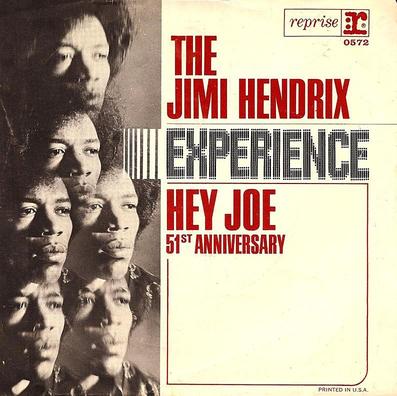
  • The solo that Jimi Hendrix laid down for his debut single “Hey Joe” in November of 1966 is one of his most straightforward and accessible efforts. I’ve taught it to many of my students, yet each time I return to it, I hear something new. The solo comprises a substantial number of tasty licks that employ many of the basic blues and rock techniques like bending, pull-offs, double-stops, sliding and vibrato, and it therefore makes a great study or ‘etude’ for the budding rock or blues soloist. But underneath the surface lies something more – a strong sense of composition and an almost classical structure that never cease to amaze me. Let’s take a look at this compact gem to see what it reveals to us about Jimi’s improvisational/compositional genius.

    Six Distinct Phrases

    The solo can be broken down into six distinct phrases (see transcription below), which in turn can also be broken into smaller melodic fragments (designated by phrase marks). Phrase One starts with a whole-step bend with a smooth, fairly wide vibrato on the target note, E, which is repeated on the string above before the melodic fragment falls through the pentatonic minor scale to the note B. This fragment begins three of the phrases, and gives the solo a feeling of a mini, “theme and variations,” if you will. Phrase One finishes with the classic, bend-release-pull-off figure, the same lick that opens Jimmy Page’s “Heartbreaker” solo, but not before we are treated to a nice melodic change of direction that ends with an upward minor third beginning on the tonic. The total range of the phrase is one octave.

    Phrase Two begins with the same four note figure. Phrase Two can be broken down into three parts, with the middle lick another whole-step bend, but this time to the dominant, B. Again, the target note of the bend is followed by the same note on the string above. This lick is the same as the repeated figure that runs over the middle section of the intro to Johnny B. Goode. This fragment ends abruptly, however, with a nice finger vibrato on A, and then continues to descend through the third fragment, with a slide up and down with the first finger that is characteristic of Hendrix. Finally, Phrase Two comes to a close on the tonic, E, which creates a ‘question and answer’ relationship between it and Phrase One. The way the first two phrases begin the same but end differently keeps our attention, yet we never feel lost or that the solo is meandering.

    Phrase Three, with two melodic fragments, would seemingly be a bit of punctuation or emphasis, or a bridge to the next section. The first one is a three note, rhythmical figure from G to E and back again, followed by a longer fragment that begins below from B and then reverses the order, E to G and back to E. Another albeit brief question and answer, yes. But Phrase Three/Fragment Two also introduces what I like to think of as the ‘second theme,’ (the first theme being the opening bend and descent from E to B) which we will see more of later. Jimi’s development of this and the opening idea are what makes the solo so logical, grounded, and balanced.  

    Hey Joe Solo Tab Blog Post