• Daniel Donato

    July 31 – Sometimes, you just get lucky. On our final night in Nashville, and the last night of our trip during which we would really hang out, we walked down to the ‘Honky Tonk’ area of the city, the downtown area situated on Broadway near the Cumberland River. It seems there are a thousand clubs, with a cowboy boot place for every second music joint. Music is blasting from every angle – you can see many of the bands performing through the windows and it is LOUD! There are additional musicians playing on the street, too.

    After twenty minutes or so of just walking through the throngs of tourists and locals, too – this was Friday night, after all – I spotted a place that looked good. There seemed to be a little room inside, they served food, and there was a band kicking some major booty right there on the stage. Turns out it was Robert’s Western World, one of the places on my list that I had more or less forgotten about. It was a disorganized night, the kind of night that turns up after you’ve been traveling for a little while.


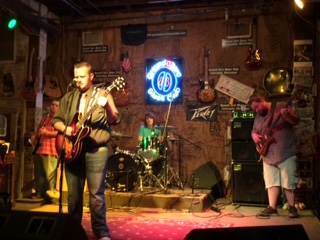
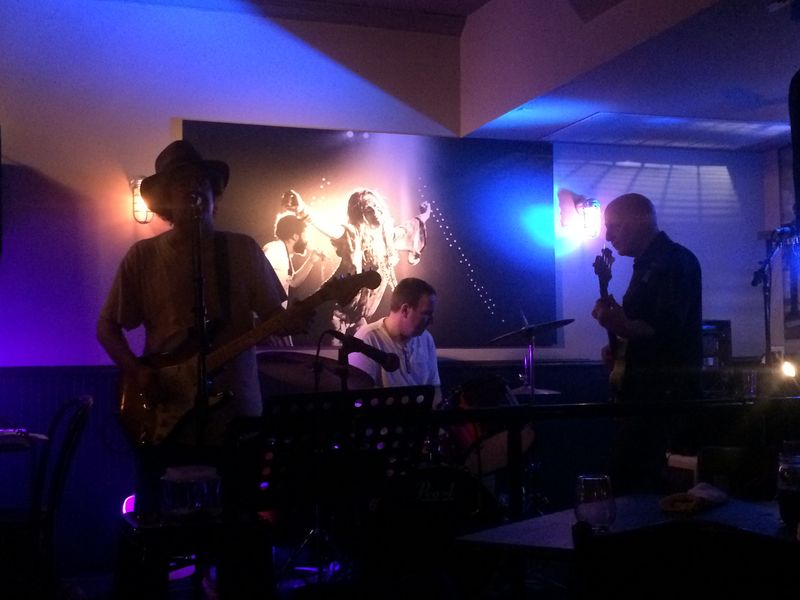
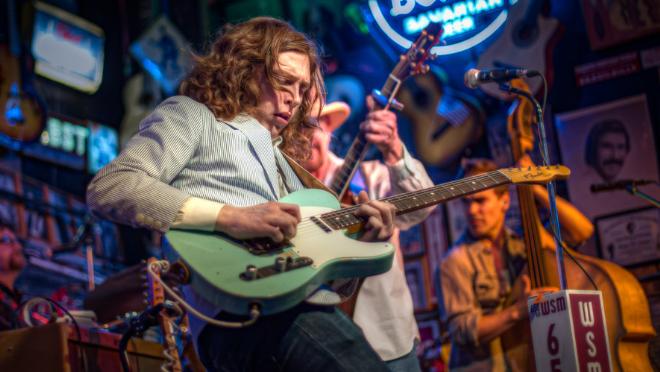
    We climbed to the second floor bar in the back, ordered some burgers and beers and set to watching the band. Before too long, I noticed this tall, slim kid – he looked a little like a young Jimmy Page – playing the heck out of a Telecaster. He had distinct star power, and the kind of chops that make you immediately forget about the old guitarist defensiveness – the “I could do that” reaction. Turns out it was the Don Kelley Band with Daniel Donato on lead guitar. It was around the point where Don said, “Let’s hear it for Danny – he’s only nineteen years old,” that I realized that we had stumbled onto someone special without even trying.

    There aren’t too many superlatives necessary for describing Daniel Donato’s playing. We’ve all heard of the many wunderkind who can play Bach’s Chaconne standing on their head on YouTube. Donato does it in a crowded bar night after night. The bands turn over the stage every two hours or so, and the music is flowing from noon until after midnight. But it was obvious when the next band took the stage that the energy level had peaked for that night. Donato probably went to play somewhere else.

    When I checked him out on the internet, I found a brilliant student of the guitar, as well as a budding teacher, and a very intelligent young man. I have already learned something from him as he mentioned in one interview how the high edges of the Tele bridge make palm muting a little difficult, so he uses a replacement model there – aha! I always wondered why I had to choke up so much on the palm muting…

    I look forward to the day when Donato takes the national stage. It would be great to hear him rock Madison Square Garden with one of his solos or show the lip-synchers on the Grammys how it’s really done. 
  • Cumberland Collective Best

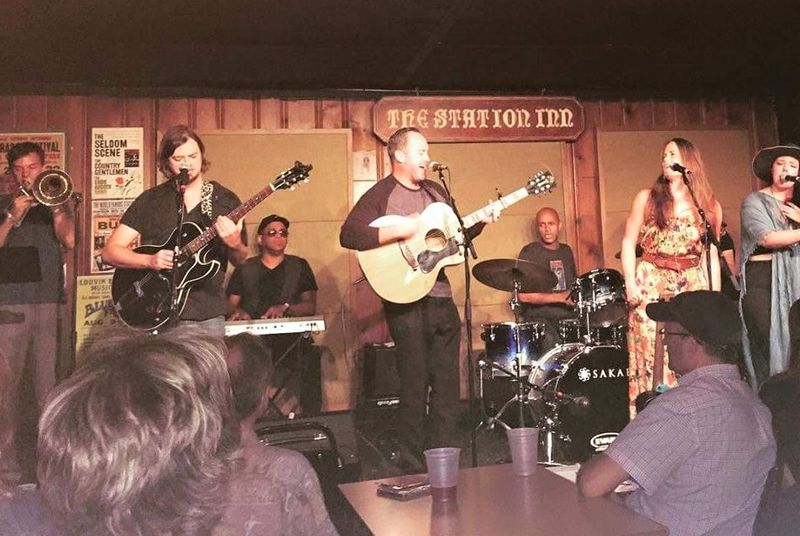
    July 30 – With so many live performance options in Nashville, it can be hard to decide who to see. We only had two nights, and the first one had to be decided quickly. My cousin Rae Ellen had driven in all the way from the Smoky Mountains, and we didn’t have a lot of time to spare. The Station Inn was mentioned in a Gram Parsons biography I had just read, so the venue was on my mind. We popped in to see what was up, and then headed down the street for a tasty Mexican dinner. An hour or so later, we took our seats as the club was filling up and the Cumberland Collective was about to go on.

    The Station Inn is famous for bluegrass but a friend of the band described them as ‘swampy, Louisiana, Americana style more than bluegrass.’ As the name implies, the Cumberland Collective is a core group that includes singer/guitarists Conner Rand and Clay Evans and Ted Pennington on fiddle/mandolin/guitar/vocals plus a talented cast of support players and singers. Their style is characterized by soulful, multi-part harmonies, with a swinging yet full and detailed instrumental texture.

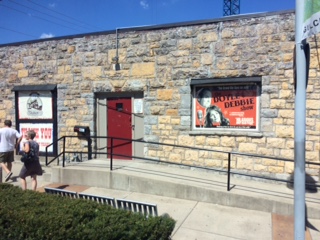
    Station Inn

    The outside of the Station Inn. You can be sure that your spouse, lover or significant other won’t be able to see through the windows if you are inside cheatin’ and they happen to pass by.

    The band fielded ten players and singers on stage just to start with, including a trombonist, saxophonist, drummer, electric bass, keyboards, several singers and the core band. The rhythm section in particular was killer, with bassist Ryan Madora providing the rock solid foundation. From the look on her face, you knew she was thoroughly enjoying herself. More guests dropped in as the evening progressed, including an appearance by Brooklyn hit makers American Authors towards the end of the second set.

    A striking aspect of the CC is the top notch musicianship, which is in the ensemble, getting the song across variety rather than the flashy, soloing style. Even though there were numerous guests on stage and the overall lineup varies somewhat from gig to gig, the cohesion and spark of the music never faltered for a moment. Before we went down to Tennessee, my friend Ron Raymond had told me, “you’re going to be blown away by how good the musicians are in Nashville.” He wasn’t kidding.

    One of the most exciting performers that night was Nicole Boggs. She has a smoky alto voice with a ton of soul, and she got one of the biggest hands of the night for one of her songs. Her back-up vocals were also an integral part of the rich sound that defined the CC that night.

    All this great musicianship still wouldn’t have satisfied me if the songs weren’t appealing, as well. A sly sense of humor is at play in many of the lyrics, and two songs which stood out in particular were “The Rabbit Got Away,” and “Yard Man.” We stayed from beginning to end, almost three hours of spirited, joyful and skilled music making. The Cumberland Collective is a group to keep your eye on and a good time to be had in the here and now.

  • 29A_0592 (640x427)

    After we returned from Avalon, we stopped off at Hick’s Tamales & Barbeque in Clarksdale, where Bill Clinton was known to feed his prodigious appetite on occasion. The atmosphere was rather dismal but the tamales were indeed excellent. We then checked into the Delta Cotton Company, a lovely pension-style hotel above the Ground Zero Blues Club.

    I had wanted to experience the Mississippi River up close and personal, so with a few free hours before the show at Ground Zero that night, we set off with directions from the local Firestone Service Center for Friars Point, the only place along the river in Coahoma County with public access to the shore.

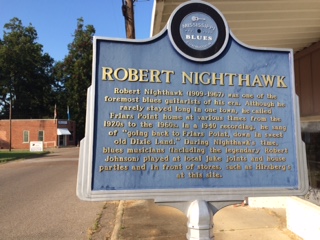
    Robert Nighthawk

    A slightly scary attempt at crossing over the levy on a gravel road led us back to the shore road, where we spotted a very friendly policeman who offered to show us the perfect spot for viewing the river (top photo). Later, we happened upon the historical marker for legendary guitarist Robert Nighthawk, who spent a lot of time in Friars Point.

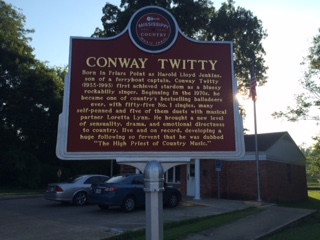
    Conway Twitty

    Barely turning around to check out a post office about seventy five yards down the street, I came upon a marker for Conway Twitty, who was born in Friars Point. It made me realize how thick with talent the state of Mississippi is, and how much fun a further investigation would be, just following the Mississippi Blues Trail.

    Evol Love Band

    That night, we went down to the Ground Zero, which is partly owned by Morgan Freeman, to catch David Dunavent and the Evol Love Band. The club was barely half full on a Wednesday night but still a great venue. Dunavent is a solid singer and guitarist but the rhythm section seemed to be more in a subdued fusion vein. However, it was the first time that I noticed an arranging idea that I would see more of in Nashville and later recognize on the radio when I returned to New York. The technique is to graft together themes from different songs and even artists, for example a Hendrix riff spliced onto the front end of a Santana song, with the sequence repeated later. This struck me as a product of the hip-hop era. All in all, it was a full day of music, sight-seeing and barbeque.

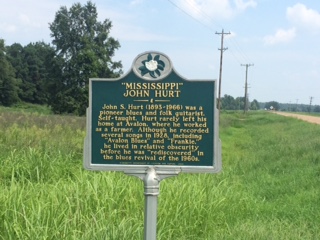
  • John Hurt Historical Marker

    July 29 – I was introduced to the music of John Hurt by a wonderful guitar teacher named Terry who I studied with between the ages of thirteen to sixteen. He taught me the technique variously known as ‘double thumbing,’ ‘Travis picking,’ or ‘alternating bass,’ and the main lick for “Spike Driver Blues.” I was then able to figure out a number of songs from Hurt’s definitive Today album. When we decided to make the trip down to Memphis, I knew we would visit Avalon, Hurt’s hometown, immortalized in his song, “Avalon Blues.”

    I was surprised to find out that there was an actual Mississippi John Hurt Museum in Avalon, which is more or less a ghost town now, about seventy miles southeast of Clarksdale, MS. If you’re thinking about visiting, make sure to view the local map on a regular computer as it is more detailed than the mobile version. Allow ample time to visit other landmarks in the area. I was sorry that we weren’t able to visit John’s grave, which is nearby. We saw a poster at the Shackupinn alerting us to the fact that you have to make an appointment with the museum’s caretaker, Floyd Bailey, to go inside.

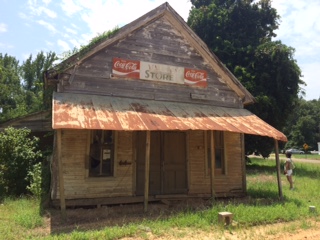
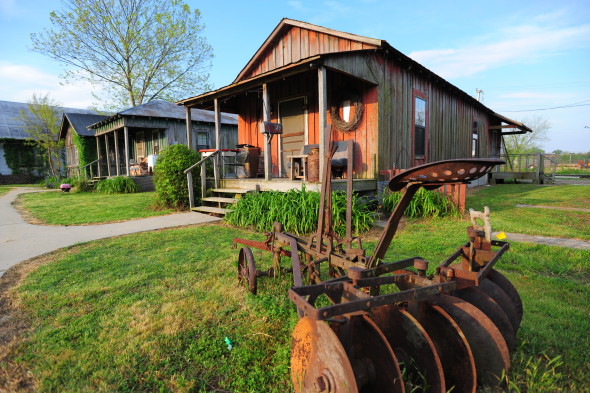
    Avalon Valley Store

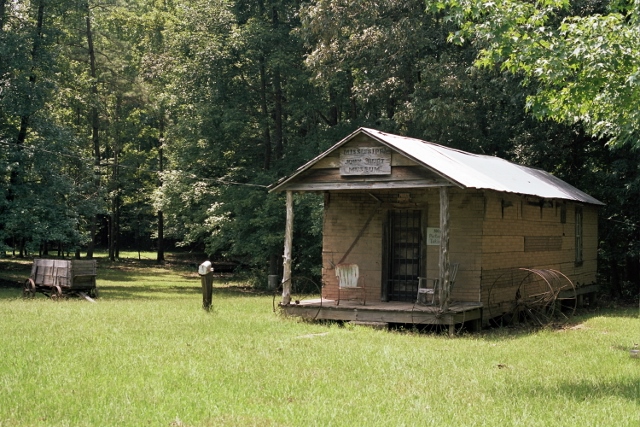
    We met Floyd by the historical marker on Route 7, and followed him through twisting back roads to get to the museum. The first stop was the abandoned Valley Store (pictured above), where Hurt would play on weekend nights. Eventually, we came upon the museum, which was established by Hurt’s granddaughter.

    Chris and Floyd

    Floyd opens the door to the museum while Chris and Maria brazenly flout the 'No Picture Taking' sign…

    The museum itself is housed in John’s shotgun shack. It was blazing hot and we didn’t have much time, as Floyd had work to do at a church that they are planning to move onto the property. There are a lot of old guitars that Hurt may or may not have played, and pictures of longtime caretaker, Art Browning. Cans of Maxwell House coffee and an old stove are among the basic staples of home that must have characterized much of Hurt’s life, save for his music and poetic vision. The grounds are beautiful and serene.

    17A_0580 (640x427)

    There are also numerous framed press clippings, and these are very interesting. No photos may be taken inside the museum, which was a little hard to understand, but as a musicologist, it dawns on me now that photos of the press clippings would be quite useful to someone thinking of writing that long overdue biography of John Hurt. It is one of these clippings that provides me with the most evocative memory of our visit.

    A murder had taken place in the area, and detectives had descended on the crime scene under full darkness. As they were getting ready to leave, a voice spoke up from the shadows, telling them, ‘you’re going the wrong way – you don’t want to get lost around here – let me show you.’ And with a flashlight, John Hurt led the detectives back to their cars.

    Visiting Avalon and the museum rekindled my interest in John’s songs. I never stopped playing them at least occasionally – see my “Mississippi Medley” – but for the first time, I began to try to sing them.

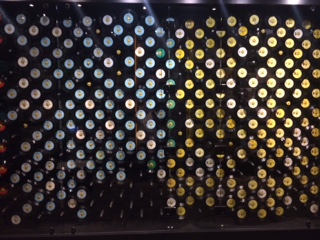
  • Wall of Singles

     A wall of singles inside the Stax Museum of American Soul.

    July 28 – If you are making a music pilgrimage to the Delta, one place that you don’t want to miss is the Stax Museum of American Soul in Memphis. Everybody who loves the music of this era has heard of the legendary record label that brought us Isaac Hayes, Albert King, Booker T & The MGs, Carla Thomas, and so many more, but that’s just the tip of the iceberg. A trip to the museum provides a window into essential aspects of local history and beyond, and is the perfect jumping off point for return visits or further reading, listening, and all around digging into your inner (and outer) funky soul.

    Your visit starts with a twenty minute film about Stax and the era that gave birth to it. One of the most important ideas that you take away is how blacks and whites worked together to produce this music, despite terrible outside pressure and tragic events. That openness and generosity of spirit is also present throughout the museum, with the many soul artists who weren’t on Stax, such as Al Green, getting their due, as well.

    Hoopers Chapel

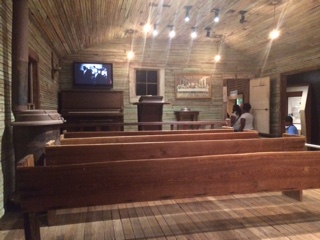
    After the film, the first exhibit is of a small chapel that has been moved from Duncan, Mississippi and installed in the museum. The Hoopers Chapel African Methodist Episcopal Church (above) was built around 1906 and is used to illustrate the gospel roots of soul music. Various preachers deliver their impassioned sermons from the television set that is mounted in the upper left of the photo.

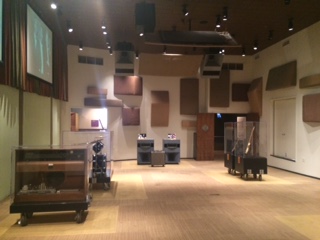
    The museum is housed in the original Stax studio building, which was formerly occupied by a movie theatre. The building was demolished in the ‘80s, but the Soulsville Foundation, a group of community leaders and philanthropists, did an amazing job of recreating the façade and designing the museum. For musicians especially, the recreated Studio A (below), with its unusual slanting floor, is an inspiration.

    Stax Studio A

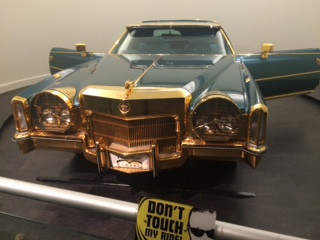
    Issac Hayes gets a certain pride of place. He may be the biggest selling Stax artist, although there isn’t an emphasis on sales figures. But his gold-plated, custom Cadillac Eldorado, mounted on a rotating platform speaks volumes. I was highly impressed by a display that included the Maestro Boomerang wah-wah pedal that Charles “Skip” Pitts used on the seminal funk track, “Theme From Shaft.” The outrageous stage wear favored by many of the later Stax artists is also given ample space.

    Gold Cadillac

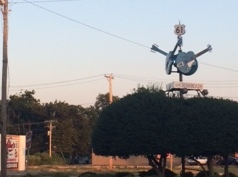
    After our visit to the Museum, we re-entered the 97 degree heat before jumping in the car and heading down Highway 61 to Clarksdale, Mississippi, home of the Crossroads where Robert Johnson supposedly sold his soul to the devil. Our first destination was The Shackupinn, a unique ‘motel’ of sorts that is comprised of numerous renovated sharecropper shacks that have been brought to the site of a former plantation outside Clarksdale. There is also a music venue with a bar/restaurant and of course, a gift shop.

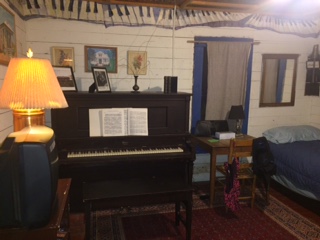
      Shack Front Room

    The front room of the Pinetop shack.

    The shacks themselves are fantastic – character filled, clean, and maybe most important of all, air-conditioned. They smelled of old, dry wood – a lovely smell – and had numerous windows through which the blazing sunlight filtered in through simple curtains. We stayed in the ‘Pinetop Shack,’ named in honor of Pinetop Perkins, the superstar blues pianist who made his mark playing with Muddy Waters. There were pictures of him around and get this – a fully functional upright piano. It broke my heart a little to leave.

    Crossroads (238x177)

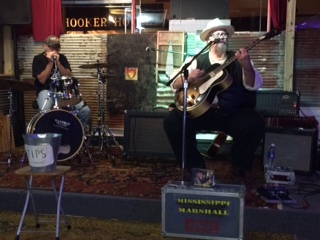
    That night, after some barbeque at Abe’s, a very good diner-like place right at the corner of the Crossroads (pictured above), we went to Hambone, an art gallery and performance space that is owned and run by Stan Street, a musician and painter from Buffalo, NY. There was a warm atmosphere with inexpensive beer to help it along as Mississippi Marshall, a singer and guitarist took the stage with his ten-year-old grandson on second guitar.

    Mississippi Marshall

    Stan later joined Marshall (left to right above, Stan Street, Mississippi Marshall) on harmonica and drums for two excellent sets, but that boy damn near stole the show. With a derby hat on, he played a perfect boogie bassline on a three-quarter-size guitar on the first song as Grandpa warmed up into his fluid, multi-voiced blues tunes and gravelly, melodious vocals. Aided by an occasional looped chord progression, Marshall had a great technique on a vintage Stella. I spoke to him for a few minutes in between sets and he handed me his guitar. To my surprise, the strings were super light for that kind of instrument and he said, ‘that’s all my hands can take at my age.’ You would never have been able to tell by the sound, which was full and sustained. Afterwards, we headed back to the shack to get some rest before our planned trip to Avalon the next day.

  • Wild Horse Tavern 080915

    We played our final show of the summer at the Wild Horse Tavern last Sunday and it was another interesting night with good friends and music. The evening opened with a set of solo blues from Irving Louis Lattin, a fine guitarist and singer from Chicago. Bugs & Crumbs played a tight set but I felt that without the tasty guitar of Sid Moskowitz they were missing something.

    We followed with a completely different set from the last time that included "Going Down To Main Street," by Muddy Waters, our own "Saint John The Baptist," and a new original, "Good Time Girl," a boogie in G with slide guitar that had a cookin' groove. We played again as a trio with Dave Gerstein on bass, Chris Trotta on drums and myself on guitar and vocals. We look forward to getting up on the Wild Horse stage with our harmonica player Christof Knoche, who has been away for the summer. 

    The night was capped off by a long set from Alan Merrill, a guitarist, singer, and songwriter who has had a distinguished career. In addition to co-writing the classic number one hit, “I Love Rock & Roll,” he had a huge following in Japan and successfully auditioned for the Left Banke. The highlight of his performance was a superb rendition of “Don’t Walk Away Renee,” that he sang and played on twelve-string guitar. It’s no wonder he got the gig with the Left Banke.  

    Our next gig is at The Shrine in Harlem on Tuesday, September 8th at 9pm. We will return to the Wild Horse on Sunday, September 27th at 9:30pm.

  • Gibson Showroom (238x206)

    July 27 – On Monday, we took the Gibson Factory tour, which was sold out. The hollow and semi-hollow body guitars are made at the Memphis factory, and we got to see the luthiers putting together these sought-after instruments. Understandably, we weren’t allowed to get too close or take pictures.

    It was the first time I ever set foot in a factory of any kind, and it gave my already strong ‘buy American’ sympathies a new twist. The smell of chemicals was in the air as were copious sawdust and other foreign agents. My immediate thought was that with the strangle hold that the American medical insurance business has on our country, it must be almost impossible to turn out high quality products that are affordable to performers. It may be more complicated than that, but it is perhaps worth noting that a trolley tour guide in Nashville, where the solid bodies are made, told us that Music City grosses ten billion in music revenue, and get this – thirty billion for the medical industry!

    The overall effect of the Gibson Factory tour however was that it made me want to go home and play my Les Paul, and for good measure, I should get my tools out and finish those lingering home repair projects that I’ve been dreaming up, like painting the inner door of the loo silver ala Andy Warhol’s factory. And speaking of painting, the finishing section of the tour was one of the most exciting parts. The guitars look fairly unimpressive in their raw wood stage – the wood looks well, raw and of undetermined quality. A full week of painting and lacquering to the rescue!

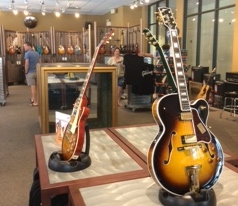
    In the showroom (pictured above), I was most impressed by a 1964 reissue ESC-TD (picture). Mind you, it was the sound – like Blind Faith-era Clapton, and that’s unplugged – and incredible playability that I was struck by. Unfortunately, there was the $4,500 price tag to consider, so I bought some much needed Dunlop fingerpicks instead.

    That evening, we went to the well recommended Lafayette’s Music Room, in the beautiful Overton Square neighborhood. The legendary Ardent Studios is down the block, where Alex Chilton and Big Star recorded Radio City, and Led Zeppelin IV played respectably from outdoor speakers situated in the eaves of the tidy one and two story buildings. The speakers? Bose. Memphis is a town where rock and roll lives, 24/7.

    DeeringandDown (320x240)

    The band at Lafayette that night was Deering & Down, fronted by Lahna Deering on vocals and rhythm guitar and Rev Neil Down on lead guitar and vocals. The sound in the cavernous, two tiered restaurant was warm and detailed, and benefited the atmospheric guitars by Down and breathy vocals of Deering, who also played tight rhythm guitar. But I couldn’t help thinking that it was a sound that had been done before, in the ‘90s, by groups like Mazzy Star, The Sundays, and many more, and that these talented musicians were involved in a labor of love.

    One aspect of the Memphis and Nashville scenes that I noticed and that was demonstrated here was the musicians stridently asking for tips. We do it in New York as well, but usually not repeatedly. However, I totally sympathize. The food was terrific at this place, the ambience added to it, and the music was top notch. There was a very good crowd on hand and no cover charge. But I was one of the only people that ventured up to the stage and put something in the tip jar. It makes you wonder if money is a bit tighter than usual in Memphis. The music doesn’t suffer for it, though. 

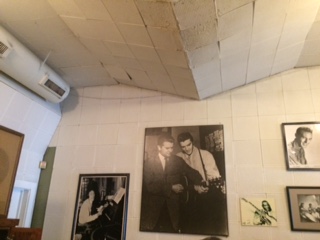
  • Sun Studios Main Room

    Photos in the main recording room at Sun Studios. Note the acoustic tile and ceiling.

    July 24-26 – One of the first things that you notice upon disembarking at Memphis International Airport is the groovy soundtrack that’s playing in the background. You know you’ll hear many cool sounds throughout your stay in Memphis, and in Mississippi and Nashville as well, as it were on our trip to these southern music meccas. But the airport music is a kind of distillation – Elvis, Stax, and other soul giants like Motown are part of the inclusive yet top quality aural tapestry – and it lets you know that you have arrived in an unforgettably musical place.

    After checking out the Peabody Hotel and unwinding with some delicious barbeque on Saturday at the Rendezvous, we began our musical pilgrimage with a visit to the legendary Sun Studios on Union Avenue in Downtown Memphis. There are three basic areas that visitors are allowed into: The ‘diner area,’ or what was formerly a diner next door now owned by the studio. It includes a tiny ‘record store’; The upstairs, which serves as a museum and a place to hear the first half of the Sun Studios story; And the studio proper, where all the great hits were cut and then later U2’s Rattle & Hum, an event that brought the studio back into the limelight.

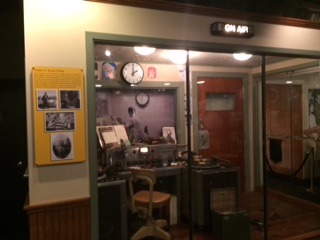
      Sun Upstairs

    A radio station exhibit in the upstairs area of Sun.

    The story is amazing, of course, and was well told by our guide. There are Ike Turner, Elvis, The Killer, and more. An astonishing revelation was the story about how Sun artist Rosco Gordon helped invent Reggae. But the overriding feeling was one of contentment, happiness and wonder. It was great to be close to Scotty Moore’s Gibson guitar and Ike’s blown out amp that was used on “Rocket 88.” From walking in the door to leaving the free parking lot, it was nifty all the way. One interesting fact – the studio was moved down the block for a couple of decades, and more recently re-created with all the original components, right down to the acoustic tiling, back in its original location. Not to be missed!

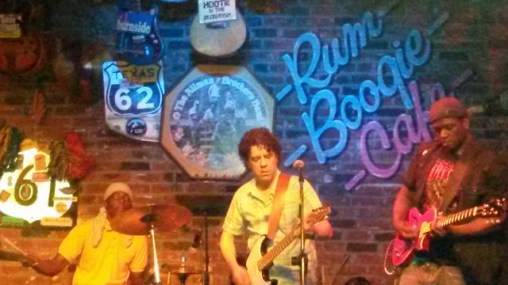
    Chris at Rum Boogie (640x360)

    The jam at Rum Boogie Cafe with yours truly in the center. 

    That evening, we headed down to Beale Street and the Memphis Blues Society’s Sunday night open jam at the Rum Boogie Café. We settled in with more decadent barbeque and it wasn’t long before I was called up to the stage. The house band, led by Elmo Lee Thomas, was top notch, but for my turn it was a lineup fully composed of jammers. I was in luck – no one wanted to sing! I had a few tunes in mind and ended up starting with “Going Down to Main Street,” by Muddy Waters, an up-tempo shuffle that I’ve played a million times, including in Amsterdam under similar circumstances, and “Door to Door Blues,” an original slow blues of my own.

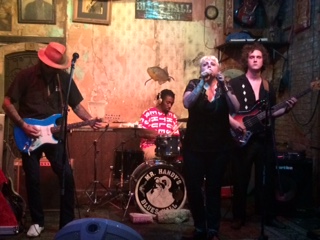
      Low Society

    Low Society work the stage.

    The reception was very good, the sound was beautiful, and my fellow musicians were in fine form. It was a treat to play with an impromptu band of talented musicians in such a great sounding room with an appreciative audience. We struck up a conversation with Elmo afterwards, and he advised me on the best place to buy a hat (Schwab’s, among others). Afterwards, we went next door to see a band called Low Society playing in what I can only describe as the auxiliary room of the Rum Boogie Café. They are a wild, ‘punk-blues’ outfit who aggressively push the limits of the form. During one song, I didn’t realize what they were playing until the final line, “Baby What You Want Me To Do?” One of my favorite songs and artists, Jimmy Reed. It was a great night.


  • Shack Up Inn

    Tomorrow we will leave town and head to Memphis, TN for a much needed vacation. From there we're going to Clarksdale, MS (pictured above – the Shack Up Inn in Clarksdale) and we'll also hit Nashville before returning to Memphis and then heading home. It's long been a dream of mine to visit these music meccas, so I'm really excited. Stay tuned…


  • In classical music there are pieces called Etudes, which embody a specific technique within a musical framework. I like to use that approach in teaching techniques that are used in rock, folk and other styles. The song Dead Flowers, by the Rolling Stones, is a perfect vehicle to learn one of the most important strumming patterns. I used to call it the ‘back beat rhythm,’ because of the two upstrokes that come right in the middle of the pattern, but a more appropriate (but less catchy and fun) name might be, ‘basic syncopated strum.’


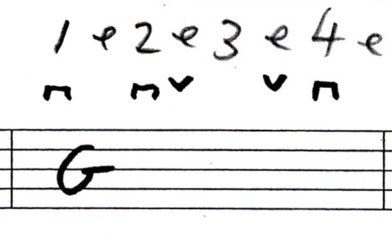
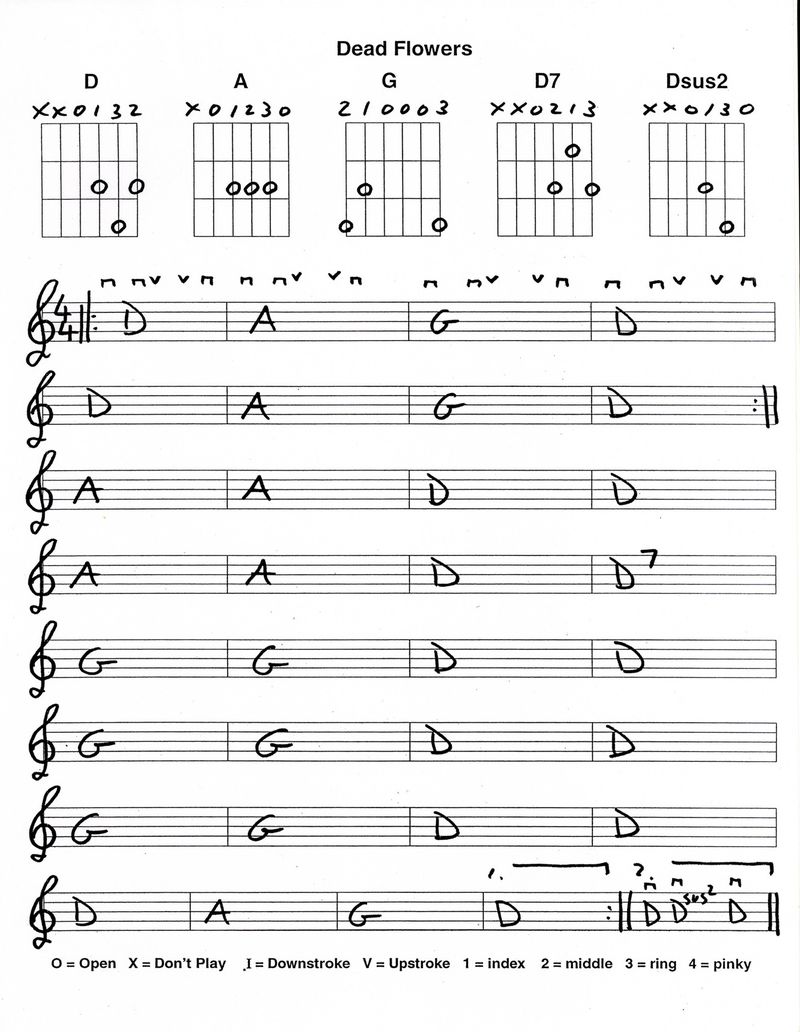
     The pattern consists of five strums – two downstrokes, two upstrokes and one more downstroke or Down-Down-Up-Up-Down. This can also be sung as Long-Short-Long-Short-Long. You can see it written out on the first line of the chart below and in Example 1. 

    Example 1

    Dead Flowers4One thing that you will notice is that there is no strum on beat three. This is where the syncopation comes in, as the note that is begun on beat 2 & ½ is held over through the first half of beat three. No need to get all technical though, take a look at the video. You may also notice that the downstrokes focus more on the bass notes while the upstrokes hit more of the upper strings.

    I like to point out that the right hand is always moving, what I call the ‘Constant Motion Principle.’ For instance, in between the two upstrokes, there is a downward motion to get back into position to play the second upstroke. None of the strings are struck. Sometimes, it’s about what you don’t play instead of what you play. Here there is space or, a continuation of the previous chord. The hand moves down, up on each beat of the 4/4 time – eight movements in all. But only five chords are struck.

    Why is this strum used? It fits in with the melody of the song. Many of the notes that Jagger sings fall neatly into the rhythm pattern of the strum. This strum is often used for brisk tempos where quarter and eighth notes dominate and there is little room for sixteenth note activity.

    The chart below represents two full verse/pre-chorus/chorus repetitions. Note the repeat signs at the beginning and at the end of the second line. Then, the entire page is repeated with the second ending at the bottom of the page. I heard the Stones use this ending on a great bootleg called “Leed Stones,” from one of their gigs at Leeds University in England. It’s very simple, utilizing a Dsus2 chord to add a melodic element to the last three chords. Another detail is the D7 chord before the chorus. I added that in to give it a little extra push into the chorus. It also makes it a tiny bit harder and illustrates a basic function of seventh chords. Check out the audio to hear how the whole piece works together (link is at the bottom of the page). 

    Dead Flowers3

    Download DEADFLO