•  

    I grew up a huge Johnny Winter fan, and as luck would have it, I got to see Muddy Waters perform in 1977 during his Hard Again tour. One of my biggest memories from that show at the Palladium in New York was Muddy sitting on a stool, playing a ferocious slide solo. He was getting so into it that James Cotton, who was sitting next to him, reached over and kicked him in the leg as if to say, “Calm down, Bro!”

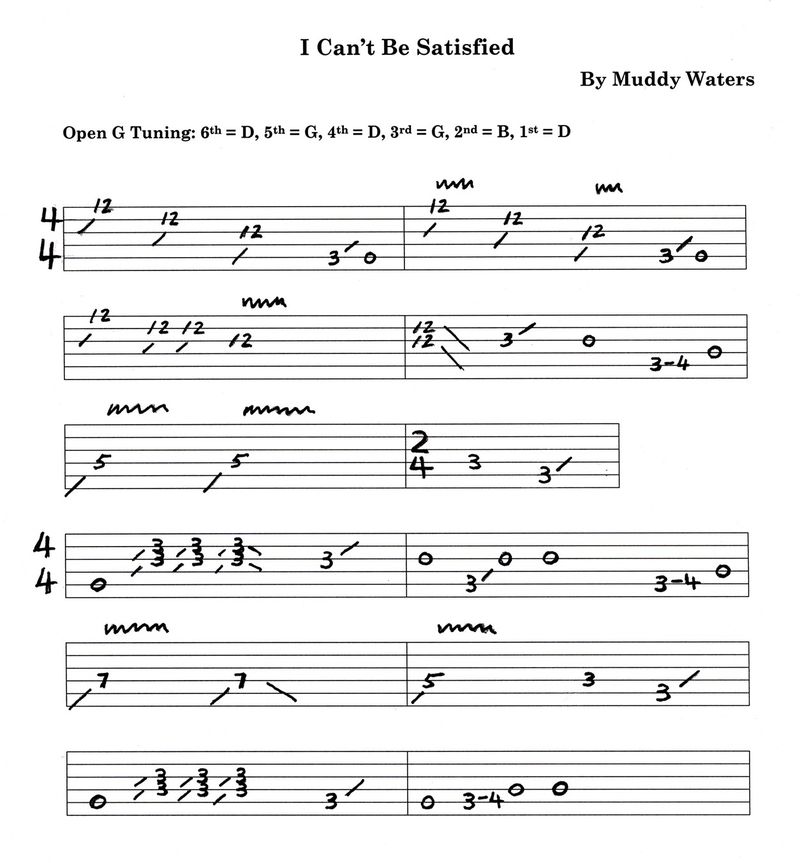
    So, I guess it makes sense that “I Can’t Be Satisfied” would end up being the first number in open tuning that I would figure out. In another important first, it was Muddy’s first hit in Chicago (recorded 1948), and it helped to get his career started. The song offers a complete, structured, and totally catchy tune to help you explore some important areas around the fretboard. There are easier tunes to begin with, such as “No Expectations,” (Open E) by the Stones, or “In My Time of Dying,” (opening sequence, Open G) by Led Zeppelin. But if you are an advanced beginner at slide and up for a challenge, it’s right here.
    I Can't Be Satisfied

    Regarding the tab, the small lines that sometimes proceed and follow a note indicate either an upwards or downwards slide. The squiggly lines above the staff represent vibrato. Most of the slides are of an indeterminate amount, a quarter step, slightly less than a half step, etc., except where there is a standard 3 – 4 notation, for example. You have to listen carefully. Part of the beauty of the style is that it’s so expressive and open to interpretation.

    Measure number six is in two-four time, i.e. there are only two beats. This makes the piece an eleven and a half bar blues. It shouldn’t be difficult to follow because it sounds so natural. Notice the slap bass part, played by Ernest "Big" Crawford. It’s quite busy, with an eighth note feel against the quarter notes of the guitar, and it really drives the song. I often feel that I’m hearing a high-hat in there!

    I played the short example (one chorus – Muddy plays the same part all the way through the song) using my right hand fingers. It’s totally possible to play it with a pick, although the use of the right hand fingers allows for better muting. Many people talk about Muddy’s wild vibrato, and I approximated it on the long notes that stand for the IV and V chords, but much less unhinged.

    Some important points to remember: Keep your left hand fingers behind the slide touching but not pressing on the strings, to reduce noise. Aim the slide right above the fret of a note to get that exact pitch, i.e. directly above the 5th fret on the D string for the note G. Finally, the slide that I’m using is a Dunlop #218 glass slide. I love it!
  • TBoneWalker UK

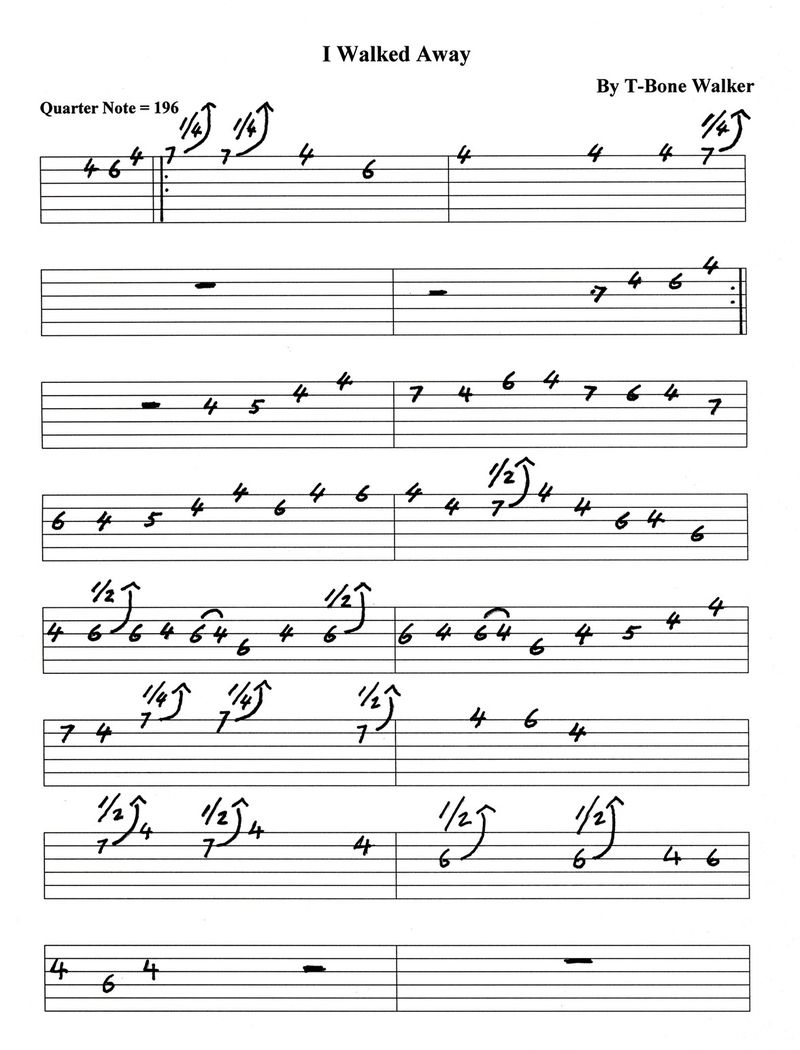
    Earlier in the year, I decided to make a study of T-Bone Walker’s guitar style, and “I Walked Away” was the first tune that I attempted to transcribe. When I got to the nitty gritty of it though, namely the second and third bar of solo proper, I was having trouble hearing it so I put it down for a while. My method then was to sit with my plugged in guitar and the tune on YouTube, clicking the cursor on the big dot to replay one or two second pieces.

    Eventually, I bought the CD so I could listen to it more comfortably. I started working on it again about a week ago and instead of just working with the computer, I started to run through the solo using a Gibson guitar to get the right sound and listening to the CD intermittently. Before long, I struck gold, unraveling the chromatic section that begins with the last note of measure two (second chorus) and carries into measure three: D – Db – Cb – C natural. I headed back to YouTube to work on the overall rhythmic structure and found it helpful to pencil the notes into the tab that you see below.

    I Walked Away

    “I Walked Away” is in the key of Ab in four-four time. The metronome marking of quarter = 196 may seem a little scary, but remember that the lead guitar is mainly playing eighth notes against a fast walking bass playing quarters. Essentially, you have to be able to play sixteenth notes at 100 BPM to cut the solo. The hard part is that almost every note is picked, there are constant string crossings and little arpeggios, and nothing is repeated except for in the intro figure. Note: Some of the half-step bends are a hair more than a half-step, but definitely not a whole step. Same for the quarter step bends – do I hear three-eighth bends? Also, note the rests, such as the eighth note rest in measure four of the intro – it’s not a ‘7.’ And in the intro, the pickup notes are not played the last time around (the four bar intro figure repeats three times).

    I finally found a use for the second channel of my Fender 65 Deluxe Reissue, putting a Boss Dr. Rhythm that I use for a metronome through there and plugging the guitar, a Les Paul Classic, through channel one aka the reverb channel with the reverb turned off. I started practicing at around 150, which was fairly easy. However, 150 is a long way from 196.

    I kept increasing the tempo, which moved up in increments of four – 154, 158, 162, and so on. If I nailed it at a certain tempo in one try, I sometimes immediately moved up to the next tempo. At 186, you know you’re close. But then there is a bigger jump from 190 to 196, which is T-Bone territory. I pushed the metronome to 202, and then took a stab at playing to the record. After a few tries I was able to keep up but of course pushing the speed even harder is the name of the game. It’s really exciting when you get it going and a super practice session. Have fun!

  •  

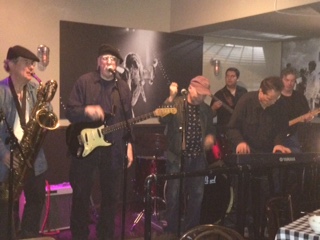
    I’ve always felt that the Wednesday night before Thanksgiving is a great night to go out, and this past Wednesday evening proved me right when I went to the Wild Horse Tavern Blues Jam. There was a really good crowd on hand with plenty of great players to create a spirited and highly entertaining musical experience. It was my first time going to the jam and I will definitely be returning soon.

    I made some new friends and got to connect with some important blues musicians on the scene. I played a couple of songs with guitarist Dan “Bluesy Dan” Berliner and he forwarded me a video (above) of his earlier performances and the two songs that I played and sang, my own “Door To Door Blues,” and Muddy Waters’ “Going Down To Mainstreet.”  The video is about twenty-three minutes long and I come in around the eleven minute mark.

      Wild Horse Blues Jam Thanksgiving 2015

    The jam was hosted by Jonathan Kalb (third from left). Jonathan performs and organizes numerous concerts and events, including a blues jam down at the Parkside Lounge on the Lower East Side that I believe is still running. Jonathan sang and played some very tasty blues on a ’63 Strat. My friend T.J. Hogarty (far right) was also on hand and I also met drummer Michael Fox and enjoyed a couple of songs by hot guitarist Johnny Allen. There was a great vibe and I hope that this jam will be running for a long time to come.

    To return to chrisbottaguitar.com click here


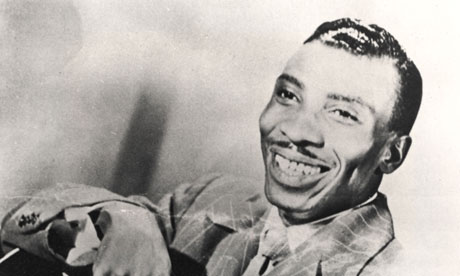
  • T-Bone-Walker-007

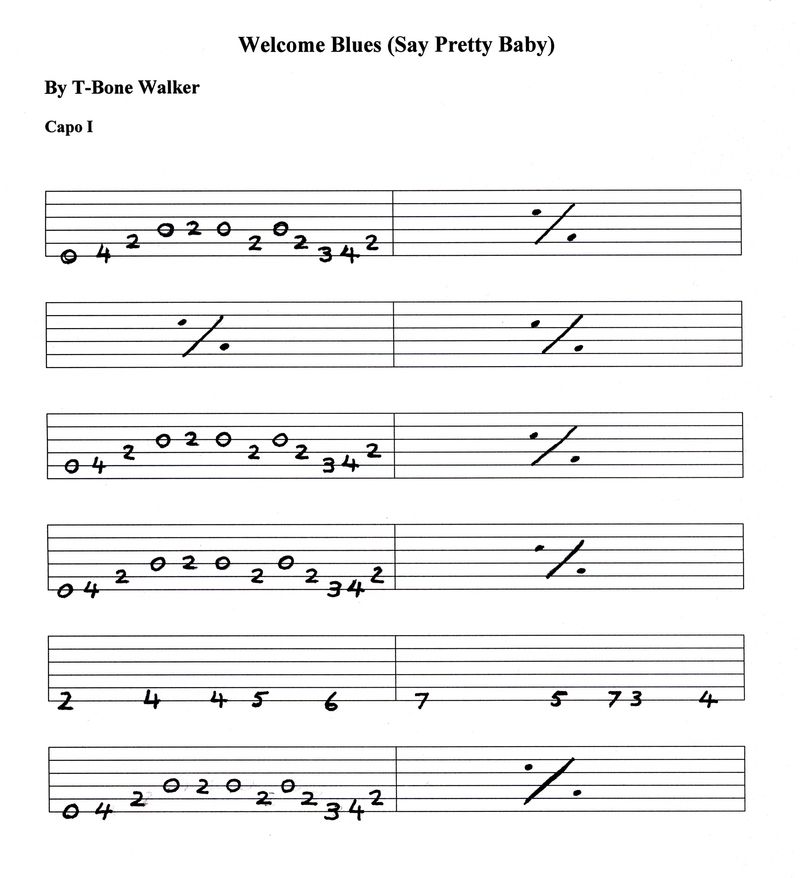
    A hot summer night in Los Angeles, 1951. Ike Turner had recently waxed “Rocket 88,” in Memphis and Fats Domino’s “Blueberry Hill” was still five years off. With the birth of rock and roll at hand, T-Bone Walker probably figured he could experiment a little. And so, he recorded this eighth note boogie, married to a blues form with raging saxophones and we’ve got “Welcome Blues (Hey Pretty Baby).”

    Aside from being a very catchy riff, the ‘rock & roll’ section of the tune, which opens the song and supports the leering, sleazy sax solo, makes for a good exercise in right hand picking and keeping up your momentum and concentration.

    Welcome Blues

    I recommend straight alternate picking, although I don’t always do this for various reasons. One is that upstrokes sometimes sound a little weak on the lowest bass strings. And in general, I don’t feel that sticking to a strict picking pattern will ever outweigh musicality. Music rarely does the same thing all the time. But in this case, it does.

    Note: The repeat symbols in measures 2 – 4, 5, 7, & 12 are a valuable reading tool. Simply repeat the last written out measure; when new material comes up, play that. However, you have to memorize these patterns – the hand is quicker than the eye! If you have trouble keeping the tempo up, slow it down for practicing. To really get comfortable with it, practice until you can play it faster than the record.

    Play along with the song. When the riff is not being played, feel free to wail along with the sax or over the vocals, although I would lay out during the stop time passages. How often do you get to play with such a killer rhythm section? Note also, the beautiful tone of the guitar and the catchy hook that comes in measures 9 – 10, utilizing space as a huge release of tension.

    Another note: There are other ways to finger/arrange this riff on the guitar, perhaps utilizing only the E, A & D strings – try it, but remember, smoothness is key. Eliminating the G string adds fatness and consistency to the sound, but at the expense of ease of playing. Experiment.

    The use of the capo may seem a little stiff to some. But, how many times do you see a picture of Muddy Waters or another blues slinger with a capo on their guitar? T-Bone often plays in flat keys, to help the horns sound their best. It can be a little uncomfortable to bend strings and improvise in the key of F with a capo on, but if you’re going to play the blues, both aspects are important to get used to. There are many great blues tunes in F, for example “My Babe,” by Little Walter. Capo I, and that riff sounds kind of familiar, doesn’t it?!

  • T-Bone Walker Splits

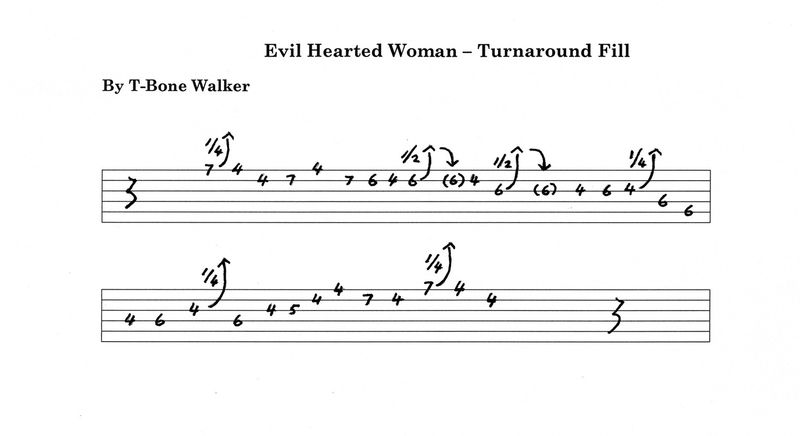
    “My blues is not screaming blues or howling blues but kind of sweet blues,” said T-Bone Walker. You could add the term ‘riffing blues,’ as well and you can see the evidence in the turnaround lick that is transcribed below. T-Bone Walker was one of the first guitarists to go electric and by 1950 he sounded smoother and better than plenty of young turks in the early to mid-sixties.

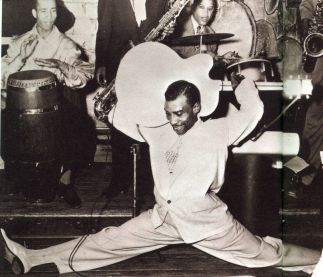
    BB King was a devotee, and he shares some of his thoughts on this video. Both Chuck Berry and Jimi Hendrix were deeply influenced by his licks as well as his stage moves which included the duck walk as well as playing behind his head and with his teeth. Walker’s The Complete Imperial Sessions is a must have and of course you will want to cop some of T-Bone’s licks and figure out what he’s doing.

      T-Bone Walker Evil Hearted Woman

    The section of “Evil Hearted Woman” that I’ve transcribed above is a long, smooth phrase that unwinds over the turnaround of the first verse. It’s a simple turnaround, with just a I – V – I motion underneath, outlined by the bass. The tempo is slow which provides a perfect opportunity to toss out a burst of quick notes in a kind of compressed free time. T-Bone’s rhythm is quite sophisticated with numerous triple and duple permutations, but what impresses me most is how the melodic contour matches the harmony.

    Each line represents one measure. The first five note lick outlines the I7 chord (Ab7) and then there is a sequential descent that bottoms out on the fifth of the scale, Eb, at the end of the first line. An upward pass through the tonic ends with the note Eb at the very end of the phrase. Note how there’s a rest at the beginning and the end of the phrase. The first rest sets the stage for this brief solo, and the one at the end, which is really almost two beats, provides plenty of room for the entrance of the vocal on the fourth beat.

    There are several of T-Bone’s trademark licks at play here. The first three notes with the quarter step bend will juice up any novice blues player’s solo. The first bend and release on the sixth degree of the scale, in this case an F, is something that most blues-rock players don’t do much, but T-Bone does it all the time so why not give it a try? Finally, the six notes that proceed the repeat of the first three note lick at the end form a dominant chord arpeggio, a jazzy touch that T-Bone always has on hand. Interesting how he starts and finishes on the same lick, huh?

    One thing you may also notice is that he smoothly cranks out these thirty or so notes in rapid succession without the use of pull-offs or hammer-ons. Although your right hand picking may be challenged, this material is useful at any speed. But getting the speed up is an excellent goal – a perfect opportunity to add some chops to your playing that go beyond repetition or scale-based runs.

    To Return to chrisbottaguitar website click here

  • Live at HiFi 110815

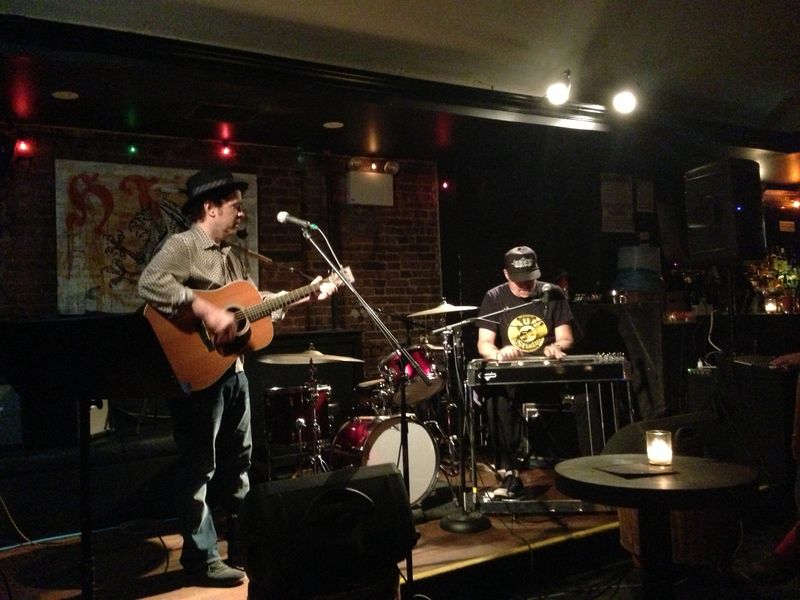
    This past Sunday I had two gigs, a happy occurrence. It was a bit of a trial, because I was fighting bronchitis and had to sing lead and harmony at the first one and lead at the second one. Definitely an experience. The first one was with my friend Ron at HiFi with our new Gram Parsons Tribute project, and the second was at the Wild Horse Tavern with my soon to be renamed blues outfit.

    I woke up late and started to get some practicing/warm-up in. On gig days, I’m always reminded of a quote from Rick Derringer that I read in a Guitar Player Magazine interview many years ago. He said, “Although I may practice for only fifteen minutes four times during the day, I’m going to have to play really well for two hours that night.” I interpret this in two ways. He doesn’t want to get tired from over-practicing. Also, the second half of the sentence suggests that he intends to refrain from any extracurricular activities that might get in the way.

    So, as per custom and with the time I had, I did two twenty minute warm ups, playing lead, a few of the blues tunes that we would play that night and a couple of run throughs of “That’ll Never Happen No More,” the most challenging piece I’ve been playing lately, a fingerpicked number by Blind Blake/Hot Tuna. Around 5pm, I headed over to Ron’s where we ran through the country set. It went well, one of those lucky gig day omens.

    Live At The Wildhorse 110815

    The show at HiFi (top) went smoothly and there was a nice crowd, mainly friends of the organizers and house band, a friendly and supportive group, taking up most of the seats. About five of them were sound men, so, hah hah – the sound was great and it was easy to set up. Ron let me use his Martin D-28 Herringbone acoustic, which was a treat. While I was singing the Advil Cold and Sinus plus the strong coffee I got at the 7/11 across the street was making my hair stand up on end, but I was able to sing OK, it was fun but a bit hair-raising, ha ha.

    I had to run out of there while the next performer was on, a kind of obscurity driven, hipster singalong, very nice. The cab ride uptown depleted all the money I would make at the Wild Horse, no problem; I forwent the free beer, sob.

    The show there (above) was pretty good. I started to lose my voice about two thirds of the way. The crowd thinned out from the previous band almost immediately. We did some interesting tunes including a cover of “Come Back Baby” by Hot Tuna (there are many versions, I think it’s basically a Ray Charles song) which I have always loved. A major plus was the improved lighting at the venue. We’ll be back on December 13th.

  • TJ and Company

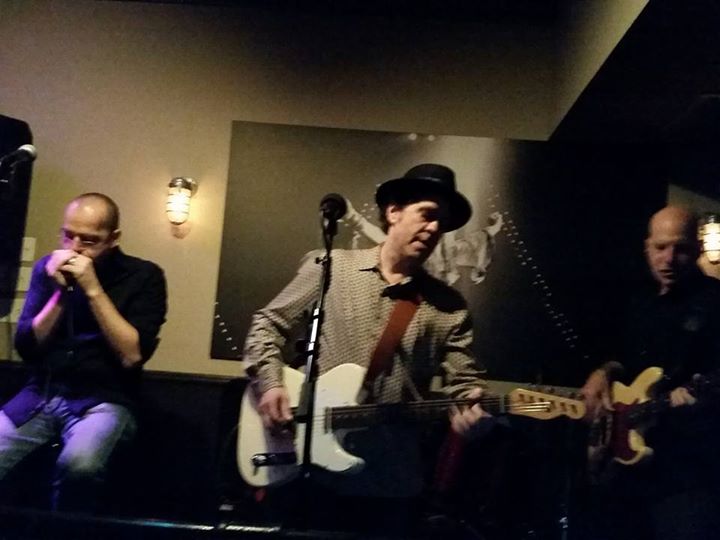
    October 31, 2015 – On Halloween night, I sat in with my friend T.J. Hogarty’s combo at Cassidy’s, a friendly Irish Pub on 55th Street in Midtown. In contrast to the hijinks that take place in New York City during this spooky and celebratory holiday, the scene was casual, with a small but supportive crowd on hand digging some blues, American songbook and rock and roll numbers. On hand that night were T.J., above left, Spring Brooks, center, and Mike Burman on bass, right.

    T.J. is an excellent guitarist who runs various jam sessions, plays a lot of gigs around town and also does sound for clubs on occasion. He actually influenced me in a big way a number of years ago, and it’s an interesting story.

    I was playing a gig at Desmond’s with my band, and T.J. appeared on the bill with the Fountain of Blues. Eventually he left that group, and I came in to play guitar for them when they couldn’t find someone good enough or dedicated enough to replace him. One of the first things they asked me was if I could play “The Stumble,” by Freddy King, a demanding instrumental that had showcased T.J. I picked it up but had to keep working on it for over a year before I was really comfortable with it. I guess I have to thank T.J. for that because I consider it both an accomplishment and something that I will be shedding and enjoying for a long time to come.

    Hopefully I’ll get to sit in again at Cassidy’s sometime soon because it was a really nice hit. I got to sing “Sad To Be Lonesome,” by Sonny Boy Williamson, “Going Down To Mainstreet,” by Muddy, and my own “Door To Door Blues,” which got a big hand. How cool is that? Thanks T.J.!

  •  

    A friend of mine who is a terrific bass player, all around musician and Harley rider told me he was learning pedal steel. Ron “King Bee” Raymond then asked me, ‘would I like to form a band?’ I thought, ‘Well, I have exactly one country number in my repertoire.’ It was “Dark End of the Street,” the famous cheating number written by Dan Penn and Chips Moman for soul singer Leroy Carr. I first heard the song on the Flying Burrito Bros album, The Gilded Palace of Sin, Gram Parsons most celebrated LP. But there were plenty of other great songs waiting in the wings, to my surprise.

    I had just finished a well-researched bio, Twenty Thousand Roads – The Ballad of Gram Parsons and his Cosmic American Music, by David Meyer. And country was on my mind, having recently returned from my first trip to Nashville. It suddenly dawned on me – it was the perfect time to form a Gram Parsons tribute band!

    Gram Parsons was introduced to me in a watershed, twentieth anniversary issue of Rolling Stone Magazine, The 100 Best Albums of the Last Twenty Years. I found a review of Sweetheart of the Rodeo by The Byrds, on which Gram was enlisted to provide a new direction to the then floundering superstars.  I was working at J&R Music World at the time – buying experimental, electronic and Greek music. I grabbed Palace and Sweetheart for my collection, and eventually started buying the country records for the store.

    We have a little show coming up, playing at an open mic night at the old Brownies space at Avenue A at 10th street, now called HiFi Bar, on Sunday, November 8th. The address is 169 Avenue A, between 10th and 11th Streets in the East Village. We go on at 7:30. Hope to see you there! 

  • Blind_blake_by_dillinger1934

    We'll be playing at the Wild Horse Tavern this Sunday, October 18th at 10pm. The joint is located at 1629 Second Ave between 84th and 85th streets. We're performing as a trio, with myself on Guitar/Vocals, Dave Gerstein on Bass, and Christof Knoche on Harmonica. We've been playing a lot of varied material, with new songs every show. This time out, we'll be playing "That'll Never Happen No More," originally made famous by Blind Blake, shown above. I got hipped to this song by Hot Tuna, and although I learned the basics long ago, I never played it live.

    I recently bit the bullet and copped Jorma's right hand technique. I had been playing it sort of classical style, right hand wise, with the right hand floating freely above the strings. After finally wising up to the fact that John Hurt and most others including Jorma brace their right hand via the pinky or pinky/ring fingers, I started experimenting. I finally went whole hog and decided to use the full compliment of fingerpicks, ie a plastic thumbpick and two metal fingerpicks. I'm bracing with my right hand pinky and I can also do some palm muting from this position, as well.

    I found that adjusting the metal picks, ie putting them further up on the fingers, made them easier to control. Also, I found that using a different thumbpick than I had been using for more Texas style, 'dead bass' thumb work made it much easier. The pick that I had been using had a big curve that stuck out over the top of the thumb, and it was catching on the A string  when I would reach in for bass notes on the D string, for example. What a revelation to get it right because it was like murder doing it wrong! Playing it on the Tele. Wish me luck!

  •  

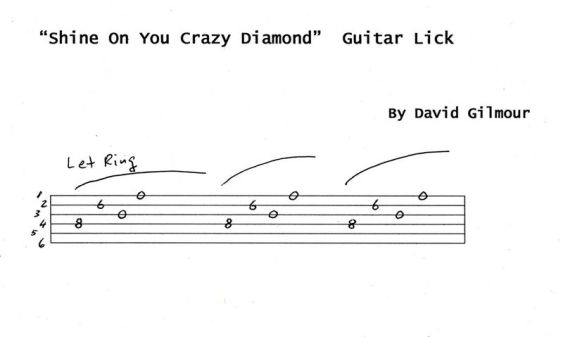
    The most memorable theme from Pink Floyd’s profound concept album, Wish You Were Here, makes a practical exercise for beginning guitarists. This lick enters the soundscape of “Shine On You Crazy Diamond" at 3:55, and it’s hard to imagine the rest of the work without it. It sounds simple, it sounds great, but what is it? Theorists have trouble classifying these four notes, but it’s not hard to play, and you can learn an important technical skill by doing so.

    You need to be able to read guitar tab. In short, a six line (see example below) staff is used, with the six lines representing the six strings of the guitar. Line number one represents the high E string and is closest to the ceiling. Line two represents the B string, and so on. Yes, this is kind of upside down, as the low E string of the guitar is actually closest to the ceiling as far as the guitar in your hands is concerned. You’ll get used to it. The numbers represent the frets, with 0 for open, 1 for the first fret, and so on.

    Shine On_Crop

    Place your third (ring) finger on the fourth string (D) at the eighth fret and hold down that note. Place your first (index) finger on the second string (B) at the sixth fret. The other two notes of the four note figure are played open, ie they are not fretted by the left hand. Now, play the four notes in order as shown in the tab by picking the following strings with your right hand: D string, B string, G string, E string. Be careful not to unintentionally mute the open strings (G & E). This is the important skill that is required to play this piece. It will probably be necessary to move the left hand fingers around a bit, no more than a millimeter or so, to get all the notes to ring clearly.

    You should here a spooky, modernistic, and highly melodic sequence of notes that sort of maybe forms some kind of chord. The notes themselves are Bb, F, G and E. Most importantly, all the notes must ring clearly and sustain for a few seconds after you have picked them. If it’s impossible to get all four notes to ring at once, try for as long as you can and then come back to it in a couple of hours or the next day. You will be pleasantly surprised that it has become possible or at least easier and better. Before too long, you will get it. Stay with it! 

    Wish You Were Here is one of my favorite albums. Its themes of loss, alienation, and music business machinations are universal, but its greatest achievement is the fabulous sound. David Gilmour's guitar plays a huge role throughout the record, with soulful bluesy solos, acoustic strumming and picking (the title cut), and coloristic flourishes wherever they are needed. There are also superb applications of modulation effects, such as phase shifting and flanging ("Have A Cigar"). By learning the guitar theme described above, you can be a part of it, which is the antithesis of alienation, isn’t it?