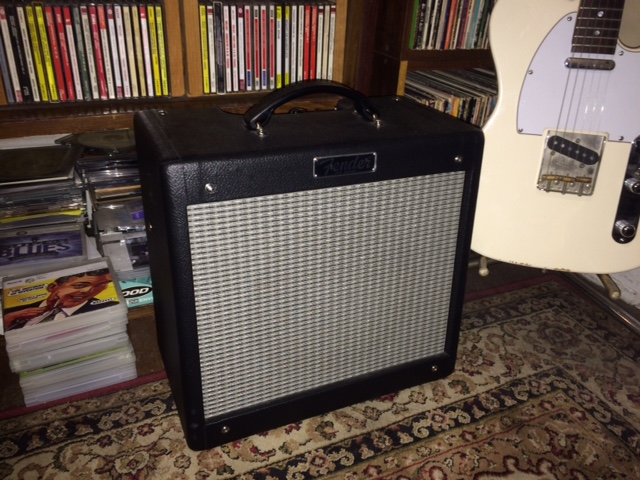
• Fender Pro Junior Rectangle

    A reliable, lightweight and great-sounding gig amp is high on the list of most guitar players, and I recently joined the ranks of those seeking to prevent backaches as well as rock the house. Before that, I played mostly locally, used backline amps or lugged various let’s just say more committed amps like a Fender 65 RI Deluxe or Rivera 5512 up and down five flights of stairs. But great sound is what I was really after.

    I had always liked Fender Blues Juniors and figured I would buy one used. The hunt continued when I met a guy on craigslist selling one of the most beaten looking Blues Juniors I’d ever seen. The reverb worked, yeah – it was on twelve all the time! Wanting to bypass the eventual reverb repair that seems to come with these amps and maybe lose a few pounds, I started looking at the Pro Junior.
    DSC00383 (640x426)

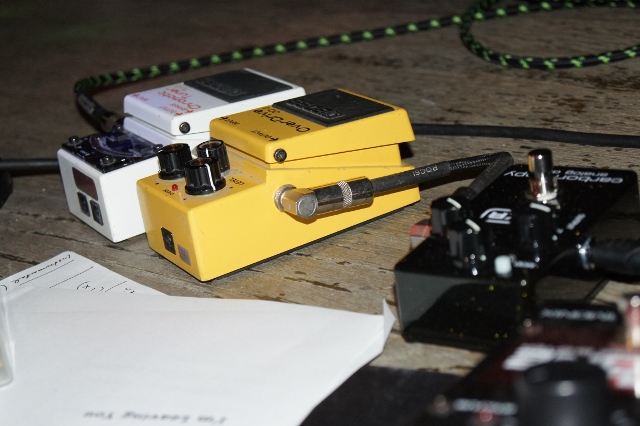
    A Boss OD-3, MXR Carbon Copy and EH Small Stone sounded superb with the Pro Junior. Photo: Jason Johnson

    I was never a big fan of ten inch speakers, so I spoke with my friend Steve about it (he owns a Blues Junior and loves it) and he seemed to think that the speaker could make a real difference. We tend to play a bit loud in my band, as do many blues outfits. Most people online felt that the Pro Junior is a better sounding but noisier amp. The Pro Junior has two EL84s and two 12AX7s, and I love EL84s. There are only two knobs, volume and tone, but I’m a big fan of plug and play. I decided to take the plunge with a big gig coming up, and bought a floor model Pro Junior from Matt Umanov in NYC.

    Umanov’s is not a great place to try things. I’ve gotten some great pieces from them, including my ’62 RI Strat. But if you’ve ever been there, you know what I mean. They play music all the time on a sound system and the little amp room is noisy and hot. When I got the amp home, it was as noisy as advertised on the web. With the volume on zero, it was still buzzing away. It had sounded great at the store with a Baja Tele. As luck would have it I tried one at Music Makers rehearsal the week before and it was impressive, making two inexpensive guitars sound terrific with both humbuckers and single coils.

    I decided to take it to my gig with my band Saints and Sinners (Dave Gerstein on bass, Daryl Cozzi on drums, myself on guitar and vocals) at American Trash Bar to play three sets and bring my 65 RI along for backup, the tremolo and some songs where my friend Harris would sit in. American Trash is a medium sized bar with a lively, clear sound. Long story short, the Pro Junior sounded fantastic. I used my 2014 SG Standard ’61 and ’76 hardtail Strat for slide, and both delivered some of the best sounds I’ve ever heard from them. Missing reverb? I could swear there was an ambient glow coming off the brick walls that was among the sweetest, dare I say ‘produced’ and complete sounds that I’ve ever heard at a gig.
    DSC00377 (640x436)

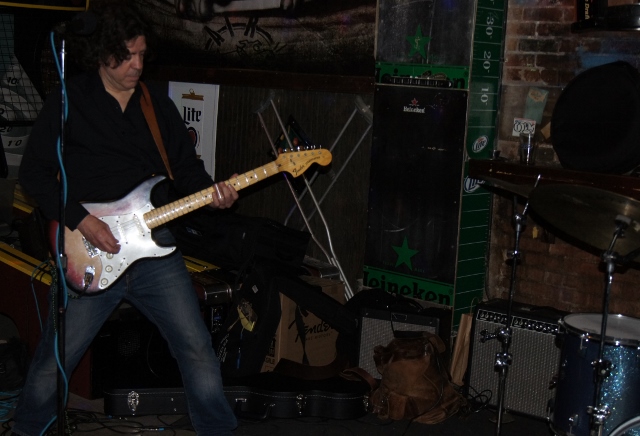
    The '76 Hardtail Strat in action – glassier and smoother, too. Photo: Clement Renaud

    The Strat sounded more balanced, less muddy than with the 65 RI, which has a Weber Green Back in it. The SG had the sweetest overdrive and a nasty, aggressive edge that was a true inspiration. The ten inch speaker didn’t seem to matter at all. The lack of a midrange control on the Deluxe is remedied on the Blues Junior, but the Pro Junior is reputed to have a midrange bump, and I feel it makes a difference. It takes pedals way better than the 65 RI, although I haven’t put anything high gain in there yet. But my biggest concern – the noise – was a non-issue. I knew that I would probably never hear it in a loud bar. But the tone easily made up for the one negative aspect of the amp: It’s not a practice amp. You could play it at home if you want, but it’s too noisy and too loud. It doesn’t get into it’s beautiful tone range at low volume. Bottom line – you’ve got to take this puppy out for a run. It’s A Sexy Little Beast.
  • BrianJones1968

    Wouldn't you know? I thought I had a catchy title for my Brian Jones article but who else but Jim Morrison would seem to have gotten there first? Morrison's poem is also an ode to L.A., so there is still room for someone to write the definitive and ultimately formally correct Ode to Brian (Jim's Ode is a little short to be considered a traditional ode). 

    I did at one time however write a term paper in grad school about Brian Jones and his impact on the blues scene in England and beyond in the the 1960s. It's called Brian Jones – Authenticity and Significance and you can read it here:  Download Brian Jones Authenticity And Significance

    Please let me know if you have any thoughts!

  • Brian Jones Live

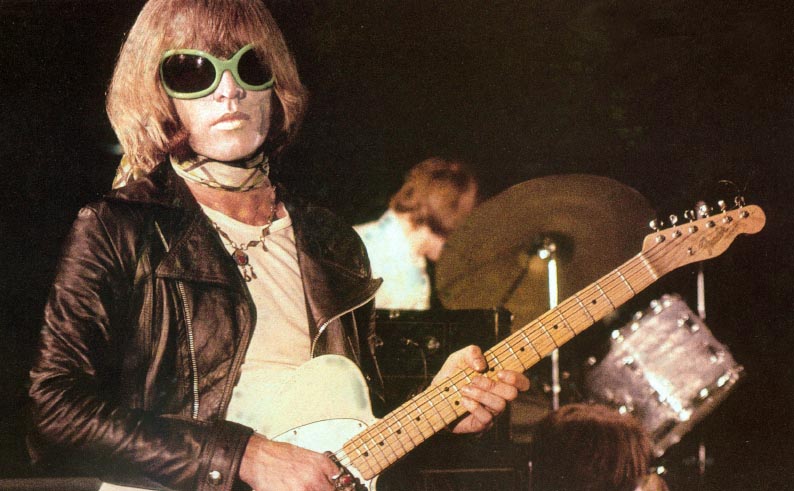
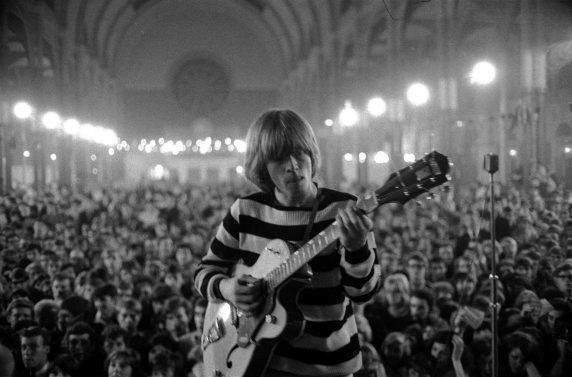
    Mad, bad and dangerous to know was the first leader of the Rolling Stones. Even though my introduction to their music came during what could be called the Jimmy Miller period, I was always curious about the charismatic blond in the foreground of early Stones pics. I loved and will always love the early Stones sound – the Brian period.

    So, please allow me to introduce you to one of my favorite Stones pastimes, looking at Brian Jones’ guitar work and trying to figure out what he did and why. Everyone is familiar with Brian’s slide work, but who plays all that tasty backing guitar on Aftermath that doesn’t sound like anything Keith did before or since? Why did Brian more or less abandon playing guitar? There isn’t space here to discuss these questions in depth, but they’re worth pondering. In the meantime, let’s look at some of my favorite tracks.

    Brian played the hypnotic lead on the Stones’ first self-penned hit, “The Last Time,” (early 1965) most probably because he wrote it or Keith couldn’t play it effectively. The lick is pure blues sexiness, oozing confidence. No guitarist who wrote this riff would allow any other guitarist to play it on an original recording that he was also playing on! Brian got no credit.

    One of my favorite Brian Jones performances is his slide guitar on the live version of Hank Snow’s “I’m Movin’ On,” (early 1965) from the U.S. compilation LP, December’s Children. It’s a huge, greasy, rich sound that drives the band in an unrelenting charge forward. It’s too bad that he didn’t take a solo – Mick steps in with his simple harmonica, bleating away ala Keith Relf, in much the same way that Relf stepped all over some of Jeff Beck’s live performances. No one ever mentions this situation when Beck’s almost losing his mind before his departure from that band is discussed. But in the case of “I’m Movin’ On,” not having a Brian Jones slide solo doesn’t detract from the power and originality of the sound.

    On “19th Nervous Breakdown,” (released early 1966), Brian is again playing a repeated riff with a thick, clean, twangy sound ala Last Time but in a lower register. The tone is the polar opposite of Keith’s fuzzed out, chordal lead licks. It seems that maybe Brian shied away from distortion. But his clean sound cuts through and drives the song rhythmically.

    Critics tend to dismiss Got Live If You Want It! (mainly recorded late 1966), but I imagine that this is what the Stones sounded like during that time. This is a full-throttle, mod sound. Keith’s distorted, blurry lead guitar dominates the upper middle of the mix, but wait, what’s holding the furious, amphetamine blast together? Brian’s rhythm guitar is what. It fills out the sound without sacrificing any velocity. One also gets a taste of what Brian might have sounded like on a more extroverted lead guitar with the live rendition of “The Last Time.” His overdriven sound is smoother and stronger than Keith’s.

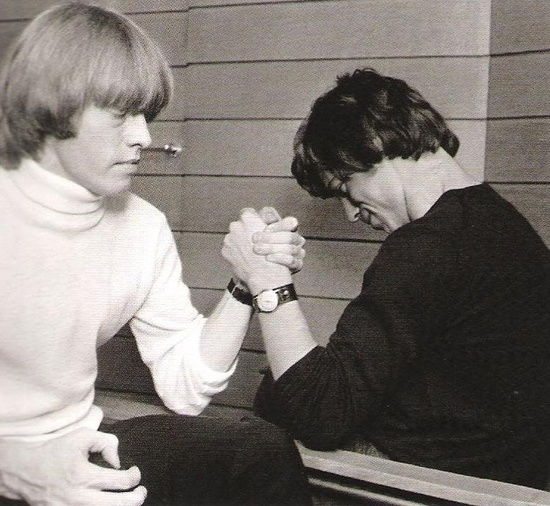
    Brian and Mick Armrestling

    When Keith wrote “Satisfaction” and it became a worldwide smash, it all but sealed Brian’s fate as the ex-leader of the Stones. This watershed moment would seem to be the beginning of the end of Brian’s obsession with blues guitar. In Peter Whitehead’s film of the Stones’ 1965 Irish tour, Charlie Is My Darling, you can clearly see Brian’s dismay as Keith takes charge of the writing and rehearsal sessions. But Brian was a team player. He changed his own role by exploiting his talent as a multi-instrumentalist on tracks too famous and numerous to mention here. When I hear those old tracks, drenched in RCA Studios reverb, I still wonder sometimes, what might have been.

  • AndreaPic2 Large

    Saints and Sinners at Desmond's Tavern on the 5th of May  - Photo by Andrea Fischman

    Saints and Sinners, formerly the Anodyne Blues Band, will be appearing Saturday, May 21 at American Trash for a three set, all out shin-dig from 10pm until 1am. The Anodyne Blues Band moniker served us well for over seven years but it’s time to move on and we’re doing so with a bang.

    Getting into the thick of it is our fantastic new drummer Daryl Cozzi, who is very in tune with the blues, blues-rock and R&B-styled grooves that we play. Well into the fold as usual is the rock solid and always dangerous Dave Gerstein on bass. The three of us recently played at Desmond’s Tavern, our first gig as Saints and Sinners.

    As it happens, my birthday is coming up soon after the gig, on May 24th, the same birthday as Bob Dylan’s, I might add, so it’s going to be kind of an early birthday celebration. We will definitely play a song for Bob, too.

    American Trash is located at 1471 First Avenue in Manhattan, right near East 77th Street. Entry is free, and there are great drinks to be had along with games and other earthly delights. We hope you can make it!

  • Squier 51 With Mods

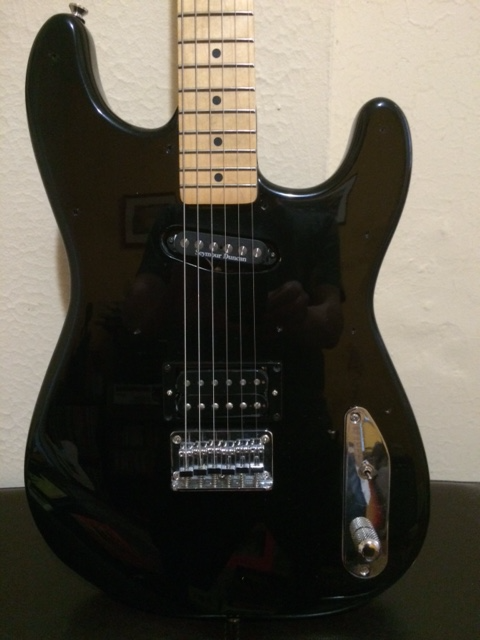
    Ever since my friend Steve changed the ancient volume pot in my ’76 Strat to a brand new American made CTS pot, I have been itching to learn how to do guitar mods. My obsession may even have begun shortly after a student of mine brought over a black Fender Squier 51. These guitars are famous for inspiring an army of guitar modders and the message boards that they frequent.

    I bought a very clean Squier 51 on craigslist, meeting the seller at a train station down on the Jersey Shore. The train fare cost me $30, the guitar, $120. The neck was quite good for these guitars, with no sharp fret edges. The humbucker barked, the single coil and overly complicated coil splitting settings were attractive but seemed to evaporate on stage. The overall live sound was somewhat blurry (see video below). But I was able to set it up where you could play both slide and regular guitar, so it was somewhat useful as a second guitar for gigs. And, I knew I could get it to sound better.


    I’m a firm believer in the idea of finding the right pickup for the right guitar. I had a couple of spare pickups in the closet, a Gibson 500T bridge pickup from my Les Paul (replaced with a Gibson 57 Classic), and a Seymour Duncan Quarter Pounder Strat neck pickup. So, I began to research the necessary wiring to swap out the cheap Squier pickups for these legitimate contenders.

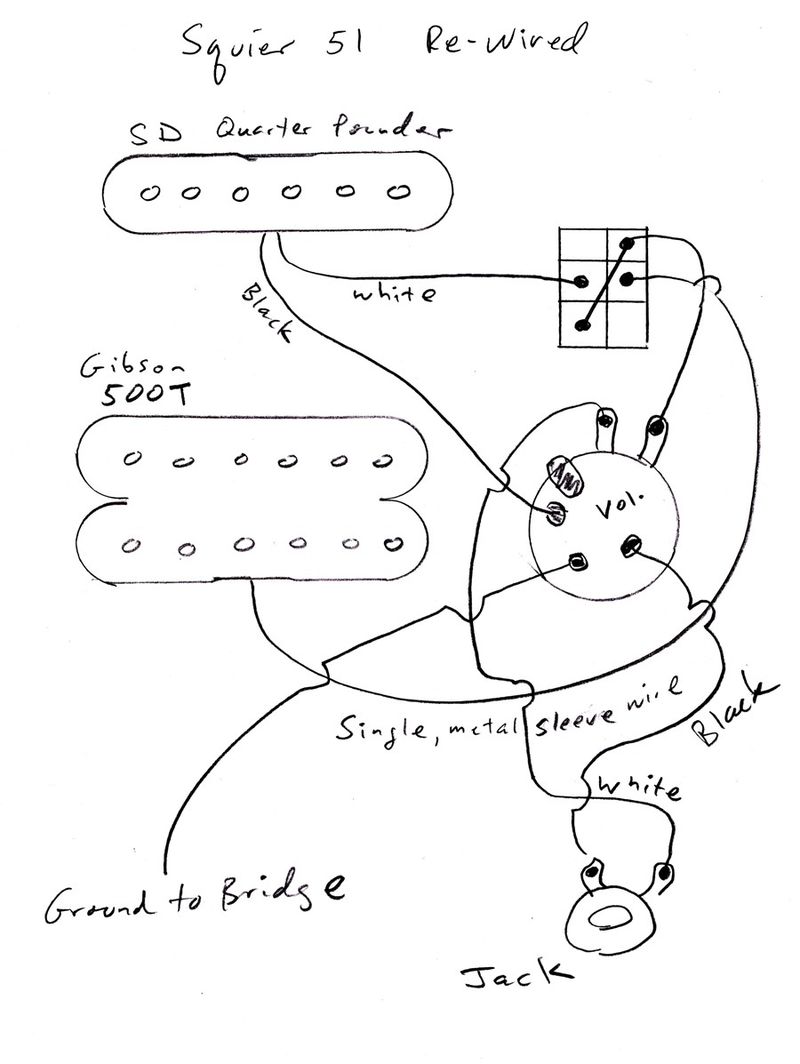
    Unfortunately, the mania surrounding the Squier 51 has died down, and the message boards supporting them are all but defunct. I soon realized that working on these guitars is not so easy because the cavity where the guts go in is tiny. A typical pickup selector switch will not fit. I did at least five hours of research online looking for parts, diagrams, etc, finally settling on using a mini toggle switch, which is most often used to make additional effects (coil splitting, etc.) in addition to the main pickup selector.

    Squire 51 Re-Wired

    My ingenious wiring diagram is shown above

    On the fateful day, I dove in, spending about four hours with my diagrams and brand new soldering iron from Stewart-MacDonald. In the end, I got one pickup to work. I was overjoyed! Let me tell you! Had I gotten nothing, I still would have been proud of myself to a degree. It was a journey in itself just opening up the guitar and getting busy with the soldering iron.

    As luck would have it, a few days later I got a call from Mike Maggio, the owner of Maggio’s Music in Brooklyn. He wanted me to come in a substitute teach, as I have in the past. It was an auspicious moment. Mike is an expert at guitar repair, and I finally broke down and let him set the Squier 51 up for me. He re-wired the guitar and it worked perfectly. The 500T is ferociously loud. I don’t know why it never sounded like that in my Les Paul, but at the same time, it was much sweeter and more balanced in that guitar. The Duncan sounds full, round and smooth. The combination of the two is somewhat unique, a little chimey, a little hot, but attractive.

    Everything worked out perfectly in the end. I’ve got my eye on another inexpensive guitar that should be perfect to work on, and I learned a lot about guitar modification in the process. To top it off, I now have a permanent day teaching at Maggio’s. How cool is that?

  • Little Feat

    I don’t know if I fully understand my fascination with Lowell George. His output was somewhat limited. His band Little Feat in their heyday was a pretty zany crew and possibly due to the somewhat bizarre, hybrid style of their music, George didn’t get to throw down loads of hot slide guitar like he easily could have. But he was a totally unique slide player and where you can catch him doing his thing, it’s impossible to resist. He also had a great voice.

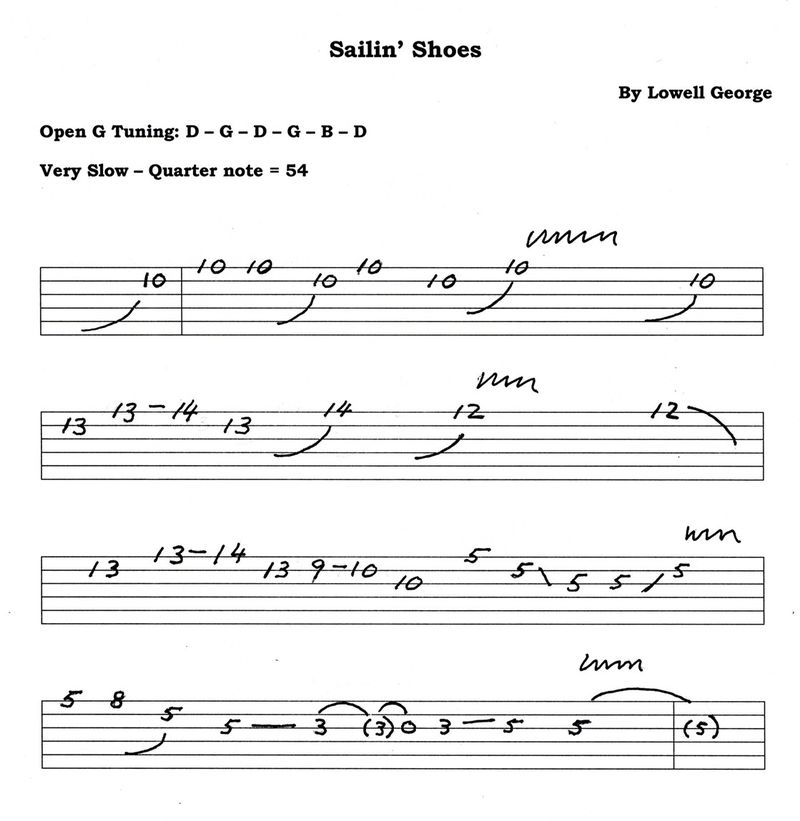
    I have here a video and tab I made for Lowell’s solo on the title track of my favorite Little Feat album, Sailing Shoes, which was produced by Ted Templeman. It’s an acoustic solo, a little atypical. There is quite a bit of studio gloss on the record, and great, California-styled musicianship. It’s not surprising that George got his big break with Frank Zappa, who only employed first rate players.

    Lowell use a socket wrench to play slide, and he favored stock Fender Stratocasters. He placed the slide on his pinky, and he kept his left hand thumb fully around the bottom of the neck (when playing slide). He played mostly in Open A, but this solo is done in Open G, although “Sailin’ Shoes” is in the key of C. It’s an interesting approach. Let’s take a look at it.


    Listening to LG, you can tell right away that his sound is different. It’s quite clear and there’s less use of vibrato than with most slide players. He is said to have used a compressor to get his sustain. Right off the bat, he’s playing a bit out of the box, hitting the root note C on the high E string, which is tuned to D. There is a quick change of register to play the next phrases up around the twelfth to the fifteenth frets. Note the use of staccato. Looking at the tab below, you can see that in the whole piece, only four notes receive vibrato. This provides a more rhythmic feeling, which emphasizes the slow, New Orleans-style shuffle feel.

    Sailin Shoes

    After an F major arpeggio lick at the tenth fret, he jumps down to the fifth fret where the rest of the solo is centered. So in just four measures, three positions are employed, really, the entirety of the fretboard if you include the open G. Yet, there is not a hint of a disjointed quality.

    I’m using a simple index, middle, thumb right hand approach. Be aware of the right hand muting, as it is crucial to get the precise, rhythmic and often staccato sound. You may also notice that the video is recorded in the bathroom. Besides the obvious reference to “Fat Man In The Bathtub With The Blues,” I find that it can be beneficial to practice slide in a tiled bathroom. All the noise is amplified along with the nice, snappy echo, and you have to work at your muting.

    Here are some more Lowell George resources to tap into. There is plenty of cool slide on the live Waiting for Columbus. And a Dixie Chicken video with Emmy Lou Harris and Bonnie Raitt. There is an excellent concert video, Little Feat Live In Holland. Here is an interview from Guitar Player, and the video for Rock and Roll Doctor and from The Old Grey Whistle Test. Have fun!

  • Eric clapton sg

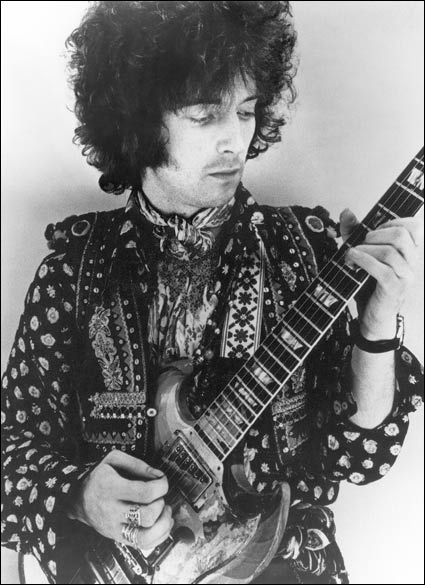
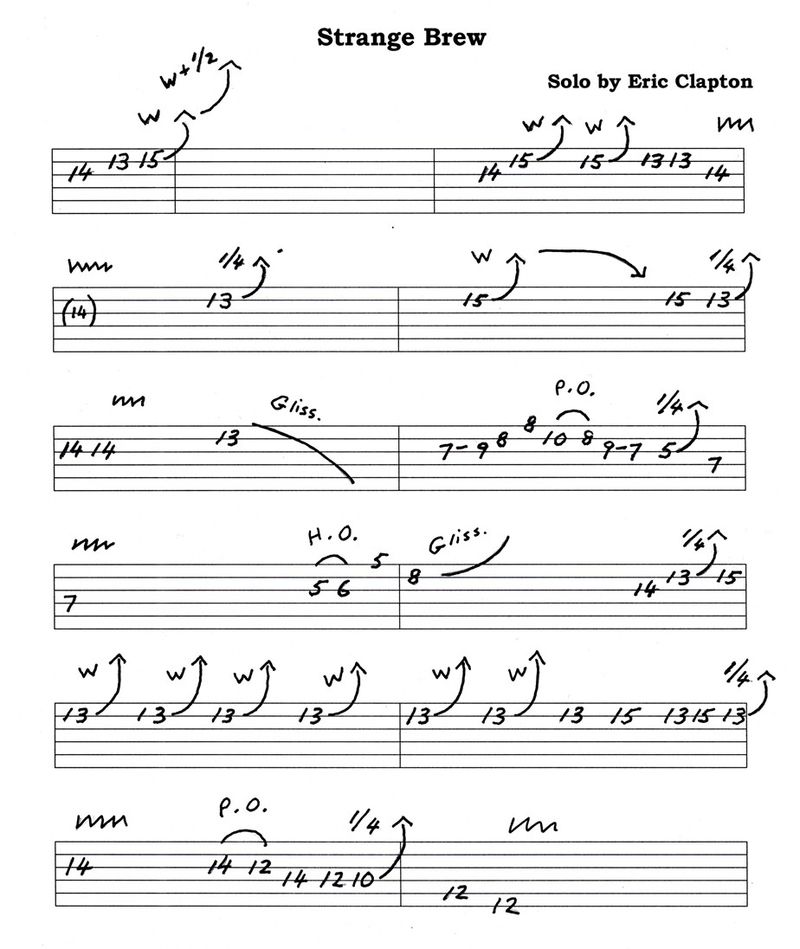
    Eric Clapton’s solo on “Strange Brew” is one of his more concise efforts and makes an excellent study in British Blues via Chicago. EC more or less copied his solo from the first half of Albert King’s “Crosscut Saw” solo, and Slowhand nails the difficult first finger bend that is necessary to achieve the right phrasing at the climax. This bend (measures 9 and 10 in the tab below) is characteristic of Albert King’s style.


    There are other tough bends, too. Right at the beginning, EC bends up a whole step (D to E on the B or second string) and almost in the same breath bends all the way up G, a combined distance of two and one half steps! It’s not absolutely necessary to do this giant bend. A whole step will work. Look in the tab below. You’ll see two curving bend arrows (pickup to measure 1). Start with the first whole step bend and work your way up to adding the second, step and a half band. The B string is the easiest string on the guitar to bend and all of the big bends in the solo are done on it.

    Strange Brew

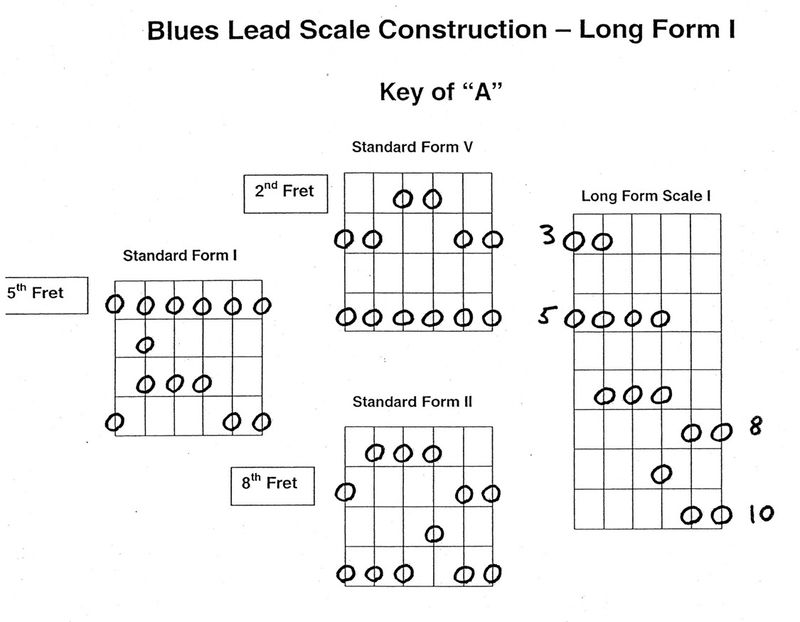
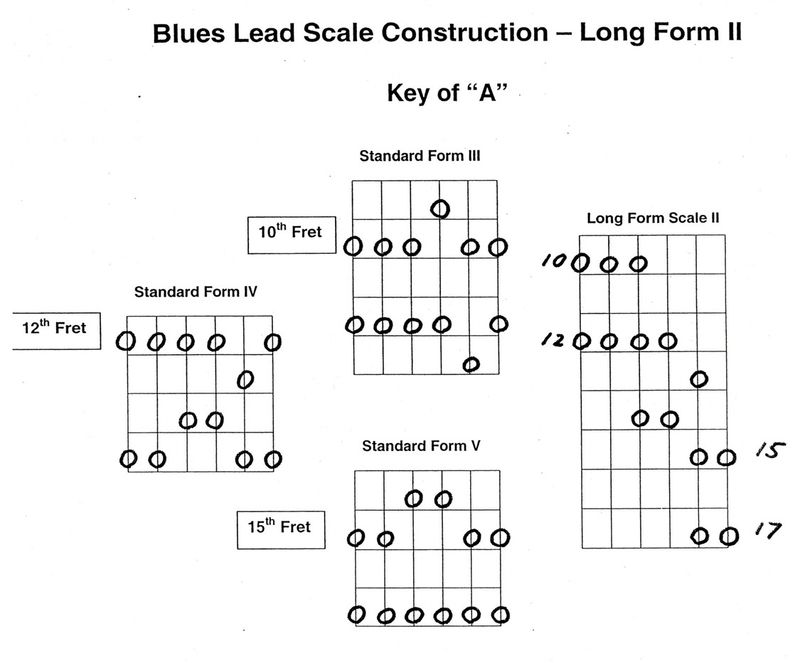
    The solo makes use of four blues scale positions: Forms I, II, III and IV. Look at the charts for these positions, which I have provided below. Form I is the one that everybody knows. Form II includes the “High Box” as the old-timers call it, or the B.B. King box. Form IV is a more advanced position but absolutely essential to learn if you want to really wail in A. It lies right at the 12th fret, prime real estate on the fretboard. Positions I and II are often combined in longer runs, with a sliding motion between them on the G string. This is accomplished with the second finger (measure 6 in the tab below). Positions III and IV are also combined for longer runs, and EC uses this combination to end the solo, in measures 11 and 12.

    Long Form I

    Another important technique in this piece is the ¼ or quarter-step bend. This is most often found on the third step of the scale, in this case the note C. Most of the time, these bends are pushed up, not pulled down. You don’t want to hear any “release.” Simply stop pressing on the string when the bend has reached its full height, which is really a very small amount. Just enough to sound different from the original note, but not enough to sound a complete half-step. Often, this note is followed by the tonic on a lower string, and the third finger will dampen any unintended release.

    Long Form II

    The little dot next to the 13th fret note with the ¼ step bend in measure 3 means staccato or “short” in Italian. The curving lines marked "Gliss." (short for Glissando) are long slides with no clear pitch. Don’t forget to add finger vibrato at or towards the ends of most phrases (the squiggly lines above the staff for example at the 7th fret in measure 7). Come to think of it, this solo is quite “greasy,” meaning there is plenty of bold articulation to keep the listener hanging on every note.

  • Sleepless Nights at Parigot 032616

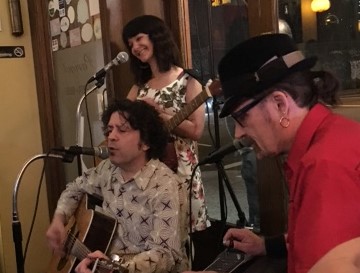
    Sleepless Nights is a new group on the scene in NYC, purveyors of Cosmic American Music, if you will. CAM, for those in the know, and out of it, one may assume, is the brainchild of one Cecil Ingram Conner III, better known as Gram Parsons, Keith’s running buddy way back when, and the godfather of country rock, it has been said.

    Sleepless Nights got together at the end of 2015. It was an epiphany of guitarist and vocalist Christian Botta and pedal steel and vocalist Ron Raymond, hatched somewhere between Nashville and the Spring Street Lounge. Nobody knows for sure exactly where but when vocalist and guitarist Ellen Croteau joined the lineup soon after, everything was set.

    The trio is proud to bring you their newly minted four song demo, and the song choices should go a long way towards explaining the nature of their music and perhaps the concept of CAM, as well, although there is so much more to come.

    Produced and recorded at The Lair by Raymond, the demo includes “Sweetest Waste of Time,” a duet between Croteau and RR that was written by Kasey Chambers that really sparkles (click on the links below).

    Sweetest Waste of Time

    The Stones’ “No Expectations” gets a bit of a he said-she said treatment with Botta and Croteau trading verses.

    No Expectations

    Then there are a pair of songs that highlight the work of one-time Byrds Gram Parsons and Chris Hillman, “You’re Still On My Mind” and “Sin City,” the latter one of the grandest of the Flying Burrito Brothers’ mile high harmony excursions. You can dig SN’s three-part harmony on both of these numbers.

    Sin City


    You're Still On My Mind

    Sleepless Nights have appeared several times at the HiFi Bar as part of the Sunday Sessions, and recently played a highly successful dinner engagement or should we say, steel guitar engagement at Parigot, a cozy French bistro on the outskirts of SoHo. They look forward to playing many more dates in the future and hitting the recording studio again soon. Enjoy!

  •  

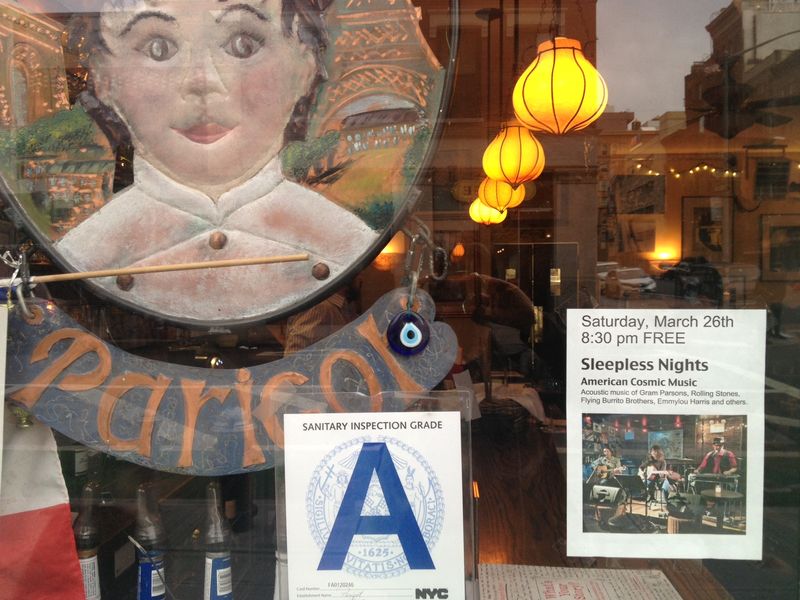
    Parigot Window and Poster
    Sleepless Nights will be appearing on Saturday, March 26th at Parigot, a cozy French restaurant on the edge of SoHo and Chinatown in NYC. We go on at 8:30pm and will play two sets. I’ve eaten at Parigot a number of times and it’s a delicious and comfy place to catch up with some authentic French cooking that won’t break the bank. “Parigot” is slang for ‘Parisian’ but I’m not really sure how that relates to the mood of the restaurant. It’s a very friendly place.

    To get you in the mood, we are including here another sneak peek at our new, almost finished demo. It’s a cover of the song, “Sweetest Waste of Time” a duet by Kasey Chambers & Shane Nicholson. We hope you enjoy it and we’d love to see you at Parigot on March 26th! Parigot is located at 155 Grand Street in Manhattan and the phone number is 212-274-8859. Reservations are not required but are suggested.

    Sweetest Waste of Time


  • Johnny Winter Raisin Cain

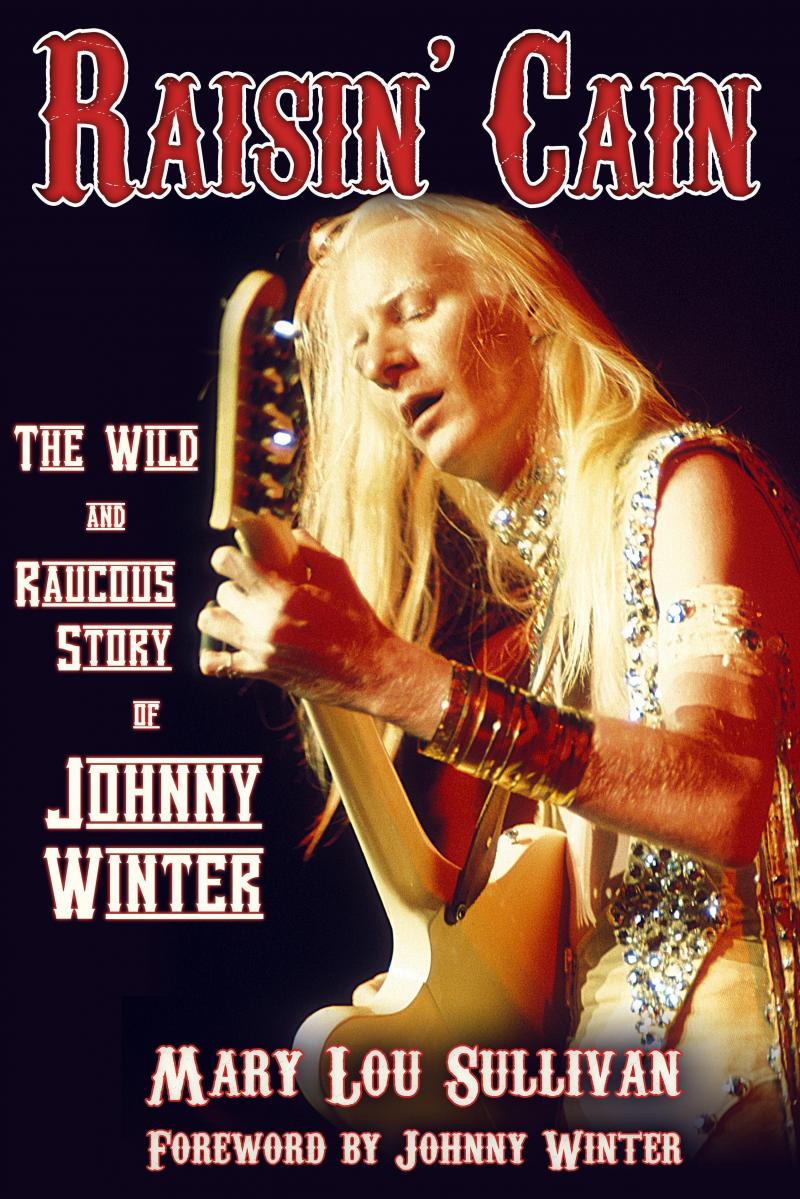
    The title of Mary Lou Sullivan’s 2010 portrait of guitar slinger Johnny Winter is a bit of a misnomer. Readers who pick up Raisin’ Cain – The Wild and Raucous Story of Johnny Winter, might expect a more lurid story of partying, groupies, and burned bridges. But what they’ll get instead is a sensitive, well-researched and respectful biography that gives equal time to Johnny’s important childhood experiences, his brief stay in the mainstream limelight and the long years that followed, with countless tours, a beautiful second act as Muddy Waters’ producer and advocate, and struggles with bad management, the fickle nature of popularity, and human foibles.

    Blues scholars say that there’s a blues boom every ten or twenty years, however you count it. There was one in the eighties, when Stevie Ray, Robert Cray and ZZ Top were going strong. Johnny Winter found success at the tail end of the long sixties blues renaissance, but he was always under pressure to play more rock. As a young fan – my first concert was Johnny Winter at the Felt Forum during his tour supporting Captured Live – I was never aware of this dichotomy. But Raisin’ Cain makes it clear that Johnny Winter lived this conundrum day in and day out. There were always plenty of fans to fill the seats on his endless tours, but they didn’t buy all that many of his records.

    Johnny Winter and BB King

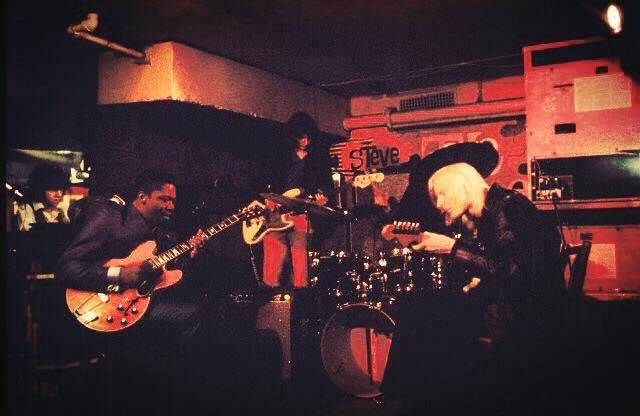
    Johnny and The Jammers?: With BB King at The Scene Club

    Enter the most clueless management to ever take up so much space in the bio of an important artist. Any fan of Jimi Hendrix will know about Steve Paul’s Scene Club, but I didn’t know that he was Johnny Winter’s manager and that he got him his groundbreaking deal with Columbia Records. I’m not really sure how badly Paul did for Johnny. He got him the big advance, and Blue Sky Records seemed to serve Winter’s interests pretty well, even putting out all of the Muddy records. But his biggest selling album was And Live, a no brainer that must have cost hardly anything to produce.

    Enter Teddy Slatus, who took over for Paul when Johnny’s contract with Columbia ran out in the eighties. Suffice it to say that Slatus pretty much wrecked Johnny’s career through inept and unprofessional management practices, including keeping him over-medicated on prescription drugs and out on the road until Johnny was more or less a wreck in his fifties, far too young to be physically and mentally debilitated. 


    Johnny around the time the book was released

    More enjoyable to read are the sections about Johnny’s childhood and his quest to form his identity as a musician from an early age. JW grew up in an upper middle class household but apparently that didn’t keep the kids in Texas from mercilessly teasing him due to his albinism. He was left with psychological scars, not unlike his friend and sometime paramour, Janis Joplin, that made it hard for him to relax and at times understand crucial relationships. But his parents were really there for him, and they nurtured his and his brother Edgar’s talent for music right from the beginning.

    There is much to recommend in this book, including details of Johnny’s working relationships with Muddy Waters and Rick Derringer, and the early years with Tommy Shannon. The biography was published in 2010, before Johnny died in July 2014. Judging by the foreword, he was very happy with the way it turned out.